
>> Continued From the Previous Page <<
The Republican primary drew several high-profile candidates, each attempting to position themselves as the leader best equipped to take on the Democrat establishment in Salem.
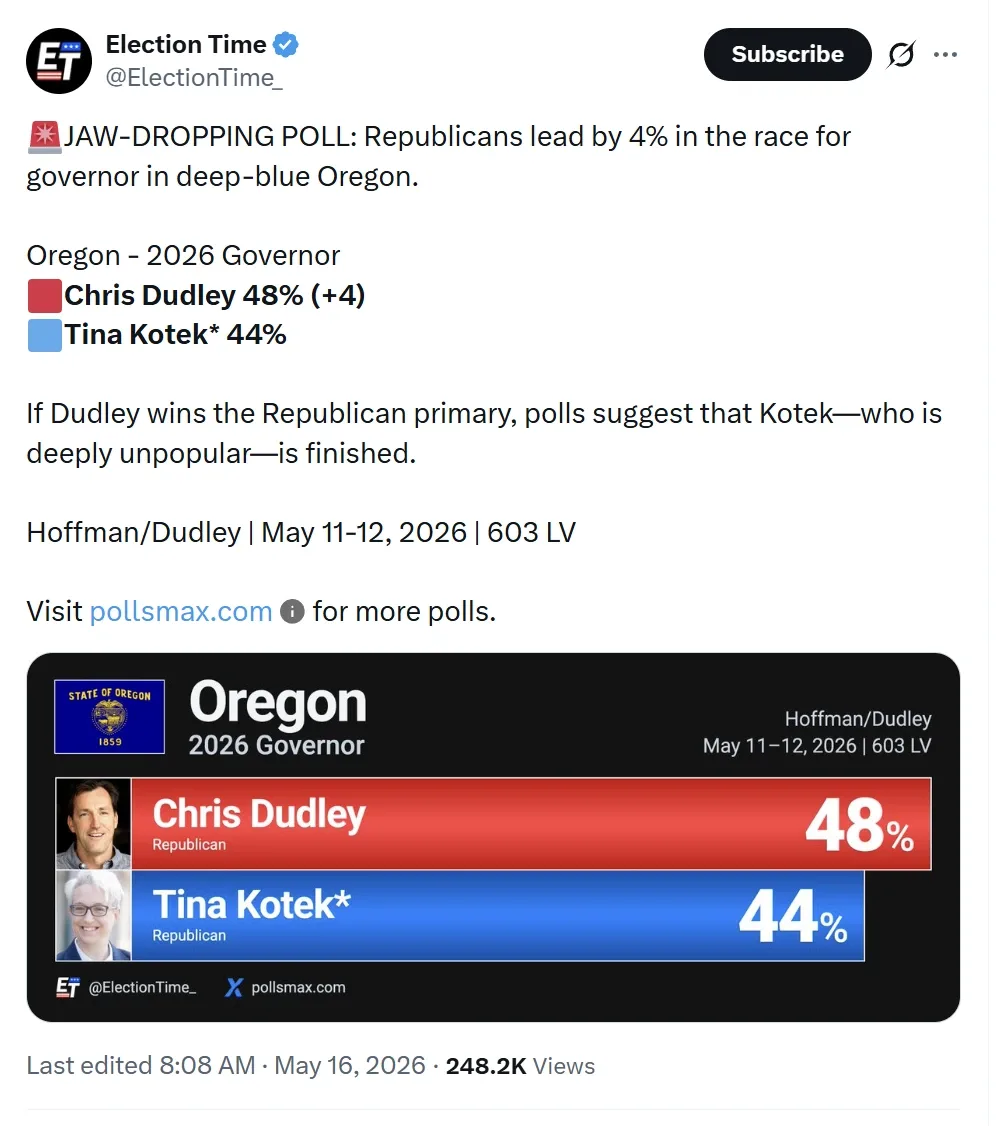
Among those competing were former NBA player and businessman Chris Dudley, state Rep. Ed Diehl, and Marion County Commissioner Danielle Bethell.

Diehl campaigned heavily on cutting taxes and slashing government spending, arguing Oregon families are being crushed financially while bureaucrats continue expanding state programs. Bethell focused much of her campaign on homelessness, public safety, and accountability in government — issues that have become impossible for many Oregon residents to ignore.
Meanwhile, Dudley attempted to capitalize on his outsider image, touting his business background and attracting support from influential figures in Oregon’s corporate world, including Nike co-founder Phil Knight.
But despite the crowded field, Drazan ultimately emerged as the Republican voters’ choice to lead the charge against Kotek.
Throughout the campaign, GOP candidates hammered Democrats over what they described as years of failed leadership in both Portland and Salem. Republicans argued progressive policies have contributed to exploding homelessness, worsening drug crises, weakening law enforcement, and a rapidly rising cost of living that has strained working families across the state.
For many conservatives, Oregon has become a symbol of progressive policies spiraling out of control. Once-beautiful city centers have struggled with visible homelessness, drug use, and public safety concerns that residents say have transformed everyday life.
Now Republicans believe those frustrations could finally translate into votes.
The GOP has not captured Oregon’s governorship since 1982, but party leaders increasingly believe 2026 may offer their best opening in decades.
Kotek, meanwhile, faced little resistance in her own bid for renomination despite ongoing criticism surrounding homelessness, housing shortages, transportation funding problems, and concerns over education spending.
Her administration has faced scrutiny over the growing number of unsheltered individuals across Oregon and continuing struggles to expand affordable housing capacity fast enough to meet demand.
The Oregon race also arrives as Republicans nationwide continue building momentum in primary contests, particularly candidates aligned with President Donald Trump and his America First agenda.
Across the country, several establishment Republicans and Trump critics have found themselves defeated by conservative challengers backed by grassroots voters eager for stronger support of the president’s policies.
One of the biggest political upsets this week came in Kentucky, where Rep. Thomas Massie reportedly suffered a crushing primary defeat at the hands of decorated former Navy SEAL Ed Gallrein.
At the same time, Republican officials are increasingly optimistic about another major development heading into the midterms: money.
According to Republican National Committee Chairman Joe Gruters, Republicans may soon hold a fundraising edge over Democrats — something virtually unheard of in recent election cycles.
Speaking with Breitbart host Mike Slater, Gruters painted a troubling picture for Democrats while boasting about the GOP’s financial position.
“How much money is that for the parties?” Slater asked while discussing reports that Democrats poured roughly $70 million into Virginia’s recent redistricting battle.
Gruters responded bluntly.
“The DNC has minus 4 million [dollars], and it wasn’t the DNC that plowed $70 million: It was the collective,” Gruters said.
“So, if you look at the collective on the right, we may have $800 million,” he continued.
“The collective on the left may have $350 million, and when you have the court, there’s gonna be a court case that is ruled on in the next week or two, coordinated campaign limits, which will magnify that, which will allow full coordination and allow the parties to spend at the candidate rate, which is massive for us,” he said.
Gruters suggested Republicans could be entering completely new political territory financially.
“When you have that financial advantage, people, you know, people don’t know that the Democrats routinely spend more than us on election cycles, because they have more massive donors and that will write massive checks,” he said.
“But this time, this cycle [we] will either spend a parity or will outspend them, and that’s never happened before,” he added.
According to Gruters, the Republican National Committee currently sits on roughly $125 million in available funds, while he claimed Democrats are dealing with negative reserves and growing internal financial pressure.
With voter frustration rising in blue states, Republican fundraising surging, and Trump-backed candidates continuing to rack up victories, conservatives are increasingly convinced the political map heading into November could look very different than it has in recent years.

