
>> Continued From the Previous Page <<
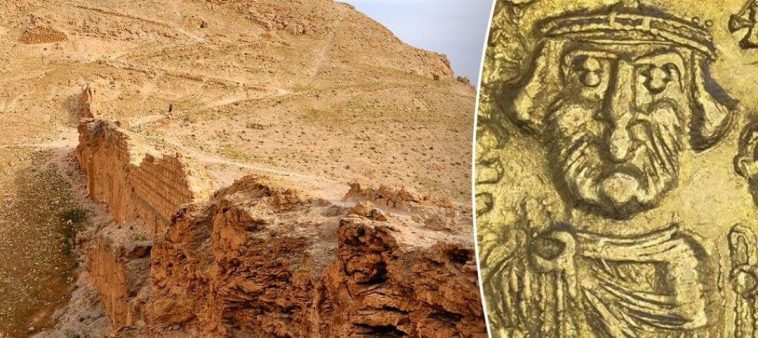
The Judean Desert is notorious for illegal digging. Entire sections of Hyrcania have been damaged over the years by thieves hunting for black-market relics. Despite that, these objects somehow remained hidden until professional archaeologists reached them.
That alone has experts calling the discovery remarkable.

Coins point directly to Christianity’s most dangerous era
The gold coins are Byzantine solidi stamped with the image of Emperor Heraclius, who ruled the Byzantine Empire from 610 to 641 AD.¹
Heraclius is one of the most pivotal figures in Christian history.
He seized power during a period of chaos, then launched a desperate military campaign to reclaim Jerusalem from Persian forces who had seized the city and carried off Christianity’s most sacred relic, the True Cross.
Heraclius succeeded.
But victory came at a devastating cost.
Years of nonstop warfare drained the empire’s manpower, wealth, and morale. When Islamic armies surged out of the Arabian Peninsula shortly afterward, the exhausted Byzantine forces could no longer hold the region.
Syria, Palestine, and Egypt fell before Heraclius died in 641 AD.
The presence of these coins tells historians exactly when the monastery was active. It places Christian life in the Judean Desert right at the moment when Christianity’s future in the region hung by a thread.
From fortress to prison to monastery
Hyrcania’s history stretches back centuries before Christianity.
The site began as a Hasmonean fortress in the second or first century BC.² It later caught the attention of King Herod, who expanded it and reportedly used it as a prison for political enemies.
After Herod’s death in 4 BC, the fortress fell into ruin.
Nearly five centuries later, the site found new purpose.
In 492 AD, Saint Sabas, one of the founders of desert monasticism, established a Christian monastery atop the ruins.³
Despite Islamic conquest in 636 AD, the monastery continued operating for generations before finally being abandoned sometime in the late eighth or early ninth century.
The gold artifacts confirm that Christian monks did not immediately flee when conquest arrived. They stayed, worshiped, and lived out their faith during one of the most unstable periods in the region’s history.
Archaeologists confirm historical significance
Binyamin Har-Even, head of Israel’s Civil Administration Archaeology Unit, emphasized why the discovery matters.
“The finds uncovered at Khirbet Hyrcania reflect an important chapter from the Byzantine period and the early Christian tradition in the region,” Har-Even stated.⁴
He also warned that looting remains a major threat to the site, noting that repeated illegal digs have already caused serious damage.
Israeli authorities are now working to protect Hyrcania and eventually open it for controlled public access while preserving its archaeological integrity.
Physical evidence that cannot be erased
Discoveries like this continue to frustrate academics who argue Christianity’s presence in the Holy Land was overstated or temporary.
Gold coins bearing the image of a Christian emperor, found at a documented Christian monastery, are not theories. They are physical facts.
No amount of ideological revision can explain them away.
From Byzantine churches to ancient synagogues and ritual baths, archaeological evidence across Israel keeps reinforcing what written history has recorded for centuries.
Christianity did not vanish quietly from the region. It endured.
That these fragile gold artifacts survived looters, conquest, and more than a millennium underground borders on miraculous.
Sometimes history waits patiently to speak for itself.
And when it does, even 1,400 years is not enough to silence the truth.

