
>> Continued From the Previous Page <<
The move followed internal defense assessments concluding that massive offshore wind installations interfere with military radar systems and could leave the United States vulnerable to attack.
“The prime duty of the United States government is to protect the American people,” Burgum stated. “Today’s action addresses emerging national security risks, including the rapid evolution of the relevant adversary technologies, and the vulnerabilities created by large-scale offshore wind projects with proximity near our east coast population centers.”

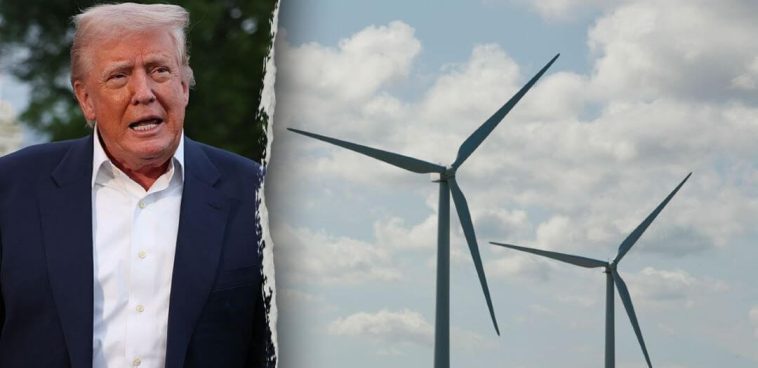
The suspended projects include Vineyard Wind 1, Revolution Wind, Sunrise Wind, Empire Wind, and Coastal Virginia Offshore Wind.
Each project was already under construction or nearing completion when Trump issued the order.
These are not small installations. They involve thousands of massive steel turbines, many rising hundreds of feet above the ocean surface, positioned near some of the most densely populated regions in the country.
Radar Interference Poses Real Defense Risks
While Democrats rushed these projects through approval, they avoided addressing a major concern long known to military planners.
Large wind turbines disrupt radar systems in two dangerous ways.
The spinning blades generate false signals that clutter radar screens, while the steel towers physically block radar detection of real threats.
A 2024 Department of Energy report acknowledged that attempts to compensate for turbine interference can backfire. Increasing radar sensitivity to counter turbine clutter actually makes it harder to distinguish real incoming threats.
That reality carries alarming implications.
Biden approved offshore wind projects in areas critical to coastal defense, precisely where adversaries could exploit radar blind spots.
Defense officials warned the interference impacts the PAVE PAWS early warning radar network, which monitors ballistic missiles and foreign military activity along America’s coastlines.
These were not speculative concerns.
Classified Pentagon reports reportedly concluded that offshore wind installations present a “genuine risk” to national security, especially near East Coast population centers.
Foreign Companies Gain Control Over Strategic Waters
National security concerns extend beyond radar interference.
Several offshore wind projects approved under Biden are controlled by foreign corporations.
Danish state-backed energy company Ørsted holds key stakes in Revolution Wind and Sunrise Wind.
Norwegian energy firm Equinor owns Empire Wind, positioned off the coasts of New York and New Jersey.
These companies were granted long-term access to strategically sensitive U.S. maritime areas under Biden’s leasing policies.
In some cases, Biden’s Interior Department reportedly altered lease terms to rescue struggling foreign developers as projects faced rising costs and financial instability.
Critics argue Biden handed over critical ocean territory to foreign interests while pouring federal subsidies into projects that failed to deliver reliable energy.
Offshore Wind Industry Was Already Collapsing
Even before Trump stepped in, the offshore wind industry was unraveling.
Projects were plagued by soaring costs, broken contracts, and developers walking away from commitments.
Industry analyst Ed O’Donnell reported that 15.5 gigawatts out of 35.7 gigawatts of announced offshore wind capacity has already been cancelled or delayed. Meanwhile, only 5.2 gigawatts are projected to be operational by 2030.
Those numbers expose a fragile industry propped up by federal tax credits and forced subsidies on ratepayers.
Electricity prices in states backing offshore wind continued to rise, while promised energy output lagged behind projections.
Trump Reasserts National Security Over Ideology
Secretary Burgum said the suspension allows federal agencies time to assess whether mitigation measures could reduce the security risks.
But defense experts note that physics cannot be legislated away.
Wind turbines have long been restricted near military radar sites because interference problems are unavoidable.
For decades, the Pentagon limited turbine placement near defense installations for that reason.
Those safeguards were weakened under Biden to satisfy environmental activists and green energy lobbyists.
Trump’s decision restores those long-standing security priorities.
By halting offshore wind development near critical defense zones, Trump signaled that national security outweighs green energy ideology.
Biden approved more than 15 gigawatts of offshore wind capacity while disregarding classified defense warnings.
Trump suspended those projects within his first year back in office.
The contrast could not be clearer.
One administration pushed an unreliable energy experiment at the expense of security.
The other put America’s safety first.

