
>> Continued From the Previous Page <<
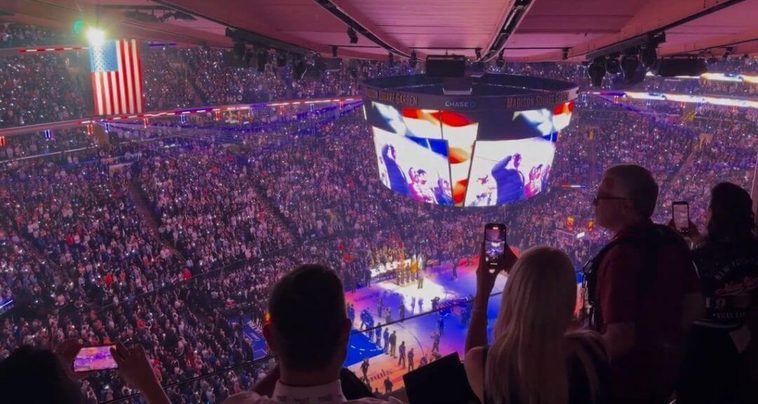
For many observers, the controversy wasn’t just about politics—it was about timing and decorum. The national anthem is traditionally treated as a unifying moment before sporting events, regardless of political disagreements in the stands. That’s why the incident quickly ignited debate beyond basketball circles and into broader cultural discussions about respect, polarization, and public behavior at major events.
Despite the tense atmosphere inside the arena, the game itself delivered a tight contest. The New York Knicks ultimately fell short in a closely fought battle, losing 115–110 to the San Antonio Spurs. While the loss was disappointing for home fans, much of the post-game discussion remained focused not on the scoreboard, but on what had happened in the stands.

Not all reactions inside the arena were negative. In contrast to the boos, other sections of the crowd responded with chants of “USA! USA! USA”, a familiar patriotic refrain often heard at major sporting events. The competing chants highlighted the divided mood in the building, with two very different reactions unfolding simultaneously in response to the same moment.
On social media platform X, users quickly weighed in. Many critics of the booing crowd mocked the display, arguing that it reflected poorly on those involved and overshadowed the sporting event itself. Others defended the right of fans to express political frustration, though even some of those voices acknowledged that the timing—particularly during the national anthem—was bound to generate backlash.
The incident also reignited broader commentary about New York City’s political climate and its reputation as a strongly left-leaning metropolitan hub. Supporters of President Trump pointed to the reaction as further evidence of deep political polarization in major urban centers, while critics pushed back, arguing that sports venues are not exempt from political expression.
Another point of contention involved the national anthem performer, who received praise from many viewers online for delivering a strong and composed rendition despite the surrounding noise. Critics of the disruption argued that regardless of political views, the performer and the symbolic moment of the anthem deserved uninterrupted respect.
Beyond the immediate controversy, the episode once again underscored how intertwined sports and politics have become in recent years. High-profile games, especially in cities like New York, increasingly serve as stages where cultural and political tensions surface in real time, often amplified by social media within minutes.
As for President Trump, reactions to his presence at the game varied widely, reflecting his continued status as one of the most polarizing political figures in the country. Supporters praised the moment as historic, while opponents used the opportunity to voice longstanding grievances.
With the Finals series continuing, attention will likely return to the court. However, the events at Madison Square Garden ensured that Game 3 will be remembered for more than just basketball. Whether viewed as a breakdown of decorum or a reflection of political expression in modern America, the night added yet another chapter to the ongoing intersection of sports, culture, and national identity.

