
>> Continued From the Previous Page <<
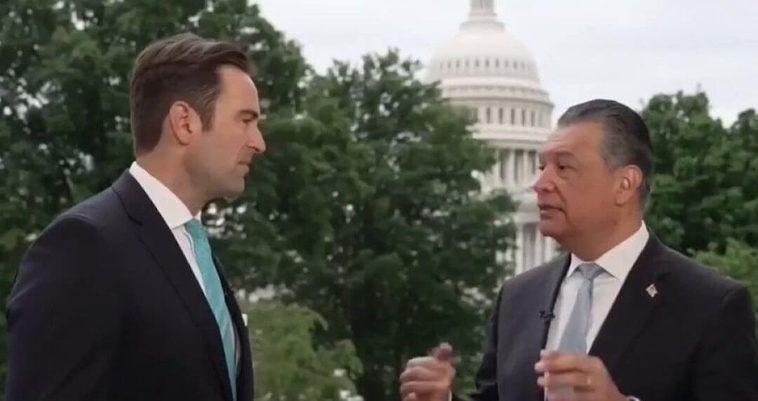
Padilla responded by focusing on potential issues tied to expired or forgotten identification. He said:
“If you forgot your ID or you forgot to renew it the week before, now it’s all of a sudden expired, and you’re not allowed to vote.”

That single explanation became the centerpiece of his argument against stricter voter ID requirements—an argument critics say relies heavily on edge cases rather than the broader functioning of election systems.
“Could” vs. “Would”: The Exchange That Drew Attention
Michaelson pressed further, asking whether voter ID laws would actually improve election security. Padilla’s response was cautious rather than definitive.
“This could also keep eligible people from voting.”
The distinction between “could” and “would” stood out in the exchange, as it highlighted a central concern among critics of voter ID laws: balancing access with integrity. Supporters of voter ID argue that election systems must be hardened against fraud risks, even if rare, while opponents emphasize the importance of avoiding barriers for legitimate voters.
Padilla’s framing leaned heavily on the possibility of inconvenience rather than documented systemic failure, a point that quickly became a focal criticism among conservatives and election security advocates.
Existing Laws Already Require ID in Much of the Country
While the debate continues in Washington, voter ID laws are already widely implemented across the United States. According to election policy data, 36 states require some form of identification at the polls, whether strict photo ID or alternative verification methods.
Georgia’s 2021 election law became one of the most high-profile examples of voter ID expansion. Democrats warned at the time that the law would suppress turnout and disproportionately affect minority voters.
However, the 2022 midterm elections in Georgia told a different story. Voter participation increased significantly, and reports showed record turnout among Black voters—undermining predictions that stricter ID requirements would reduce participation.
Fraud Cases and Public Trust Concerns
Supporters of voter ID often point to documented cases of election fraud to argue that safeguards remain necessary. The Heritage Foundation’s Election Fraud Database has recorded more than 1,300 proven instances of election-related fraud, including absentee ballot abuse and impersonation cases.
While election officials stress that widespread fraud is rare, critics of Padilla’s position argue that even isolated cases justify stronger verification systems to preserve public confidence in outcomes.
From that perspective, voter ID is not about restricting access, but about reinforcing trust in the process itself.
Public Opinion Runs Strongly in Favor of ID Requirements
Polling across the political spectrum has consistently shown broad support for voter identification laws. Surveys indicate that majorities of voters—including Black and Hispanic Americans—support requiring photo ID to vote.
That level of consensus creates a political challenge for opponents of voter ID laws, who must argue against not only Republican voters but also a significant share of Democratic and independent voters.
Critics of current Democratic messaging say this is why the debate is often framed in terms of “voter suppression,” rather than direct engagement with public opinion trends.
A Debate That Shows No Signs of Cooling
As the national discussion over election integrity continues, Padilla’s comments have added fuel to an already heated issue heading into future election cycles.
To supporters of voter ID, the idea that election access should not include basic identification requirements appears increasingly disconnected from everyday American life. To opponents, even small barriers risk disenfranchising eligible voters.
What remains clear is that the issue is not going away. And as this latest exchange shows, the divide is not just about policy—it is about fundamentally different views of how secure, accessible, and accountable American elections should be.


There were dead people counted in every city in the very state. People with more than one resident. Voter rolls not cleaned in every city. By law supposed to be cleaned at least every two years. Illegal immigrants did vote. A lot. There were late votes counted. A lot. Unregistered votes. Blank voter rolls, with names put in with no check. Name did not even have to be legit. These were verified by the NVRA. So no, the most secure election. Democrats said that. Which means it snot. Never seen so many evil dummies. Do not know how they go home at night. Have to be on drugs of some kind to be that stupid. Is it the TDS?
Democrats are desperate to keep Voter ID off the books! If Save America Act goes through, They’re means of Rigging Elections comes to an end! Democrats have been Cheating for over 20 years!! This country is So fouled up because of Democrat policies they have Lost the people’s trust to the point even their own party can’t or won’t stand with their leaders! So Now they need a new base. Illegal Aliens. And they want them to vote! So of course they don’t want voter ID!! We Need The Save America Act To Pass!!