
>> Continued From the Previous Page <<
The command center at Port Shuaiba served as a critical hub for coordinating American forces operating throughout the region. When the drone struck the facility in the early hours of the morning, the blast caused catastrophic damage and multiple casualties.
Initial reports from U.S. Central Command indicated that three service members had been killed and several others wounded. As recovery teams continued working through the damaged structure, however, additional remains were discovered and the casualty count rose.

Ultimately, six American service members were confirmed dead after one of the wounded troops later succumbed to injuries.
The Pentagon later released the identities of the fallen soldiers.
They include Captain Cody A. Khork, 35, of Winter Haven, Florida; Sergeant First Class Noah L. Tietjens, 42, of Bellevue, Nebraska; Sergeant First Class Nicole M. Amor, 39, of White Bear Lake, Minnesota; Sergeant Declan J. Coady, 20, of West Des Moines, Iowa; Major Jeffrey R. O’Brien, 45, of Indianola, Iowa; and Chief Warrant Officer 3 Robert M. Marzan, 54, of Sacramento, California.
Sergeant Coady was posthumously promoted after the attack.
All six soldiers served in the U.S. Army Reserve and were assigned to the 103rd Sustainment Command, headquartered in Des Moines, Iowa. The unit plays a key logistical role in supporting American military operations overseas.
The deadly attack came just days after the launch of Operation Epic Fury, a large-scale military operation that began on February 28 with nearly 900 coordinated strikes by U.S. and Israeli forces targeting Iranian military installations.
Those strikes focused on missile launch facilities, air defense systems, military compounds, and senior leadership targets connected to Iran’s Revolutionary Guard Corps.
In response, Iran launched a sweeping retaliation campaign against U.S. positions and Israeli targets across the Middle East. Waves of ballistic missiles and drones were fired toward military bases and allied infrastructure throughout the region.
Several Gulf states were impacted by the attacks, including Bahrain, Kuwait, Qatar, the United Arab Emirates, Saudi Arabia, Jordan, Iraq, and Oman.
Iranian strikes have targeted radar installations, communication networks, and temporary military structures used by coalition forces. Satellite imagery has revealed damage at several strategic sites, including the headquarters of the U.S. Navy’s Fifth Fleet in Manama, Bahrain, as well as Ali Al Salem Air Base in Kuwait.
Iranian attacks have also struck diplomatic facilities, forcing the temporary closure of several American embassies and consulates in the region, including those in Riyadh and Kuwait.
The war has already taken a heavy toll.
Inside Iran, more than 1,300 people have reportedly been killed since the opening phase of the operation. The casualties include a large portion of senior Iranian military leadership and personnel connected to the Islamic Revolutionary Guard Corps.
Outside Iran, Iranian missile and drone strikes have killed civilians as well. Eleven people have died in attacks targeting Israel, while nine additional civilians have been killed across several Gulf states.
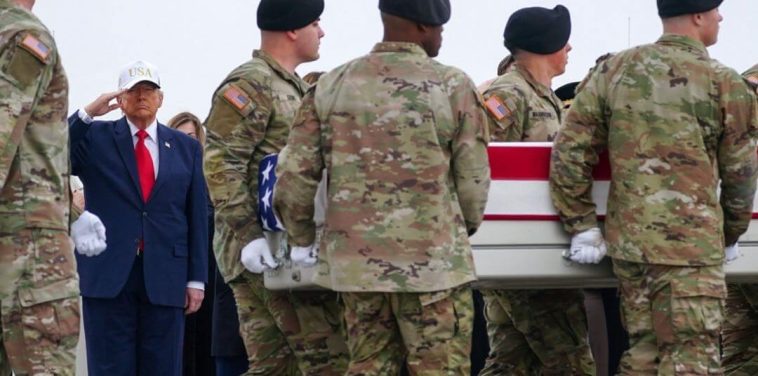
Despite the growing scope of the conflict, the dignified transfer at Dover Air Force Base will focus on honoring the six Americans who made the ultimate sacrifice while serving their country.
The ceremony represents one of the military’s most solemn traditions, where fallen service members are returned home under full honors.
For the families of Captain Khork, Sergeant First Class Tietjens, Sergeant First Class Amor, Sergeant Coady, Major O’Brien, and Chief Warrant Officer Marzan, the moment will serve as a painful but powerful reminder that their loved ones gave everything in service to the United States.

