
Domingue said he made substantial personal sacrifices while working for El-Sayed, including leaving jobs overseas, relocating to Michigan twice and accepting major pay cuts.
“I protected Abdul for two years, I worked as his personal assistant/executive protection lead on his campaigns. I departed two jobs early from working abroad, moved to Michigan twice, and took paycuts averaging 50,000k.”
He also described developing a personal relationship with El-Sayed and his family.

“I took his lovely wife to the hospital for visits when she was pregnant. His youngest daughter called me Mr. Jorjan. I painted him an original piece of artwork for his birthday.”
According to Domingue, his view of El-Sayed changed dramatically during the Senate campaign. He claimed that foreign policy became increasingly central to the candidate’s political message and that he eventually concluded the campaign’s rhetoric did not reflect a genuine concern for civilians or peace.
“I was happy to do and experience all of this. For his gubernatorial run he never mentioned foreign policy. During his senate run, his foreign policy was driven by a desire to invoke what seemed like misplaced revenge.”
“When I finally realized he didn’t actually care about civilians and peace, everything I had previously ignored or excused made it obvious to who he was and that I was on the wrong side.”
Domingue’s public profile makes his political break especially notable. His biography identifies him as a USMC combat veteran, international security professional and Democratic field organizer, among other descriptions.
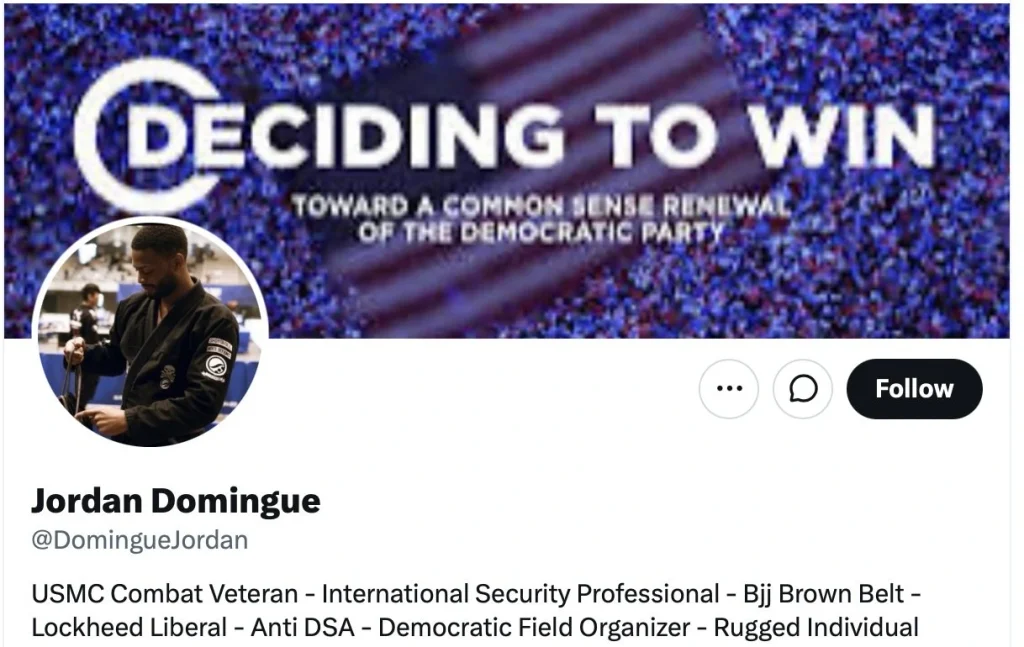
After leaving El-Sayed’s operation, Domingue became involved with Democrats for Mike Rogers, using the account to criticize his former candidate and raise questions about El-Sayed’s positions on Israel, Hamas and Hezbollah.
Former insider describes campaign culture
Perhaps the most damaging portion of Domingue’s account concerns El-Sayed’s management style.
Domingue said he spent more time with the candidate than virtually anyone else on the campaign, describing extremely long workdays and constant travel.
“I’ll share insight as the campaign staff member who has to this day, had the most 1:1 time with him. The first person to see him in the morning and the last to see him at night. Some average of 6-7 days a week, 12-14 hr days, 50,000+ miles, hundreds of Harribo Halal Happy Colas, and so much more.”
Domingue also referenced El-Sayed’s fondness for the Shakespeare line “Past is prologue,” arguing that the candidate’s past behavior should be examined carefully before voters entrust him with national office.
According to Domingue, he once rationalized behavior that he now regards as deeply troubling.
“When he acted liked an entitled mobster to elected officials in 2017-2018, I excused it as justified outsider earning their place. When he would say one thing to one group and another thing to a different group hours later, I considered it just the norm or “strategic ambiguity” as he calls it.”
He also claimed that campaign management decisions caused severe distress among staff members.
“When his management pushed multiple staff to tears and dangerous breaking points, in addition to them, I considered his stress.”
Domingue argues that documents and previous reporting involving El-Sayed should be examined alongside his own firsthand experiences.
Questions over El-Sayed’s public-service record
Another issue raised by the former aide involves El-Sayed’s description of his professional background.
Domingue said the candidate routinely describes himself as having “10 years of public service experience,” but argued that the claim creates an incomplete picture of El-Sayed’s career.
“On the trail he likes to say he has “10 years of public service experience.” I knew that was a lie while working for him, but I also was surprised he would say it. Not because it was a lie, but because 10 years of public service work experience at 41 was embarrassing to me.”
The former aide contrasted El-Sayed’s career with his own early work history, saying he began working in lawn care as a child.
The issue is politically significant because candidates seeking a U.S. Senate seat routinely emphasize their professional experience as evidence that they are prepared to represent millions of constituents.
Domingue rejects speculation about El-Sayed’s sexuality
Domingue also addressed online speculation surrounding El-Sayed’s personal life, specifically claims about his sexual orientation.
Rather than endorsing those rumors, Domingue rejected them outright.
“A lot of people are saying he might be gay, and I think that is inaccurate.”
Instead, Domingue offered his own explanation for what he described as El-Sayed’s unusual public persona, characterizing the candidate’s displays of masculinity as performative.
“This behavior is best explained by the guy who never grew past the high school locker room. His masculinity is a performance, and he has the maturity to match it.”
Domingue went on to recount what he described as immature behavior during their time working together.
A warning to journalists covering the Senate candidate
Perhaps one of Domingue’s most direct warnings was aimed at journalists who interview El-Sayed.
He argued that reporters should not allow an aggressive presentation or lengthy answers to prevent them from pressing the candidate on difficult questions, particularly concerning Israel and Palestine.
“To anyone in media interviewing him. Don’t let the appearance of toughness and his slightly antagonistic filibusters bully you. After he does his stunt just get to your questions. He will fold, and transition into the victim built on grievance, which is truly all he is.”
Domingue claimed that El-Sayed’s posture during interviews does not necessarily reflect the person he knew privately.
He also argued that the candidate’s positions on the Israel-Palestinian conflict deserve sustained questioning because foreign policy has played an important role in his Senate campaign.
Questions surrounding law enforcement
Domingue has also attacked what he describes as a disconnect between El-Sayed’s campaign imagery and his actual record on policing and crime.
He specifically criticized a campaign advertisement that depicts El-Sayed appearing to prepare protective equipment.
“A manufactured man. They even have the shot of him pretending to be “getting his kit” ( kit = weapons, plates, etc) out of the trunk. It’s meant to invoke he has worked in law enforcement or in protection industry.”
Domingue further questioned the significance of El-Sayed’s endorsement from the Wayne County Deputy Sheriff’s Association, arguing that voters should distinguish between an endorsement by a union or association and an endorsement from an entire sheriff’s office or statewide law-enforcement community.
He also pointed to past controversies involving El-Sayed’s positions on crime and policing.
His central argument is that voters should examine policy records rather than campaign imagery.
“If Abdul were an honest man, he would just say he was wrong. Say he is here to listen and learn. Instead we get this weird cosplaying chamelon.”
The broader political warning
Domingue’s defection represents more than another campaign staff departure. His criticism goes directly to the question of whether voters should trust a candidate who is seeking one of Michigan’s seats in the United States Senate.
His argument is also rooted in a broader political complaint: that Democrats have increasingly struggled to connect with working-class voters who care about wages, gasoline prices, crime, public safety and cultural issues.
“These people don’t trust the Democratic Party. They know that gas will still be high under the Democratic Party, because of climate initiatives instead of war. They know their economic situation won’t improve. They are red voters and will stay red voters because they know at least things won’t get weird again.”
Whether Michigan voters ultimately accept Domingue’s assessment remains to be seen. But his decision to leave the campaign after years of close personal access gives his criticism a level of insider perspective that El-Sayed’s opponents will undoubtedly highlight.
For voters, however, the key question is not simply whether Domingue’s accusations are politically damaging. It is whether the claims can be independently substantiated and what El-Sayed’s own record shows.
The Senate race will ultimately be decided by Michigan voters. And as the campaign moves forward, El-Sayed is likely to face increasingly pointed questions about his record, his foreign-policy positions, his approach to law enforcement and the dramatic allegations being raised by a former member of his own inner circle.

