
>> Continued From the Previous Page <<
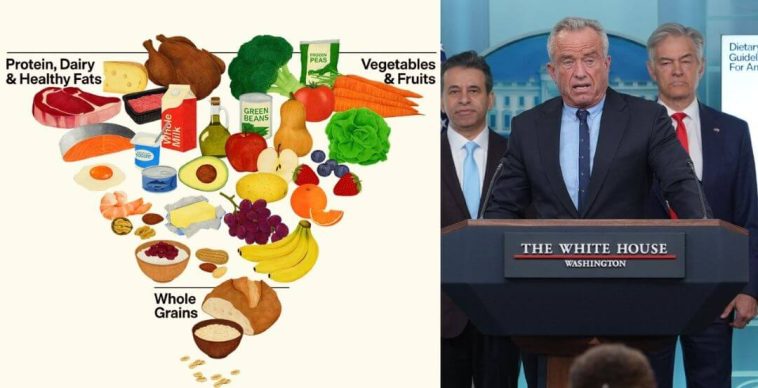
The new guidelines also feature an inverted food pyramid, placing red meat, cheese, vegetables, and fruits at the top—the foods that truly fuel your body—while grains, long heralded as essential, now occupy the base.
How the Old Pyramid Failed Americans

The food pyramid introduced in 1992 reshaped American diets in ways that scientists are only now fully admitting were harmful. Its base demanded six to eleven servings of bread, cereal, rice, and pasta daily, while fats were shoved into the tiny tip labeled “use sparingly.”
Decades of fear-mongering about saturated fat encouraged generations to ditch butter and load up on “low-fat” processed foods—often packed with sugar and refined carbs. The results have been devastating: Americans now consume roughly 152 pounds of sugar and 146 pounds of flour per person each year, fueling record obesity, type 2 diabetes in children, and persistently high rates of heart disease.
The pyramid didn’t just fail—it directly contributed to the health crisis it promised to prevent.
Industry Influence and the Long Road to Reform
The history behind federal dietary policy reveals deep conflicts of interest. The USDA’s original “Eating Right Pyramid” in 1991 faced immediate pushback from meat and dairy lobbies, halting its release. When it finally appeared a year later, it had been altered to satisfy industry pressures.
Repeatedly, attempts to reduce meat and dairy consumption were blocked by powerful lobbying groups. As the National Cattlemen’s Association warned in 1977, cutting red meat “was not without risk to millions of Americans.” Meanwhile, the saturated fat hypothesis—the idea that it caused heart disease—was never proven in clinical trials, yet it became federal policy for decades.
Over the last twelve years, more than twenty systematic reviews have confirmed that saturated fats have no effect on cardiovascular disease, mortality, or total death rates. Even the 2015 Dietary Guidelines Advisory Committee admitted via emails obtained through FOIA requests that there was no scientific basis for numeric limits on saturated fats—but the limits remained anyway.
Why Critics Are Furious
While the guidelines technically maintain a 10 percent limit on saturated fat intake, critics are outraged by the visual shift: red meat, butter, and full-fat dairy are now celebrated rather than hidden.
Stanford nutrition scientist Christopher Gardner, who contributed to the ignored 2024 advisory report, exclaimed, “Science is under attack.” Harvard’s nutrition chair warned of “mixed messages” that could confuse the public. Tufts’ Alice Lichtenstein insisted there’s no proof that adding saturated fat is beneficial—but conveniently ignored the lack of evidence showing it’s harmful in moderation.
These are the same experts who endorsed margarine over butter and low-fat diets that left Americans fatter and sicker than ever. Many of them have financial ties to the food industry, yet now cry foul when the truth threatens their reputation.
Kennedy, by contrast, examined over twenty systematic reviews, looked at America’s obesity and diabetes crisis, and chose to treat real food—steak, butter, and full-fat dairy—as allies, not enemies. This isn’t science denial; it’s following evidence instead of clinging to outdated dogma.
The fury from nutrition academics is telling: it’s less about protecting public health and more about defending a decades-long legacy of advice that, for millions of Americans, made them sick.

