
“Based on highly productive conversations with Middle East leadership, I have decided to replace the 20% United States Reimbursement Fee with Trade and Investment Deals that the various Gulf States will be making into the United States,” Trump wrote Tuesday on Truth Social.
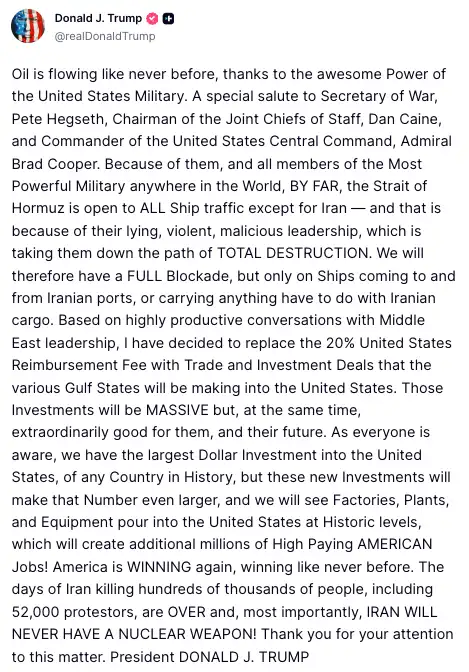
Although the president did not disclose specific agreements or identify which Gulf nations had made commitments, he expressed confidence that the new strategy would generate significant economic opportunities for the United States while also benefiting America’s partners in the region.
“Investments will be MASSIVE but, at the same time, extraordinarily good for them, and their future,” he wrote.

Trump’s latest announcement came shortly after the International Maritime Organization, the United Nations agency responsible for global shipping standards, voiced opposition to charging fees for vessels traveling through international waterways. The organization noted on Monday that it would reserve further comment until more details about Trump’s original proposal became available.
While stepping away from the reimbursement fee, Trump made clear that his administration is not easing pressure on Iran.
Instead, the president announced that commercial shipping through the Strait of Hormuz will remain open to virtually every nation except those connected to the Iranian regime. According to Trump, the United States will restore a targeted blockade focused exclusively on Iranian maritime commerce.
“We will therefore have a FULL Blockade, but only on Ships coming to and from Iranian ports, or carrying anything have to do with Iranian cargo,” Trump wrote.
The president emphasized that the strategic waterway will continue operating normally for the rest of the international community, while Iran and businesses conducting trade with Tehran will face renewed restrictions.
“The Hormuz Strait is OPEN, and will remain OPEN, with or without Iran. We are reinstating the THE IRANIAN BLOCKADE, so named because it is only stopping Iran’s ships or customers from entering or leaving. All other countries will have fair and open use of the Strait.”
The revised policy reflects Trump’s effort to balance economic growth with his administration’s broader strategy of maintaining maximum pressure on Iran. Rather than collecting fees from allied nations using the shipping lane, the White House is now betting that expanded trade partnerships and foreign investment from Gulf countries will produce greater returns for the American economy.
At the same time, Trump’s announcement signals that his administration intends to keep Iran economically isolated while ensuring that global commerce through one of the world’s busiest energy corridors continues without disruption for America’s allies and trading partners. The combination of expanded investment, continued access to the Strait of Hormuz for friendly nations, and renewed restrictions on Iranian shipping underscores the administration’s effort to strengthen economic ties with regional partners while maintaining a hardline stance against Tehran.

