
>> Continued From the Previous Page <<
“My lord, America – the conquest we’ve warned about is exploding now. The Adhan isn’t a ‘beautiful call to prayer’; it’s a militant declaration: ‘Allahu Akbar’ (Allah is greater than your gods, laws, freedoms), ‘There is no god but Allah’ (all other faiths are false).
Blared 5× daily from loudspeakers – 5 AM wake-ups included – it’s forced submission on non-Muslims, pure civilizational jihad straight from the Muslim Brotherhood playbook.
THIS IS NOT NORMAL – but they’re aggressively normalizing it.”
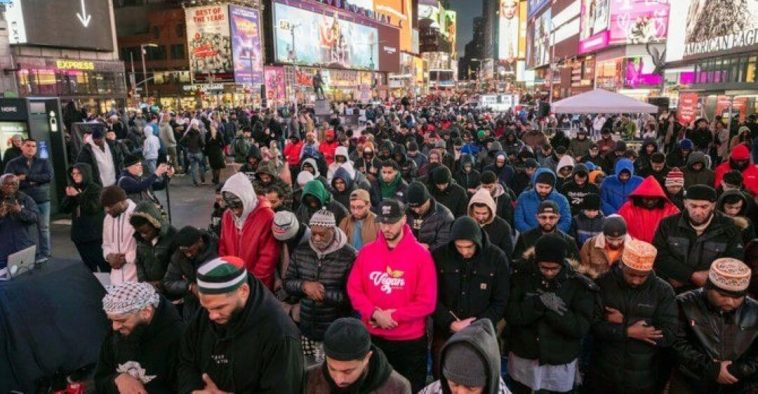
Residents in neighborhoods stretching from Astoria to Brooklyn say the situation is rapidly deteriorating. Noise complaints are reportedly pouring in, yet instead of scaling back the broadcasts, locals claim the calls are becoming louder and more frequent—particularly in Muslim-majority areas.
Critics point out that this did not begin overnight. The policy shift traces back to 2023 under former Mayor Eric Adams, when the city loosened restrictions to allow permit-free calls to prayer on Fridays and during Ramadan. At the time, City Hall framed the move as a gesture of inclusion.

But opponents argue that what began as a limited accommodation has now morphed into something far more aggressive. Under what many residents call “Mamdani’s regime,” the calls are no longer occasional or ceremonial. They are daily, amplified, and effectively unchecked.
“What we’re seeing isn’t coexistence,” one Manhattan resident told local activists. “It’s enforcement. If you don’t like it, you’re told you’re intolerant—or worse.”
A recurring point of frustration is the lack of reciprocity. Critics note that in Islam’s holiest city, Mecca, public displays of other religions are strictly forbidden. Church bells, hymns, or Christian prayers would result in immediate arrest. Yet in a city still haunted by the memory of September 11, 2001, many Americans are now told they must simply accept daily Islamic broadcasts over public streets.

To them, the double standard is impossible to ignore.
Security analysts and cultural critics also warn that this strategy mirrors tactics historically promoted by the Muslim Brotherhood, which advocates gradual normalization of Islamic dominance in public life through incremental policy changes rather than outright force.
City officials, for their part, insist that the policy reflects religious freedom and diversity. But residents pushing back say freedom of religion does not mean forced participation—or forced exposure—especially when amplified by loudspeakers and imposed on entire neighborhoods.
“This isn’t about private worship,” one Brooklyn mother said. “This is about using government permission to impose one faith on everyone else.”
As New York barrels forward, critics argue the question is no longer whether the city is changing—but whether anyone in power is willing to admit how fast, how far, and in whose favor that change is happening.

