
>> Continued From the Previous Page <<
For far too many, adulthood begins with homelessness.
According to federal data, roughly one in five foster youth ends up homeless almost immediately after aging out of the system. Others fall into unemployment, addiction, trafficking, or criminal activity while trying to survive completely alone.

Melania Trump used one young man’s story to force Congress to confront that reality.
Jayden Martinez entered foster care at just six years old. Against overwhelming odds, he eventually made it to college and later testified before Congress.
“I had success through great luck and a passionate new family, but success for a foster youth should not be a result of luck, it should be a result of opportunity,” he said.
That testimony became a driving force behind the legislation now sitting before the Senate.
For decades, Washington politicians allowed the federal foster care support structure to stagnate. The John H. Chafee Foster Care Program, designed to help foster youth transition into adulthood, has not seen meaningful modernization since 1999.
That means the system responsible for helping vulnerable teenagers prepare for adulthood was still operating under rules written during Bill Clinton’s presidency.
Meanwhile, the needs of foster youth exploded.
A January 2025 report from the Government Accountability Office revealed that states had actually returned millions of unused Chafee program dollars back to the federal government while foster children struggled to obtain housing assistance, educational funding, job training, and mental health support.
The money existed.
The bureaucracy simply failed to deliver it.
Rather than quietly attaching her name to a ceremonial initiative, Melania Trump personally entered the legislative fight. Earlier this year, she traveled to Capitol Hill and met directly with members of the powerful House Ways and Means Committee to advocate for reforms.
“New legislation for the foster care community is a moral imperative,” she told lawmakers.
That push helped produce the Fostering the Future Act, a package of six bipartisan bills aimed at expanding educational opportunities, workforce training, housing assistance, legal aid, and support systems for young parents emerging from foster care.
The legislation passed the House this week without a single dissenting vote.
One of the biggest reforms dramatically increases educational assistance. Foster youth currently capped at $5,000 in education vouchers would now gain access to as much as $12,000 under the proposal.
The funding would also become far more flexible.
Instead of steering every student toward traditional four-year universities, the legislation allows foster youth to use the money for vocational schools, apprenticeships, certification programs, and GED completion programs.
That shift reflects the real-world paths many young Americans take to stable careers.
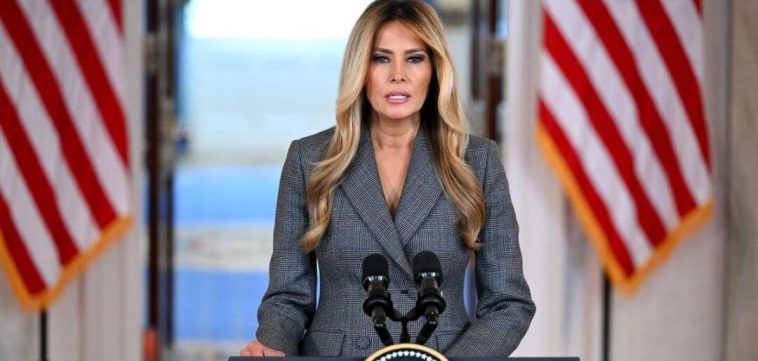
At Wednesday’s luncheon, Melania Trump made clear that this fight is about more than statistics or government programs.
She told the audience that education, resilience, career ambition, and love are essential foundations for transforming the lives of foster youth. She then directly challenged senators’ spouses to become advocates in their own states.
She highlighted both Jayden Martinez and foster advocate Jocelyn Fetting as examples of what becomes possible when struggling children are given meaningful support.
“If every one of your states gets involved to support our foster care community, we can accelerate our vision to protect these individuals and set them on a pathway to shine,” she said. “I consider this your moral obligation.”
The Senate now faces enormous pressure to move the bill quickly.
And lawmakers understand this is not a symbolic campaign.
Melania Trump’s legislative agenda already produced results earlier this term with passage of the Take It Down Act, which became federal law and has already led to criminal enforcement actions.
The Trump administration has also expanded its broader Fostering the Future initiative across dozens of states while building partnerships with major universities including Vanderbilt University, Louisiana State University, University of Virginia, Ohio State University, University of Texas, and University of Miami.
Congress has already approved tens of millions in housing assistance tied to the initiative.
This is no longer a publicity campaign.
It is a coordinated legislative effort with growing bipartisan momentum and real policy victories already on the board.
Now the Senate must decide whether to act while the political pressure is high or leave another generation of foster children trapped in the same broken system Washington ignored for decades.
For thousands of young Americans preparing to age out of foster care this year, the answer could determine whether they begin adulthood with opportunity or with nothing at all.

