
>> Continued From the Previous Page <<
The conversation did not stop there.
According to those who overheard the exchange, Macron encouraged Zelensky to remain at the summit longer. The Ukrainian leader reportedly explained that he was scheduled to travel to Brussels and could not extend his stay.

Macron then shifted the discussion toward Trump, asking whether Zelensky had arranged a private meeting with the U.S. president.
When Zelensky indicated that no such meeting had been scheduled, Macron quickly stepped in.
“Okay, I will arrange that.”
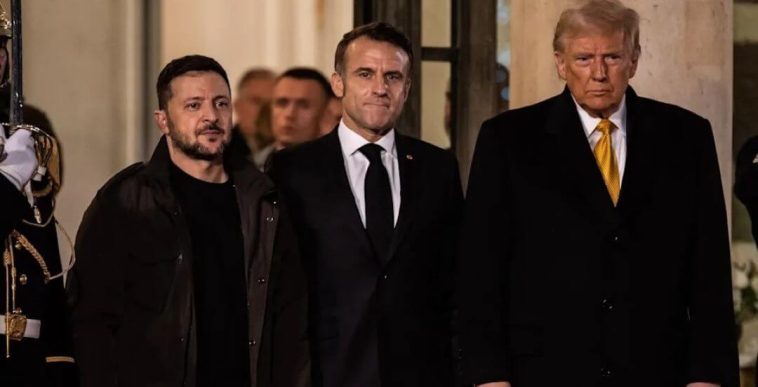
The exchange highlighted Macron’s increasingly visible role as an intermediary between Washington and Kyiv.
European leaders have spent much of the past year attempting to bridge the gap between Trump and Zelensky, whose relationship has experienced significant turbulence since Trump’s return to the White House.
That strain became impossible to ignore during a dramatic Oval Office meeting in February 2025.
What was supposed to be a routine diplomatic gathering instead turned into one of the most contentious public confrontations between American and Ukrainian leaders since the war began.
During the meeting, Trump and Vice President JD Vance openly challenged Zelensky, questioning his approach to the conflict and urging him to seriously consider negotiations aimed at bringing the war to an end.
The disagreement quickly escalated.
The planned joint press conference was scrapped, discussions surrounding a major minerals agreement collapsed, and Zelensky departed Washington earlier than expected.
The fallout extended beyond optics.
In the weeks that followed, the Trump administration temporarily suspended intelligence cooperation and military assistance before eventually restoring both programs.
Although direct communication between Trump and Zelensky resumed afterward, tensions never completely disappeared.
The broader disagreement centers on how the war should end.
Trump campaigned on a promise to bring the conflict to a close and has repeatedly argued that a negotiated settlement is achievable.
However, progress toward a peace agreement has remained elusive despite multiple rounds of diplomacy.
Earlier this year, Trump publicly suggested that Ukraine itself was contributing to the deadlock.
When asked by a Reuters reporter what was preventing meaningful progress in negotiations, Trump offered a strikingly brief response.
“Zelensky.”
The president has also repeatedly expressed confidence that Russian President Vladimir Putin is willing to negotiate.
“I think he’s ready to make a deal,” Trump said, adding, “I think Ukraine is less ready to make a deal.”
Those comments stand in sharp contrast to the position held by many European leaders, who argue that Kyiv has consistently sought peace while Moscow remains unwilling to make meaningful concessions.
Despite the disagreements, recent developments suggest relations between Washington and Kyiv may be stabilizing.
Trump and Zelensky met again during the G7 summit, where both sides appeared eager to project a more cooperative tone.
Following the meeting, Trump described the discussion as “very good” and indicated that additional talks were expected later in the summit.
The president also reiterated his desire to see the conflict brought to an end, emphasizing that “Russia should make a deal” and stop the bloodshed that has turned into a grinding war of attrition.
For Zelensky, the priority remains convincing the White House to apply greater pressure on Moscow while maintaining Western support for Ukraine’s defense.
For European leaders such as Macron, the challenge may be even greater.
As the hot mic moment demonstrated, they continue finding themselves in the middle—working to keep Ukraine, the United States, and NATO allies moving in the same direction while navigating increasingly complicated political realities.
And if Macron’s off-the-cuff admission is any indication, those conversations behind closed doors may be far more difficult than the public ever sees.

