
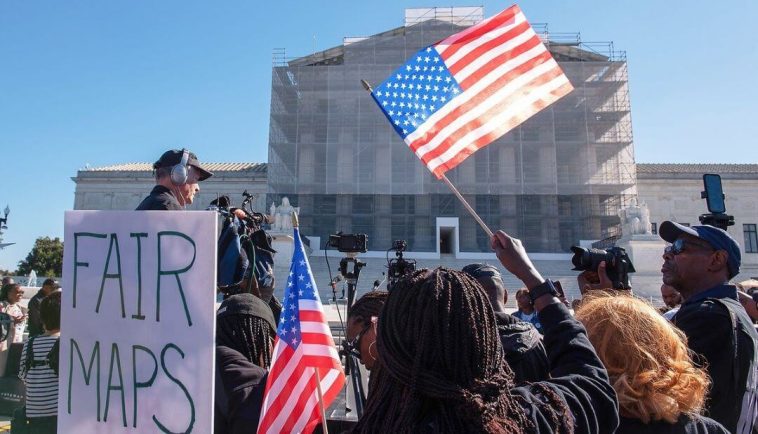
At issue is Section 2 of the Voting Rights Act, the powerful federal tool that has been used for decades to challenge election maps accused of diluting minority voting strength. After recent arguments, it appears the Court’s conservative majority is seriously weighing whether to narrow how federal courts apply that provision, particularly in cases where race and party affiliation overlap.
The case now before the justices stems from Louisiana’s congressional map. In 2022, a federal district court found the state’s original map likely violated Section 2 by concentrating Black voters into just one majority-Black district, even though Black residents make up roughly one-third of the state’s population. Louisiana has six congressional seats.
In response, lawmakers adopted a new plan in 2024 creating a second majority-Black district. But that did not end the fight. A group of white voters sued, arguing the new boundaries amounted to unconstitutional racial gerrymandering. A district judge sided with them.

Now, in the re-arguments of Louisiana v. Callais, the Supreme Court is considering whether federal courts have gone too far in policing how states draw their maps.
During arguments, members of the conservative bloc appeared open to an approach supported by the Trump Justice Department. The proposal would make it significantly harder for plaintiffs to win racial vote dilution claims in regions where race and party loyalty strongly correlate, as is common in many Southern states.
>> Click Here To Continue Reading <<

