
>> Continued From the Previous Page <<
The key question is whether states can defend their maps by pointing to partisan strategy rather than racial intent.
This debate echoes the Court’s 2019 ruling in Rucho v. Common Cause, which held that federal courts cannot referee purely partisan gerrymandering disputes. Under that precedent, mapmakers can pursue political advantage. The argument now is that if political goals drive the map, even when racial demographics are intertwined with party preference, that alone should not automatically trigger a Section 2 violation.

Chief Justice John Roberts, who authored the Court’s 2023 decision in Allen v. Milligan requiring Alabama to create a second majority-Black district, pressed attorneys on whether the proposed framework could be squared with established doctrine.
That doctrine traces back to Thornburg v. Gingles, which requires plaintiffs to show that a minority group is sufficiently large and geographically compact, politically cohesive, and that majority bloc voting typically defeats their preferred candidates. Roberts appeared cautious about abandoning that framework entirely, signaling concern about overturning settled law.
Justice Brett Kavanaugh, who joined Roberts and the liberal justices in Allen, floated another idea. He suggested the possibility of limiting Section 2 remedies with a “sunset” concept, referencing prior rulings that restrict race-based government policies to temporary measures.

Conservative justices showed little appetite for fully erasing Section 2, a cornerstone of the Voting Rights Act since 1965 and strengthened in 1982. But even narrowing its reach could have dramatic consequences.
Left-leaning voting groups are already sounding alarms. Fair Fight Action and the Black Voters Matter Fund warn that weakening or eliminating Section 2 could open the door for Republican-controlled legislatures to redraw as many as 19 congressional districts to their advantage. Broader research suggests up to 27 seats nationwide could potentially shift depending on how aggressively states respond, with 19 directly tied to the fate of Section 2 protections.
Those numbers carry enormous implications for control of the U.S. House of Representatives.
Meanwhile, some blue-state lawmakers are exploring state-level countermeasures. In Mississippi, Democratic legislators Zakiya Summers and Johnny DuPree have introduced bills to establish a state version of the 1965 Voting Rights Act. Their proposal would create a Mississippi voting rights commission empowered to review and approve certain election law changes in designated areas. It would also expand language assistance and add new procedural safeguards.
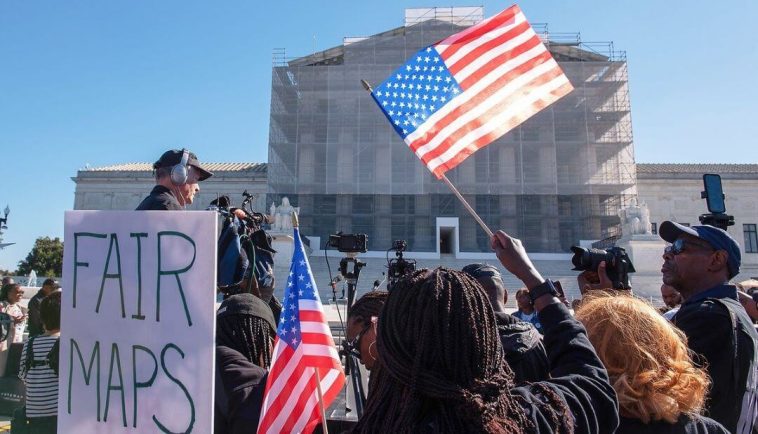
The broader legal backdrop underscores how high the stakes are. In Rucho, the Court stepped away from partisan gerrymandering oversight. In Allen, it reaffirmed Section 2’s force in certain racial vote dilution cases. Now, in Louisiana v. Callais, the justices appear poised to draw a sharper line between race and politics.
If the Court ultimately adopts a stricter standard, federal judges could be far more reluctant to strike down maps when states argue they were pursuing “valid partisan objectives.”
The coming decision could redefine how far Washington can go in supervising state election maps. It may also determine whether future redistricting battles are fought primarily in federal court, state court, or not at all.
One thing is certain. When the Supreme Court speaks, the political map of America may shift in more ways than one.

