
>> Continued From the Previous Page <<
Walz, however, avoided providing specific details on how a Harris-Walz administration would lower these costs. Instead, he shifted the conversation to climate change, claiming that environmental factors were playing a significant role in the rising cost of living.
The reality is that since Kamala Harris assumed office as Vice President, inflation has reached levels unseen in over a century. According to recent data, the Consumer Price Index (CPI) shows inflation hitting all-time highs, with gas prices up 35% and food prices increasing by 21.5% under Biden’s administration. Experts blame this spike on the administration’s reckless spending policies, further worsened by Harris casting the tie-breaking vote on the so-called “Inflation Reduction Act.”

Far from reducing inflation, the act has left millions of Americans grappling with higher costs for everyday necessities. In fact, a recent poll conducted by The Economist/YouGov highlighted that inflation and grocery prices are the most important concerns for Americans right now. When asked about what a future administration would do to ease this burden, Walz’s response left many puzzled.
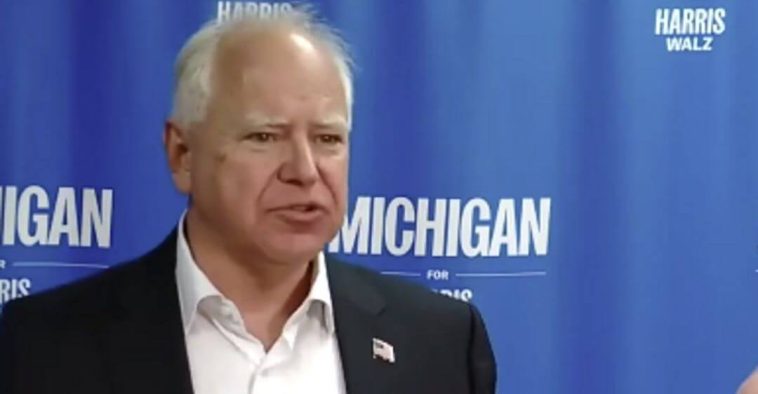
Rather than addressing the core issue—runaway inflation driven by irresponsible fiscal policies—Walz blamed grocery stores for the steep food prices Americans are currently seeing. “Somebody in the middle is taking more than they should on this!” he remarked during the interview. His comments seemed to echo a socialist approach, shifting responsibility from governmental policies to private enterprises.
WATCH:
But Walz’s argument falls flat. According to industry reports, grocers operate on razor-thin margins. The average annual profit margin for grocery stores stands at just 1.2%, well below the 8.5% all-industry average. These numbers suggest that the real culprit behind the soaring prices is not greedy corporations but the inflationary policies enacted by the Biden administration.
Rather than offering viable solutions, Walz’s interview highlights a continuation of the same tactics we’ve seen from progressive politicians—diverting attention from the failed policies that have caused economic hardship for millions of families.
The reporter pressed Walz to be more specific about what a Harris-Walz administration would do to lower the cost of living, asking, “I hear from a lot of people, ‘I just want my gas and my groceries to be cheaper,’ what is your administration’s plan, be more specific on lowering the cost of living?”
But Walz failed to provide any concrete answers. His pivot to climate change and deflection of blame onto grocery stores illustrated a lack of understanding of the core issues affecting everyday Americans. Instead of addressing the problem, Walz’s comments seemed to endorse the idea of government intervention and price controls, ideas reminiscent of Soviet-style economic policies, which have historically failed to curb inflation.
As Americans continue to struggle under the weight of rising prices, they are looking for real solutions—not political posturing. But the Harris-Walz agenda, as outlined in this interview, seems far more interested in deflecting blame and maintaining the status quo than in offering tangible relief to millions of suffering families.
Once again, political leaders are out of touch with the needs of ordinary citizens. Instead of focusing on policies that would foster economic growth and reduce inflation, Walz’s remarks suggest that his administration would likely double down on the same failed policies that have already caused so much economic pain.
In the end, the interview only reinforced what many Americans already suspect: under a Harris-Walz administration, there will be more finger-pointing and fewer solutions. And for families struggling to make ends meet, that’s simply not good enough.

