
>> Continued From the Previous Page <<
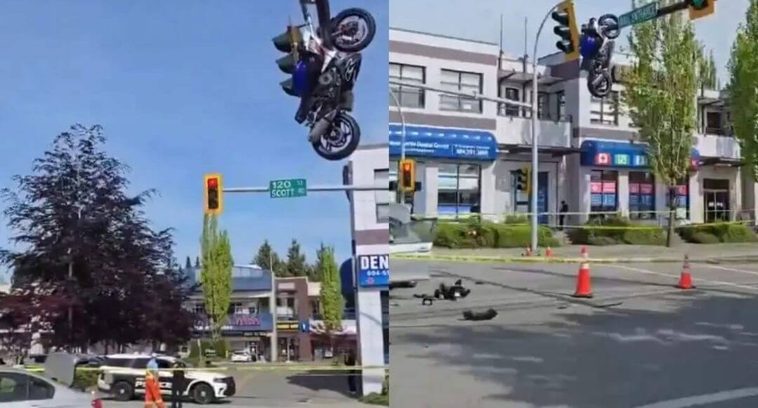
First responders later confirmed they required heavy equipment, including a crane, to safely remove the motorcycle from its position above the intersection. Despite the violent nature of the crash, the rider survived and was transported to a local hospital with serious but non-life-threatening injuries. The driver of the BMW was not physically harmed.
Witnesses in the area described the scene as surreal and difficult to process in real time. One bystander, William Chan, had been parked near a Krispy Kreme when the collision unfolded. He initially noticed the damaged car but quickly realized something far more unusual had happened above him. “I was looking down,” he said, “and then I looked up and the motorbike was above – kind of crazy.”

Another witness, Jevon Ryan, echoed the disbelief, noting how unpredictable the trajectory appeared from the roadside. “You’d think it would launch to the sidewalks, to the businesses,” he said. “But to perfectly get up there and wrap itself around – it’s wow.”
Local police, fire crews, and emergency medical teams shut down the intersection for an extended period while they assessed the scene and coordinated recovery operations. Authorities also confirmed that speed is believed to have been a contributing factor in the crash, though the investigation remains ongoing.
While the visuals are striking, safety analysts point out that the underlying scenario is far from rare in motorcycle collisions. Data from the National Highway Traffic Safety Administration shows that roughly 43 percent of fatal multi-vehicle motorcycle crashes occur when a car makes a left turn in front of an oncoming rider. In many cases, the driver simply misjudges the motorcycle’s speed or fails to register it as an immediate threat during a routine visual scan of the roadway.
This pattern is often referred to as a “looked-but-failed-to-see” scenario. Drivers are conditioned to recognize larger vehicles more easily, while motorcycles—smaller and faster—can blend into peripheral vision or be misjudged in distance and speed, even when directly in view.
The intersection factor is also significant. Studies consistently show that a large share of motorcycle crashes involving another vehicle happen at intersections, where multiple decision points occur in seconds. Left turns remain one of the most dangerous movements in traffic flow due to crossing paths and limited reaction time.
The motorcycle involved in this incident was a 2026 Suzuki GSX-R1000R, a high-performance machine known for producing roughly 192 horsepower and designed for track-level endurance. Built for speed and precision handling, it is capable of sustained high-speed operation under controlled conditions—far different from the unpredictable environment of urban traffic.
However, that same engineering advantage becomes a liability in sudden obstruction scenarios. Under heavy braking, sport motorcycles can shift weight aggressively forward, reducing rear-wheel stability and making them more vulnerable to abrupt changes in direction or elevation when impact forces are involved.
For families watching the footage, the lesson is less about the machine and more about the environment. Intersections like this one—routine, familiar, and often mentally “auto-piloted” by daily commuters—remain among the highest-risk zones for riders. The danger is not always reckless behavior, but misjudgment, timing, and visibility.
In this case, the rider survived an impact that could easily have been fatal. The motorcycle, however, ended its journey suspended above the roadway, requiring industrial equipment to bring it back to ground level.
It is a stark reminder that on public roads, physics does not offer second chances—and even familiar intersections can turn into impact zones in the span of a heartbeat.

