
>> Continued From the Previous Page <<
Those developments raised urgent fears of a boiling liquid expanding vapor explosion (BLEVE), a rare but extremely dangerous industrial event in which a pressurized container fails catastrophically. Officials warned that such an explosion could have triggered secondary detonations involving nearby tanks and equipment, potentially turning the facility into the center of a large-scale industrial disaster.
As a precaution, authorities issued mandatory evacuation orders covering roughly nine square miles. The evacuation zone included large portions of Garden Grove as well as parts of Anaheim, Buena Park, Cypress, Stanton, and Westminster. In total, nearly 50,000 residents were temporarily displaced as a state of emergency was declared and federal assistance was requested to support local response efforts.

The scale of the evacuation reflected the seriousness of early modeling, which suggested that if a BLEVE had occurred under certain conditions, a powerful blast and fireball could have been followed by a toxic vapor plume spreading across densely populated neighborhoods. Emergency planners also considered worst-case dispersion scenarios involving airborne chemical exposure, which helped drive the initial wide evacuation perimeter.
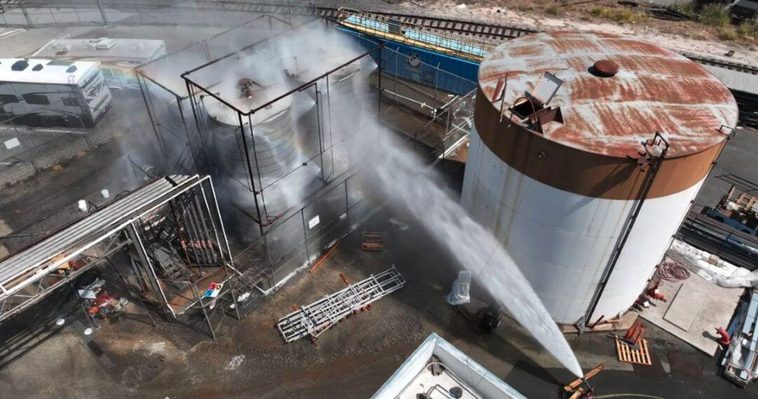
Crews worked continuously to stabilize the situation, applying sustained water cooling to reduce internal temperatures and relieve pressure buildup in the tank. By the night of May 24 into May 25, officials reported a key breakthrough: the tank had developed a crack that, while concerning in appearance, actually allowed internal pressure to vent in a controlled manner. This development significantly reduced the immediate risk of a catastrophic rupture.
Following continuous monitoring, officials confirmed by May 25 that the likelihood of a major BLEVE event had effectively been eliminated. Internal temperatures began trending downward and stabilized, marking a turning point in the emergency response effort. As conditions improved, authorities began scaling back evacuation zones by approximately 65 percent, allowing a majority of displaced residents to return home.
Despite the improvement, around 16,000 residents remained under evacuation orders in more limited areas as crews continued monitoring the site for any signs of renewed instability. Officials emphasized that caution remained necessary until full verification of long-term stability could be completed.
By the evening of May 26, all remaining evacuation orders were lifted after additional inspections confirmed that the tank had fully stabilized. Authorities reported no ongoing risk of explosion, fire, or significant chemical leakage. A brief exclusion zone remained in place afterward to allow final assessments and safety checks at the facility.
Experts noted that while a worst-case industrial disaster was avoided, a BLEVE event in this scenario could have produced an intense explosion and fireball capable of spreading toxic fumes across a wide region. Even a contained spill would have required extensive cleanup and environmental monitoring, though officials confirmed no widespread contamination had been detected.
Air quality tests conducted throughout the incident showed no major public health threats, and no significant environmental damage has been reported so far. However, investigations are ongoing, including a review of the facility’s safety systems and operational procedures. According to reporting from Los Angeles Times, authorities continue to examine how the refrigeration failure occurred and whether any preventive measures were missed.
As the investigation moves forward, officials are expected to evaluate both equipment performance and emergency response coordination, with a focus on preventing similar industrial incidents in the future. While the immediate danger has passed, the event has raised broader questions about chemical storage safety in densely populated industrial zones across Southern California.

