
>> Continued From the Previous Page <<
This wasn’t just a return. It was a reassertion.
And it all came after months away from competitive play following a right groin strain that cut her WNBA season short after only 13 games. That injury was part of a rare stretch of setbacks for Clark, who had previously built a reputation for durability, never missing time during her college career or rookie season.

Before the tournament began, Clark gave a measured assessment of where she stood physically.
“I feel like I put myself in the best possible shape that I could be in at this point,” Clark said before the tournament. “Once you get in kind of the flow of things, and you figure things out – you’re in a little bit better of a position.”
If anything, that comment undersold what was coming.
More Than Just a Tune-Up
Officially, Team USA didn’t need this qualifying tournament. Their spot in the World Cup was already secured after winning the AmeriCup.
But this wasn’t really about qualification. It was about evaluation.
Head coach Kara Lawson used the opportunity to test combinations, assess chemistry, and identify which players could contribute on the international stage in Berlin.
What emerged from that process was something bigger than a routine roster check.
It became Caitlin Clark’s global arrival.
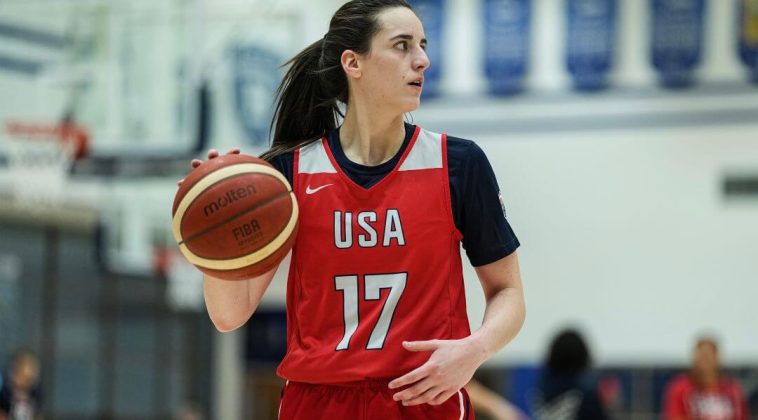
Despite playing without several of the program’s biggest stars, including A’ja Wilson, Breanna Stewart, and Sabrina Ionescu, Clark seamlessly stepped into a leadership role. With a roster filled with newcomers, she orchestrated the offense with the confidence of a veteran.
The results were overwhelming.
Team USA went undefeated, finishing 5-0, and dominated opponents by an average margin of 42 points. Even in their closest contest, a 14-point win over Spain in the final game, Clark remained impactful. Coming off the bench, she still produced 7 points, 7 assists, and a block in just 22 minutes.
The only real question entering the tournament was whether Clark was truly back to full strength.
That question didn’t last long.
She answered it within the first quarter of her opening game.
The Bigger Impact
This performance wasn’t just about numbers on a stat sheet. It highlighted something much larger happening in the sport.
Clark has become a rare figure in women’s basketball. Not just a star, but a draw.
Her presence alone has driven massive viewership and renewed interest in the game. When she appeared on an NBA pregame broadcast earlier this year, it pulled in 4.5 million viewers, marking the most-watched Sunday night regular-season pregame show in over two decades.
That kind of reach doesn’t happen by accident.
Fans are responding to her style of play. No theatrics. No distractions. Just execution.
At a time when the WNBA faces ongoing labor discussions and uncertainty about the league’s future direction, Clark represents something different. Stability. Consistency. And a level of competitiveness that resonates with audiences.
She didn’t spend the past eight months in headlines. She spent them recovering, preparing, and quietly working her way back.
Then she showed up in Puerto Rico and took over.
Now, all eyes turn to Berlin.
Team USA is chasing its 12th World Cup title, adding to a legacy that already includes four straight gold medals. With Clark now firmly back in form, the team gains not just a playmaker, but a player capable of shifting momentum on the biggest stage.
The critics questioned whether she could return to her previous level.
She didn’t just return.
She raised it.
And come September, the rest of the world is going to see it up close.

