
>> Continued From the Previous Page <<
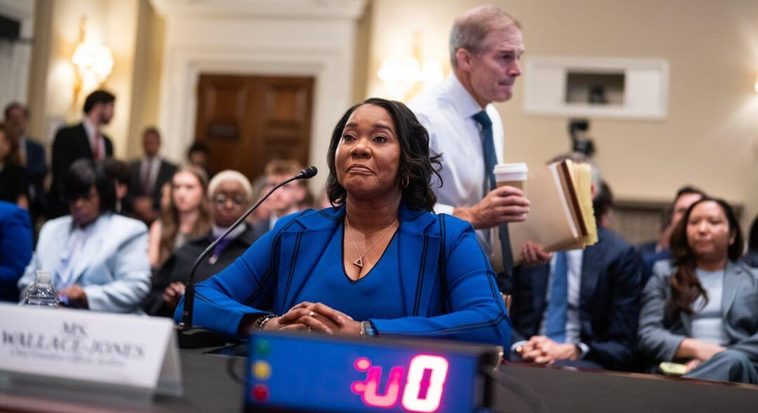
During the hearing, Wallace-Jones declined to answer every question posed, invoking her Fifth Amendment rights a total of 22 times, effectively refusing to engage with lawmakers’ inquiries.
Chairman Bryan Steil (R-WI) of the House Administration Committee led a detailed line of questioning, referencing a 2023 letter Wallace-Jones had sent to Congress defending ActBlue’s fraud prevention systems. He raised concerns that the letter may have been inaccurate or misleading based on later reporting.

Steil pressed her with questions including whether she believed her earlier statements were truthful at the time, whether she was aware of potential inaccuracies when the letter was sent, and why corrective action was not taken after concerns were raised.
He also challenged ActBlue’s claims about requiring passport verification for foreign-address donations, as well as how the platform handles contributions routed through third-party payment services such as PayPal and Venmo.
Republicans further questioned whether ActBlue weakened its fraud safeguards in 2024 despite internal concerns that doing so could increase fraudulent donations.
Rather than responding, Wallace-Jones repeatedly declined to answer, asserting her constitutional protection against self-incrimination.
The committee’s questioning was extensive. Below are the exact questions posed by Chairman Steil:
“In 2023, I sent you this letter with five straightforward questions with a goal of confirming that foreign funds are not in our elections and that ACT Blue had adequate fraud prevention measures in place. You replied a month later with a four-page letter describing your fraud prevention policies and procedures that you had in place at ActBlue. But according to the New York Times, your response to this committee may have been false and misleading. When you signed this letter to me, did you believe that this letter was false and misleading?
Before you sent this letter, was it brought to your attention that this letter that you sent me was false and misleading?
According to the New York Times, you’ve been aware for quite a while that the response you made was likely false or misleading. Did you ever consider correcting the record for this committee when it was brought to your attention that your letter to me was false and misleading?
Your letter claimed that passport information is required from donors providing an address outside the United States. In November 2023, when you wrote that letter, did every ActBlue donation provided an address outside the United States require passport information?
Your letter also claimed that ActBlue would contact a donor to request passport information if the contribution appeared to be from a foreign address, and you told this committee that the contribution would be refunded if ActBlue was unable to make contact with the donor. Is that correct?
We have reason to believe that your letter in 2023 was not correct because, according to the New York Times, donations that were made through third party apps like PayPal or Venmo, passport information was not always required. So, what’s true? The 2023 letter you sent me or the New York Times article?
After you sent me the 2023 letter. ActBlue weakened its fraud prevention rules twice in 2024, quote, ‘even after internal assessments confirmed that these policy changes would lead to more fraudulent donations,’ End quote. Did you weaken fraud prevention standards to increase donations on the ACL blue platform?
You’ve been asked legitimate questions that are intended to elicit information the committee has the right to have to aid our inquiry. You’ve refused to answer the questions. Are you formally asserting your Fifth Amendment privilege against self-incrimination today?”WATCH:
Additional lawmakers, including House Judiciary Committee Chairman Jim Jordan (R-OH) Jim Jordan and Rep. Greg Murphy (R-NC) Greg Murphy, also confronted Wallace-Jones with further questions tied to alleged foreign contributions and internal instability at the platform.
They raised concerns about claims that tens of millions of contributions in 2024 showed indicators of foreign origin, as well as whether ActBlue had received donations linked to adversarial nations, including Russia. Lawmakers also pressed for answers regarding reported legal team resignations and whether internal staff departures were connected to changes in fraud enforcement policies.
Among the additional questions posed:
“Your board chairman said ActBlue accepted up to 38 million contributions in 2024 that had the signs of foreign origin. How much fraud is too much fraud?
How many foreign contributions did ActBlue accept?
How much money did ActBlue accept from Russia?
Why did your entire legal team quit, your in-house legal team?
Did your legal team quit because of reduced fraud standards?
Did you weaken your fraud standards to help Democrats?
Do you regret any of the things that you said or any of the things that ActBlue has done in the past in regards to foreign donations?
If you had the chance to pick another place to be employed, would you have joined ActBlue?”WATCH:
Despite repeated attempts to extract answers, Wallace-Jones maintained her refusal to respond, continuing to invoke her constitutional protection throughout the session.
According to reporting from the New York Times, Democrats on the committee did not question Wallace-Jones directly. Instead, they focused their attention on criticizing Republican fundraising platform WinRed and outside investigations led by state and federal Republican officials.
The broader investigation into ActBlue’s fundraising practices continues to expand. Committee chairs Bryan Steil (R-WI) Bryan Steil, Jim Jordan, and House Oversight Committee Chairman James Comer (R-KY) James Comer recently sent letters requesting documents and interviews from members of ActBlue’s board of directors.
Those letters cite allegations of “knowing and willful” acceptance of questionable donations and internal concerns about whether the organization misrepresented its safeguards to Congress.
Earlier reports also indicate that multiple ActBlue employees previously deposed by the House Judiciary Committee invoked the Fifth Amendment repeatedly when questioned—adding further tension to an already escalating investigation into one of the most influential fundraising platforms in American politics.

