
>> Continued From the Previous Page <<
The demonstration was reportedly organized by activist student coalitions including Students for Justice in Palestine and No Tech for Apartheid, both of which have been active on campuses nationwide in protests related to U.S. technology companies and Middle East policy.
Pichai, who is also an alumnus of Stanford University, returned to his alma mater to deliver the keynote address. He earned a master’s degree in materials science and engineering from Stanford in 1995, a credential that has often been highlighted in discussions of his rise to leading one of the world’s most influential technology companies.

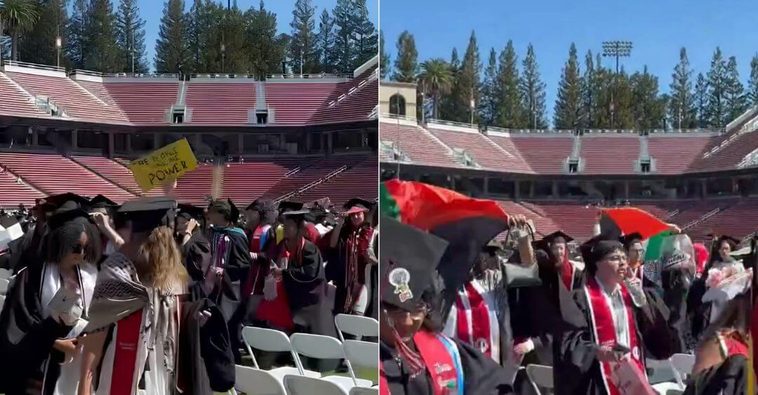
Many of the graduates participating in the walkout were seen carrying Palestinian flags as they exited the stadium grounds, underscoring the political focus of the protest. What is typically one of Stanford’s most ceremonial and unifying academic traditions was instead transformed into a stage for activism and confrontation.
At the center of the protest was criticism directed at Google’s participation in Project Nimbus, a $1.2 billion cloud computing and artificial intelligence contract jointly held with Amazon. The agreement provides cloud services for the Israeli government, and critics argue that the technology could be used by Israeli military and security agencies in ways that raise ethical concerns.
Google, however, has consistently rejected those claims, stating that the contract is intended strictly for government cloud infrastructure services and not for military operations. Company representatives have maintained that the allegations circulating among activist groups misrepresent the scope and intent of the project.
The controversy surrounding Project Nimbus has been a persistent source of internal tension within Google, particularly among employees aligned with progressive political movements. The issue has fueled organized protests, petitions, and workplace disruptions over the past several years.
In 2024, the company terminated dozens of employees following sit-ins and demonstrations at offices in California and New York. Those protests were similarly tied to opposition against Project Nimbus and broader criticism of Google’s business relationships involving Israel.
Sunday’s walkout at Stanford is the latest example of a growing trend in which commencement ceremonies—once viewed as politically neutral celebrations—are increasingly being used as platforms for protest against invited speakers and corporate figures.
Across the United States, similar scenes have played out this year at multiple universities. Speakers at graduation events have faced organized demonstrations tied to issues ranging from foreign policy and artificial intelligence ethics to corporate partnerships and global conflicts, reflecting the heightened political climate on college campuses.
Despite the disruption, Pichai continued delivering his keynote address without interruption. His remarks largely centered on optimism, resilience, and the uncertainty facing students as they transition into the next stage of their lives.
He notably avoided directly addressing artificial intelligence debates, the Israel-related controversy, or the Project Nimbus contract during his speech. Instead, he focused on encouraging graduates to remain forward-looking and adaptable in a rapidly changing world.
The Google chief urged students to stay hopeful as they step into an increasingly complex global environment, emphasizing perseverance and openness to change.
While the protest dominated much of the visual narrative of the ceremony, the university proceeded with its scheduled commencement activities, underscoring the tension between tradition and activism that continues to define many elite campuses in recent years.

