
>> Continued From the Previous Page <<
Behind closed doors, the administration is reportedly preparing alternatives if diplomacy collapses completely.
At the center of the crisis is Iran’s attempt to tighten control over the Strait of Hormuz, one of the most strategically vital waterways on Earth. Nearly 20 percent of the world’s oil supply moves through the narrow passage, making any disruption an economic nightmare for global markets.

Iranian officials now appear determined to force commercial vessels into a new authorization system that critics say amounts to a maritime shakedown operation.
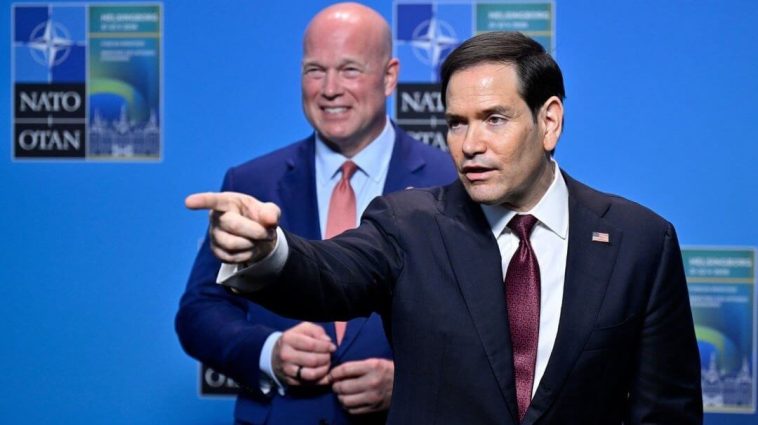
Rubio blasted the proposal outright.
“No one in the world is in favor of the tolling system,” Rubio said. “It can’t happen. It would be unacceptable.”
“It would make a diplomatic deal unfeasible if they were to continue to pursue that. So it’s a threat to the world if they were trying to do that, and it’s completely illegal,” Rubio added.
That statement may have been the clearest signal yet that Washington views Iran’s move not merely as a regional dispute, but as a direct challenge to international commerce and global stability.
Pakistan has unexpectedly emerged as a key player in the unfolding negotiations.
According to security sources, Pakistan’s Army Chief, Field Marshal Syed Asim Munir, has become one of the primary intermediaries between Washington and Tehran. Munir is now traveling to Tehran for another round of discussions with Iranian officials in hopes of preventing a complete collapse in talks.
WATCH:
But even as diplomats scramble, military tensions continue exploding across the region.
Israeli strikes targeting Iran-backed Hezbollah positions in Lebanon have reportedly killed more than 3,100 people since March, according to Lebanon’s health ministry. Fighting has continued despite a ceasefire framework brokered earlier this year with U.S. involvement.
Hezbollah has openly rejected the truce and remains opposed to ongoing negotiations between Lebanon and Israel.
Meanwhile, Europe is beginning to harden its own stance against Tehran.
The European Union announced Friday that it is considering expanded sanctions targeting individuals and entities connected to Iran’s efforts to obstruct maritime traffic through the Strait of Hormuz. EU officials called the blockade efforts “contrary to international law” and indicated the measures could include travel bans, asset freezes, and financial restrictions.
At the same time, new developments from Iranian state media raised fresh alarms in Washington.
According to reports, Iran has launched a so-called “Persian Gulf Strait Authority” intended to regulate maritime transit through Hormuz. Commercial vessels would reportedly need advance authorization and would receive instructions through official Iranian channels before being permitted to pass.
Fox News anchor Bret Baier revealed Friday that President Donald Trump remains hopeful a breakthrough is still possible.
“We’re in the middle of this — what the president is looking at on this proposal, this one-pager, this memorandum of understanding, I talked to him today, and there was this sense of optimism, not — I would say cautious optimism that they maybe get to a deal within a week,” Baier said on “America Reports.”
But Baier also acknowledged the obvious problem now hanging over the negotiations.
“However, at the same time, you have the United Nations, Iran has introduced a new mechanism, the Persian Gulf Strait Authority, to regulate maritime transit through the strategic Strait of Hormuz. That’s according to Iranian state media,” Baier added.
“Under the system, vessels intending to pass through the strait will receive guidance from an official email address outlining the rules for transit. Ships are required to comply with the framework and obtain prior authorization before crossing the waterway.’ That doesn’t seem like that’s going to fly,” Baier continued.
And that may ultimately become the deciding issue.
Iran appears to believe it can leverage one of the world’s most important shipping corridors as political leverage against the West.
The Trump administration appears determined to prove otherwise.
Rubio’s comments strongly suggest the White House is still willing to pursue diplomacy, but the message coming from Washington is increasingly blunt: if Tehran refuses to back down, America’s “Plan B” may arrive much sooner than Iran expects.

