
>> Continued From the Previous Page <<
A recent “Crystal Ball” analysis outlined the growing imbalance.
According to the projections, Republican-led states have already completed redistricting moves that could produce a massive net gain in GOP seats nationwide.

Completed changes include:
• California: +5 Democrat seats
• Utah: +1 Democrat seat
• Texas: +5 Republican seats
• Florida: +4 Republican seats
• North Carolina: +1 Republican seat
• Missouri: +1 Republican seat
• Ohio: +2 Republican seats
• Tennessee: +1 Republican seat
Current totals show Democrats gaining six seats overall while Republicans gain fourteen.
But the story may not be over.
Pending redistricting fights in Alabama, Louisiana, and Mississippi could widen the gap even further.
If current projections hold, Republicans could finish with a net pickup of roughly eleven seats nationwide through redistricting battles alone.
That possibility has sent alarm bells ringing throughout Democrat leadership circles.
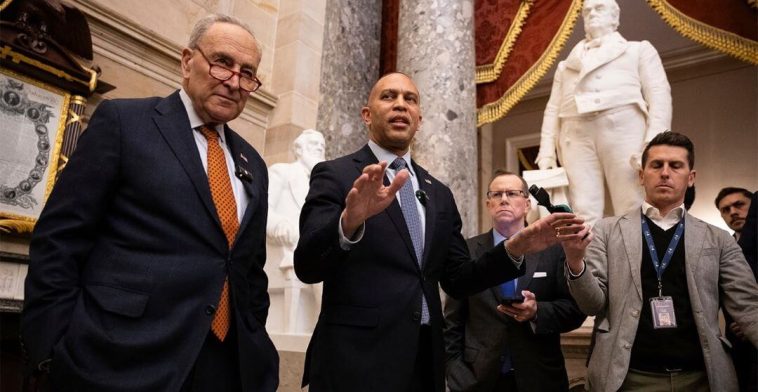
Minority leaders like Chuck Schumer and Hakeem Jeffries are now facing a political landscape that looks increasingly hostile before campaigning even begins.
The Virginia ruling was especially painful for Democrats because it directly dismantled one of their biggest opportunities for expanding House control.
In a narrow 4-3 decision, the Virginia Supreme Court struck down the state’s new congressional map after ruling that lawmakers violated the Virginia Constitution during the amendment process.
The court issued a blistering rebuke of the legislature’s actions.
“On March 6, 2026, the General Assembly of Virginia submitted to Virginia voters a proposed constitutional amendment that authorizes partisan gerrymandering of congressional districts in the Commonwealth. We hold that the legislative process employed to advance this proposal violated Article XII, Section 1 of the Constitution of Virginia. This constitutional violation incurably taints the resulting referendum vote and nullifies its legal efficacy,” said the 4-3 ruling.
The court also reminded lawmakers that Virginia voters had already demanded reforms years earlier.
“Virginians voted by a wide margin” in 2020 “to reform the redistricting process in the Commonwealth in an effort to end partisan gerrymandering,” the ruling continued. “They adopted Article II, Section 6-A of the Constitution of Virginia to create the Virginia Redistricting Commission. Under the 2020 amendment, if this bipartisan commission could not reach a consensus, the responsibility to achieve the amendment’s ultimate goal — ridding political partisanship as much as possible from the redistricting task — would become the constitutional responsibility of the Supreme Court of Virginia.”
The justices did not stop there.
“In 2021, partisan disputes in the Virginia Redistricting Commission deadlocked the 16-member commission. When the task fell to us pursuant to Article II, Section 6-A, we unanimously ordered that the prior district maps be replaced with wholly new maps that commentators across a wide spectrum of political views later deemed to be free of partisan bias,” the ruling noted further.
The court then accused Democrat lawmakers of attempting to override that bipartisan system with a map designed almost entirely for political gain.
Under the rejected proposal, Republicans would have faced near political extinction in Virginia’s congressional delegation despite the state remaining deeply divided politically.
The court highlighted the imbalance directly.
“Under the proposed new map, approximately 47% of Virginians that voted for representatives of one of the major political parties in the last congressional election would now be represented by 9% of Virginia’s delegation to the U.S. House of Representatives — while the approximately 51% of Virginians that voted for the other major political party would now be represented by 91% of Virginia’s congressional delegation,” the court wrote.
The Virginia defeat comes as Republicans continue stacking victories elsewhere.
Florida recently approved a new congressional map expected to add four GOP-friendly seats. Texas moved earlier this year to strengthen Republican control with an additional five-seat advantage. Courts have already upheld the Texas plan, frustrating Democrat legal challenges.
Meanwhile, Tennessee Republicans approved a congressional map that eliminated the state’s only Democrat-held majority-Black district, leaving the delegation entirely Republican.
Democrat-aligned activist groups have rushed into court in several states hoping to block the GOP momentum.
So far, the results have been mixed at best.
And with every ruling, the reality facing Democrats becomes harder to ignore.
The battle for Congress may already be shifting beyond persuasion, messaging, and turnout.
Instead, it is becoming a cold political fight over maps, courtrooms, and raw institutional power.
Right now, Republicans appear to be winning all three.

