
>> Continued From the Previous Page <<
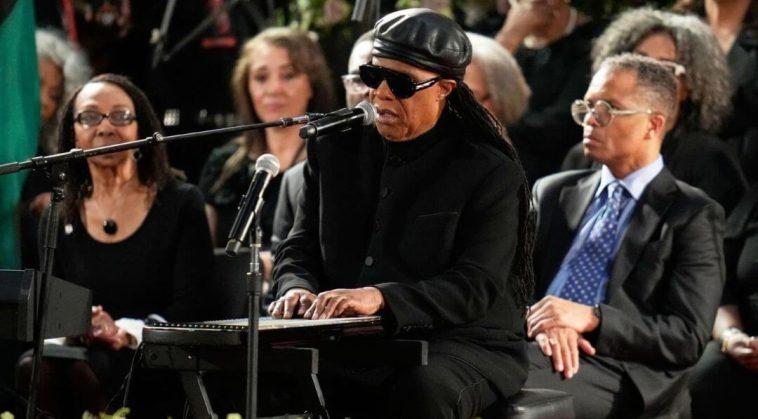
But his appearance shifted tone when he paused the music and began addressing the crowd with a broader message.
“It is you, and you know who you are,” Wonder told the audience. “You need to overcome hate. You need to overcome the mindset of white supremacy. You shall overcome the need to dominate every single country and every people.”

The comments immediately drew reaction online and among observers who believed the remarks moved the focus away from Jackson’s life and toward contemporary political grievances.
Biden, Obama, and Harris Deliver Political Messages
The service also featured speeches from several political figures who reflected on Jackson’s legacy while connecting it to present-day political issues.
President Joe Biden drew attention for a remark that critics say struck an unusual tone during a memorial service. At one point he told the crowd he was “a hell of a lot smarter than most of you,” a comment that circulated widely afterward.
Former President Barack Obama spoke for nearly half an hour, warning that greed and prejudice are being “celebrated” in modern political culture. Vice President Kamala Harris also addressed the audience and referenced her predictions about how the political climate would unfold following Donald Trump’s return to power.
To critics, the combined speeches gave the impression that a memorial service had turned into a platform for contemporary political arguments.
Jesse Jackson Jr. Speaks Out
The most pointed response came not from political commentators, but from Jackson’s own son.
Jesse Jackson Jr. appeared the following day at the headquarters of the Rainbow PUSH Coalition and openly criticized the tone of the funeral speeches.
“Yesterday I listened for several hours to three United States presidents who do not know Jesse Jackson,” Jackson Jr. told supporters.
He emphasized that his father’s public life was never confined to partisan loyalties and that Jackson Sr. often challenged political institutions across the spectrum. According to Jackson Jr., the elder Jackson insisted on maintaining what he described as a “prophetic voice” speaking on behalf of marginalized Americans.
His message suggested that reducing Jackson’s life to modern partisan politics missed the broader point of his decades-long activism.
A Debate Over Political Memorials
The controversy also revived a long-running debate about whether memorial services for prominent figures should remain strictly personal tributes or allow space for political commentary.
Observers on the right pointed to past examples where memorials became politically charged events. The 2002 memorial for Minnesota Senator Paul Wellstone is often cited as a case where a tribute turned into a campaign rally, sparking public backlash at the time.
Critics argue that similar dynamics appear whenever highly influential political figures pass away, with tributes sometimes becoming platforms for ideological messaging.
Trump’s Tribute Draws Attention
While many political leaders attended the service, Donald Trump did not. Instead, the former president released a written tribute reflecting on his personal interactions with Jackson over the years.
“I knew him well, long before becoming President,” Trump wrote. “He was a good man, with lots of personality, grit, and ‘street smarts.’ He was very gregarious – someone who truly loved people.”
Supporters of Trump highlighted the statement as a contrast to the tone of speeches delivered during the service, arguing that it focused more directly on Jackson’s character and personality.
A Complicated Legacy
Jackson’s life and career were filled with both influence and controversy. As a prominent activist who worked alongside civil rights leaders and later ran for president, he spent decades navigating tensions between grassroots movements and political institutions.
That complicated history even extended to his relationship with Obama. In 2008, Jackson was caught on a hot microphone expressing frustration with Obama’s remarks about the Black community, saying he wanted to “cut [Obama’s] nuts off.” The two later reconciled publicly.
The history between the two men was well known, making Obama’s lengthy speech at the funeral particularly notable to those who remembered the earlier dispute.
The Reaction Continues
As reactions continue to circulate online and across political media, the debate surrounding Jackson’s funeral highlights how deeply intertwined politics and public memory have become in modern America.
For some, the ceremony honored a towering civil rights figure. For others, the moment raised questions about whether political messaging had overshadowed what was supposed to be a final tribute to a man whose influence stretched across generations.

