
>> Continued From the Previous Page <<
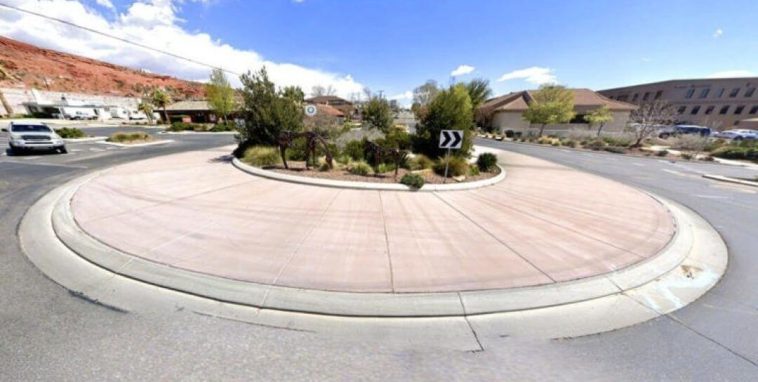
According to Utah Code Section 41-6a-804, drivers must use their turn signals when turning, changing lanes, or shifting left or right on any roadway. That includes every roundabout, without exception.
Defay dug deeper into the traffic code and discovered that motorists are technically required to signal both when entering and exiting a roundabout, no matter which exit they plan to take.

For the Kaysville Republican, it was a jaw-dropping revelation. Most residents in her district had never heard of this law before.
Lawmakers Move to Fix It
In response, Defay introduced House Bill 128 last week to remove the roundabout signaling requirement.
The bill easily passed its first hearing with the House Transportation Committee on Friday.
The problem isn’t just that drivers are unaware of the rule. It’s that the law makes little sense in practice.
“There are many exits while you’re going in a circle,” Defay explained. “By the time you have signaled, you may be beyond one exit to another exit.”
“It’s very confusing which exit you’re intending to leave from.”
Think about it: Utah law requires drivers to signal 100 feet before a turn. In most roundabouts, the distance between exits is far shorter, meaning a driver could still be signaling for the wrong exit while already approaching the one they intend to take. It doesn’t clarify anything—it just causes confusion.
The Law Nobody Actually Follows
Roundabouts are designed for one-direction travel, so signaling upon entry is almost meaningless. Drivers only have one path to follow. Exiting adds complexity, but motorists are already scanning traffic, yielding, and planning their route. Adding another turn signal just increases distractions.
Most officers probably aren’t aware of this rule either, which explains why it hasn’t been enforced regularly. Yet the law gives any officer the technical excuse to issue a ticket. Essentially, nearly everyone who navigates a roundabout in Utah is unknowingly breaking the law.
A Nationwide Problem
Utah isn’t alone. Across the U.S., roundabout signaling rules are inconsistent and outdated. A Washington state survey of 16 law enforcement officers revealed three different interpretations of the law.
Most turn signal rules were written in the 1970s, long before roundabouts became common in America. Minnesota is one of the few states to clarify that drivers don’t need to signal once inside a roundabout, though signaling upon entry is still required. Many other states have vague language, technically allowing tickets for actions most drivers would never think twice about.
This legal confusion creates a perfect opportunity for officers to target unsuspecting drivers under the guise of enforcing obscure rules.
What Defay’s Bill Would Change
House Bill 128 wouldn’t eliminate all signaling requirements. Drivers in two-lane roundabouts would still signal to indicate lane usage—a rule that makes sense for safety.
For single-lane roundabouts, the signal requirement would vanish entirely. No more forcing drivers to signal intentions that are already obvious.
“I don’t know how law enforcement will feel about it, but I think from the general population it will be a very enthusiastic ‘Yes,’ for this legislation,” Defay said.
The bigger question remains: what other hidden traffic laws are sitting in state codes, ready to ensnare unwitting motorists?
Traffic regulations drafted decades ago often fail to account for modern road designs. As infrastructure evolves, so too must the rules—otherwise, these outdated laws become traps, not tools for safety.

