
>> Continued From the Previous Page <<
The current landscape features 11 majority-Black and 31 majority-Hispanic congressional districts, based on the latest U.S. Census. Those numbers may be on the chopping block.
Timing is everything—and this legal clash arrives just as both parties are sharpening their blades for redistricting battles of their own. Republicans in Texas are already charging ahead with a rare mid-decade map redraw to potentially carve out 3 to 5 more GOP-leaning districts. Meanwhile, Democrats in deep-blue states like California and New York are preparing their own counterattacks.

Control of the House is on the line. If Democrats regain a majority, they’ll be able to “block President Donald Trump’s legislative agenda and launch aggressive investigations into his administration,” Bloomberg reported.
The challenge stems from Louisiana’s controversial 2022 map, which was drawn to include a second majority-Black district after a lower court said it was necessary to comply with the Voting Rights Act. The 6th District was engineered to stretch over 250 miles, linking Black communities from Shreveport to Baton Rouge. While Republican strongholds remained untouched—including House Speaker Mike Johnson’s seat—the new map opened the door for Democrat Cleo Fields to secure a win.
Although the Court allowed that map to be used in the 2023 elections, another legal challenge soon followed. This time, a group of plaintiffs identifying as “non-African Americans” argued that race had been used too aggressively as a redistricting tool—violating the Constitution’s equal protection clause.
A lower federal court sided with those challengers and blocked the map. But the Supreme Court intervened, allowing it to remain in place for now, citing the need to avoid disruption so close to the 2024 election.
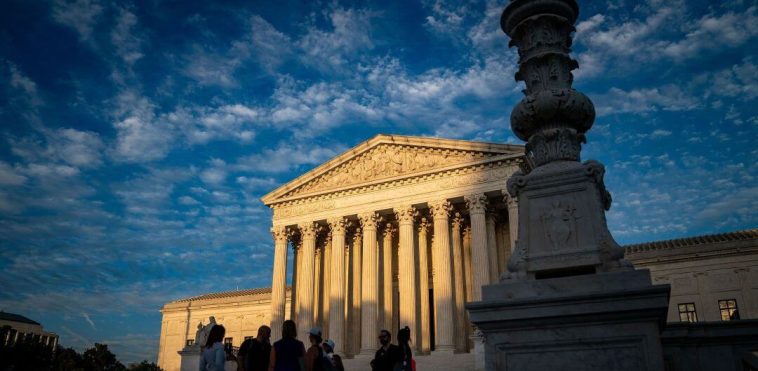
The case has now escalated, and the Justices will decide whether such race-based maps can stand for the rest of the decade. While some conservative members of the bench raised deep concerns about the constitutionality of using race as a redistricting metric, Justice Brett Kavanaugh, considered a pivotal swing vote, hinted that the plaintiffs may have hurt their own case by not bringing up certain arguments earlier.
As Bloomberg noted, “a ruling is expected sometime next year, likely too late to directly affect the 2026 election.” But the political fallout could be immediate. State legislatures may start moving now to erase majority-minority districts ahead of a formal ruling, sensing which way the winds are blowing.
The original intent of the Voting Rights Act was to safeguard against voter suppression tools once rampant in the Jim Crow South—poll taxes, literacy tests, intimidation. But critics argue that those tactics are relics of the past, and that continuing to use race as a foundation for political boundaries is outdated and unconstitutional.
Even the legal backbone of current Voting Rights Act enforcement—based on findings from the 1980s—is now under fire. Though Congress reauthorized the law in 2006, today’s Court appears increasingly skeptical of applying decades-old standards to modern political maps.
In addition to Louisiana, other states are in flux. Court orders led both Alabama and Louisiana to add a second majority-Black district for the 2024 cycle. Meanwhile, North Carolina may have gone in the opposite direction, scrapping one.
As the Court revisits the racial underpinnings of redistricting, one thing is clear: this decision won’t just shape the next election—it could reshape American democracy.

