
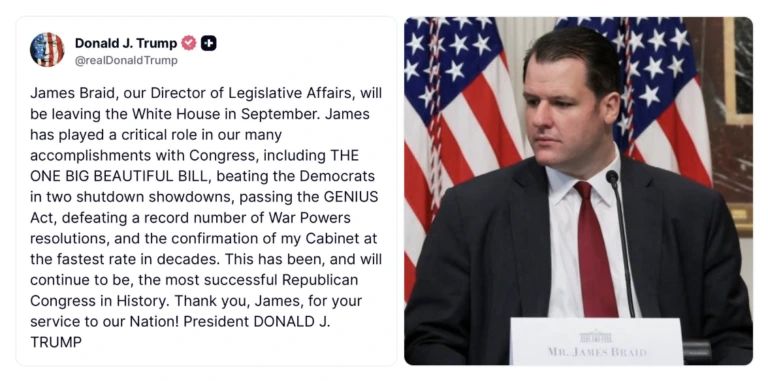
The White House has already achieved passage of the One Big Beautiful Bill, the sweeping legislative package that represented the centerpiece of Trump’s second-term domestic agenda. Getting the measure through Congress required extensive negotiations and disciplined coordination between the White House and Republican lawmakers.
Braid and his team were also involved in advancing several other major priorities.
Among them were legislation addressing housing, the GENIUS Act, a package of spending rescissions and the administration’s effort to install a new chairman of the Federal Reserve. The White House legislative operation also successfully fought off more than two dozen war powers resolutions during Braid’s tenure, frequently doing so without meaningful Democratic backing.

Perhaps one of Braid’s most notable accomplishments was his record on Senate confirmations.
During his time running the White House legislative affairs operation, the administration did not lose a Cabinet-level confirmation vote on the Senate floor. His team helped secure confirmation for controversial and closely watched nominees including Defense Secretary Pete Hegseth, Health and Human Services Secretary Robert F. Kennedy Jr. and Deputy Attorney General Todd Blanche.
Each of those confirmations faced intense opposition, making the victories particularly important for an administration determined to move quickly on its agenda.
Not every nomination reached the Senate floor.
Former Florida Rep. Matt Gaetz withdrew his nomination for attorney general before senators could vote on it. Meanwhile, New York Rep. Elise Stefanik ultimately remained in Congress after concerns emerged that her departure could further weaken Speaker Mike Johnson’s already narrow House majority.
Even with those setbacks, Braid’s overall record has positioned him as one of the most successful legislative affairs directors Trump has had.
Trump cycled through four legislative directors during his first term: Marc Short, Shahira Knight, Eric Ueland and Amy Swonger. Braid, by comparison, remained in the position throughout Trump’s second-term opening stretch and accumulated a lengthy list of legislative and confirmation victories.
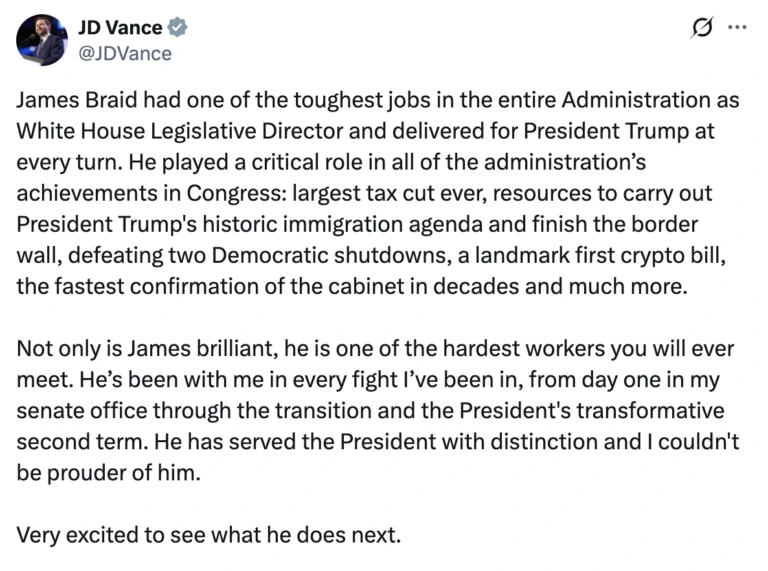
His relationship with the president and Vice President JD Vance has also been viewed as an important part of his effectiveness.
Before joining the White House, Braid worked directly for Vance as his legislative director during Vance’s time in the Senate. Earlier in his career, Braid built experience working on Capitol Hill, giving him a valuable understanding of the personalities, procedures and political calculations that often determine whether legislation succeeds or fails.
His coming exit now leaves Trump with a major personnel decision.
The White House could elevate someone already working inside the administration, preserving continuity, or it could recruit a seasoned Capitol Hill operator from outside the administration. Either option carries significant consequences with the 2026 midterm elections approaching.
The next legislative affairs director could face a far more difficult political environment.
If Democrats win control of either the House or Senate, the White House could be forced into negotiations with congressional Democrats to prevent government shutdowns and advance even basic legislation. At the same time, a Democratic majority could unleash a new round of congressional investigations targeting the Trump administration.
The administration may also have to prepare for a potentially turbulent lame-duck session if Republicans lose control of either chamber. Such a period could demand extensive negotiations and a legislative strategist capable of navigating competing factions on Capitol Hill.
That makes Braid’s replacement more than a routine staffing decision.
Successful congressional negotiations require relationships, institutional knowledge and the ability to understand where lawmakers are willing to compromise. Those skills can take years to develop, and relatively few officials inside the administration possess the combination of White House access and Capitol Hill experience that Braid brought to the job.
His departure is also part of a broader change within the White House legislative operation. Pace McMullan, who oversaw Senate outreach under Braid, recently left the administration as well.
With the midterms looming, Trump will now have to decide who can take over the demanding job of keeping his legislative agenda moving through an increasingly unpredictable Congress.
Braid leaves behind a record filled with major victories. His replacement will inherit the challenge of matching it when the political stakes could be even higher.

