
Taking to Truth Social, Trump made it clear that he views the issue as too important to ignore.
“Today’s Housing News Conference and Signing is hereby cancelled until such time as we pass the desperately needed SAVE AMERICA ACT, which I consider to be a National Emergency,” Trump wrote in a Truth Social post.
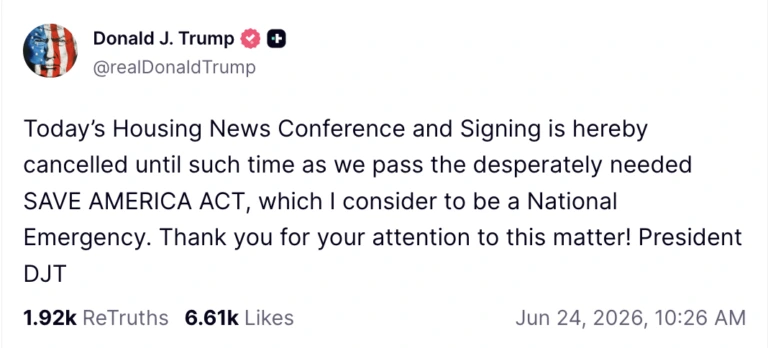
The announcement caught many in Washington off guard. The housing bill had not been viewed as controversial and had received broad bipartisan backing in both the House and Senate. Most observers expected a routine signing event and little political drama.

Instead, Trump transformed what was expected to be a ceremonial occasion into a high-stakes showdown over election law and Senate procedure.
The president has spent months pushing lawmakers to advance the SAVE America Act, a proposal aimed at strengthening voter eligibility standards. Trump and many of his supporters argue that stronger safeguards are necessary to restore confidence in federal elections and prevent potential abuses.
The latest move also highlights a growing divide between Trump and some Senate Republicans, particularly regarding the strategy needed to move the legislation across the finish line.
A major obstacle remains the Senate filibuster, which requires a supermajority of votes to advance most legislation. Trump has repeatedly urged Senate Republicans to eliminate or modify the rule so that priority legislation can pass with a simple majority vote.
At the center of that debate is Senate Majority Leader John Thune. Trump has publicly encouraged Thune to take aggressive action to clear a path for the SAVE America Act. However, Thune has thus far resisted calls to dismantle the filibuster, arguing that preserving Senate traditions remains important.
That disagreement has become one of the most closely watched battles inside the Republican Party as lawmakers weigh competing concerns about legislative priorities and institutional rules.
Meanwhile, the housing legislation now faces an uncertain future despite receiving strong support from lawmakers in both chambers. Because the bill passed with veto-proof margins, many expected it would quickly become law.
However, Trump’s decision to withhold his signature raises new questions about what happens next.
Political observers have noted that if a president refuses to sign legislation and Congress formally adjourns within a specific timeframe, a pocket veto can effectively kill the measure. While that scenario remains unlikely at the moment, it has become part of the discussion following Trump’s announcement.
Congress is scheduled to leave Washington for a two-week recess beginning Friday. Nevertheless, Senate leaders are expected to maintain pro-forma sessions during the break, a procedural step that generally prevents Congress from officially adjourning.
As a result, lawmakers may still have an opportunity to address the standoff when they return.
For now, Trump appears determined to keep the pressure on Capitol Hill. By putting a widely supported housing bill on hold, the president has sent a powerful message that he wants Congress focused on election security before turning its attention to other legislative victories.
Whether Senate Republicans ultimately embrace Trump’s strategy remains to be seen. But one thing is certain: what was supposed to be a routine bill-signing ceremony has quickly evolved into another major battle over the future direction of the Republican agenda—and the fight is far from over.

