
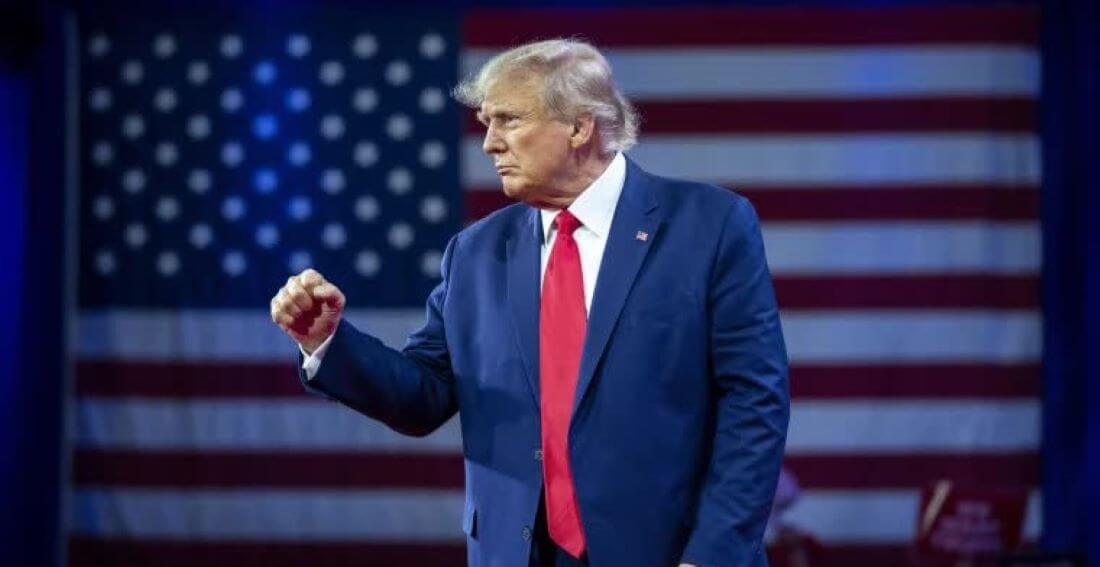
A recent survey reveals that average, working-class Americans strongly favor former president Donald Trump.
Center Square’s survey of “2,573 likely voters, conducted in conjunction with Noble Predictive Insights, shows Trump’s support is highest among Republican voters making less than $50,000 and those without a college degree.”
The survey indicates that among prospective Republican and Republican-leaning voters, Donald Trump has a sizable lead over other Republican contenders. Sixty-one percent of these potential voters said they would vote for Trump. Former US Ambassador to the UN Nikki Haley came in second with 13%, followed by Florida Governor Ron DeSantis with 12%. Businessman Vivek Ramaswamy received 7% of the vote, compared to barely 2% for former governor of New Jersey Chris Christie, whose candidacy has been halted. The Center Square released this information.

Don’t miss this! Carry faith with you everywhere with the Exclusive National Prayer Coin!
Seventy percent of respondents who reported having a household income under fifty thousand dollars supported Trump. He garnered 58% support in the income range of $50,000 to $100,000. Nevertheless, among individuals earning more than $100,000 annually, this fell to 51%. Trump got more support than all of his Republican rivals combined, regardless of economic level.
“Voters without a college degree backed Trump with 68% support compared with 48% for those with a college degree,” Citing the survey results, the outlet’s story went on to say more.
Center Square was informed by Michael Bitzer, the chair of Catawba College’s politics department in North Carolina: “With the growing diploma gap between the two parties, if college-degree Republicans are softer in their support of the former president come the general election in November, that may pose a challenge for a candidate that believes he can only win his base and secure an electoral victory.”
Moreover, he underscored that the suburban support will be quite influential.
“The other interesting dynamic is among suburban Republican voters compared to urban and especially rural Republican respondents,” Bitzer said. “Compared to almost two-thirds of urban and rural Republicans supporting the former president, the below 60% of suburban voters supporting the former president in the primary may be another warning signal for the general campaign, since nationally so many suburban areas tend to be the swing areas of deciding November’s election.”
The Center Square survey was carried out by Noble Predictive Insights, whose chief of research is David Byler. He also added: “Trump’s strength with the working class is a product of policy and persona,” he said. “On policy, he moved the GOP away from supply-side economics and toward tougher immigration policies – the working-class wing of the GOP wanted that for a long time. He made those moves and built unique credibility with working-class voters.”
Trump’s personal effect on voters is an important consideration.
“Persona is also part of the equation,” Byler said. “We let Trump supporters tell us, in their own words, why they backed him. And a decent chunk of his loyalists said he was tough, a straight-shooter and honest in a way that other politicians aren’t. Not every voter thinks this persona is genuine – but his supporters do.”
ALERT! Major Water Restrictions In Effect!
Despite his political career of highlighting his blue-collar upbringing, President Joe Biden has seen a change in the Democratic Party’s base of support. In recent election cycles, the party has recruited more and more wealthy Americans.
“Republicans’ grasp on the upper crust of American society is beginning to slip, while Democrats are increasingly becoming the preferred party of America’s elite. And it could cost them their grip on the White House,” Newsweek observed in a June investigation.
“Republicans have appealed to America’s wealthy with a platform that’s long committed itself to lower taxes and fewer regulations for big businesses. However, wealthier Americans are gravitating more toward Democrats, voting blue in the last two presidential elections. And the new appeal to wealthier individuals is creating a divide with a key Democratic voting bloc: blue-collar workers,” Newsweek added.

