
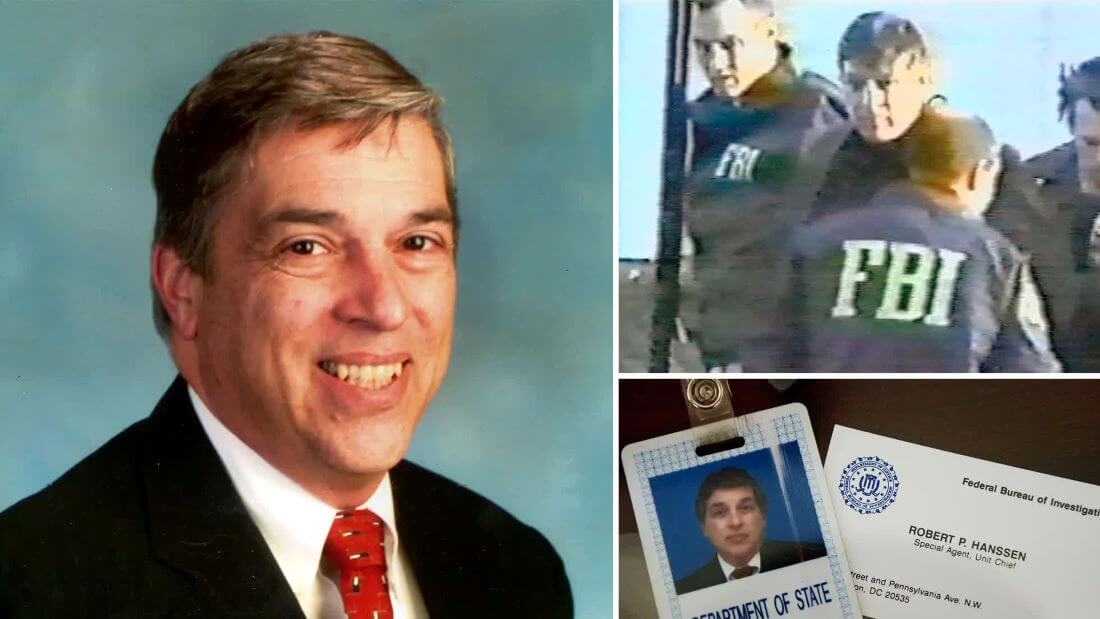
According to CBS News, former FBI agent Robert Hanssen was discovered dead in his detention cell yesterday.
Hanssen, who was 79 years old at the time and admitted to espionage for both the Soviet Union and the Russian Federation, was detained after his confession in 2001.

According to the U.S. Department of Justice, Hanssen’s spying was “possibly the worst intelligence disaster in U.S. history.”
The following Wikipedia background information
The first cycle of espionage for Hanssen, an FBI agent who joined the organization in 1976, began in 1979 when he offered his services to the Soviet Main Intelligence Directorate (GRU). He carried on spying until 1981 before picking it back up in 1985. The Soviet Union’s fall in 1991 put an end to his covert efforts, which left him fearful of being discovered. He returned to the game, nevertheless, the next year, and played on until he was caught. He took great care to hide his identity from the Russians throughout these times.
The disturbing account of Hanssen’s espionage for the KGB centers on the selling of top-secret information about American nuclear war plans, military weaponry, and counterintelligence program elements. While collaborating with Aldrich Ames, Hanssen also revealed the identities of KGB agents working secretly for the U.S. as a result of which some of them were put to death for their allegiance. Hanssen also disclosed a multi-million dollar FBI eavesdropping tunnel that was constructed beneath the Soviet Embassy. Ames was arrested in 1994, but certain intelligence breaches persisted. However, the FBI shelled out a stunning $7 million to find an undercover agent who eventually turned out to be Hanssen after being identified by fingerprint and voice analysis.
When Robert Hanssen, a U.S. intelligence spy, was apprehended after dropping off sensitive documents at a location close to his Vienna, Virginia, home, a notorious case of espionage began. His arrest on February 18, 2001, followed this occurrence, and he was charged with selling intelligence documents to Russia for an astounding $1.4 million, which he collected over a 22-year period in cash and diamonds. In order to avoid the death penalty, Hanssen, who was first incarcerated at the Alexandria Adult Detention Center, pled guilty to 14 charges of espionage as well as a conspiracy charge. He was given a harsh sentence that included fifteen life sentences without the possibility of parole. He was then sent to ADX Florence, where he spent the remainder of his life before dying there in 2023.
When staff members found Hanssen unconscious in his cell, they attempted to revive him but were unable.
“Staff requested emergency medical services, and life-saving efforts continued,” Bureau of Prisons spokesperson Kristie Breshears said in a statement.
“The inmate was subsequently pronounced dead by outside emergency medical personnel.”
According to two sources and CBS News, Hanssen passed away from natural causes.
Breaking: Tinnitus Wipes 1% Of Your Memories Every Month
CBS News states:
An FBI employee named Hanssen started spying for the Soviet Union and its successor, the SVR, in 1979. He decided to contact them after three years on the job. But as soon as his wife approached him, the unlawful deed was put an end to.
He picked up his spying again in 1985 and made over $1.4 million in cash, jewels, and foreign bank accounts selling thousands of top secret documents. By employing dead drops and encrypted conversations to provide sensitive material to espionage agencies, he endangered human sources and counterintelligence techniques. all while using the identity “Ramon Garcia” to be completely unknown. He never really interacted with a Russian handler.
Through the eyes of Eric O’Neill, learn the amazing tale of Robert Hanssen, the infamous spy apprehended by the FBI. O’Neill, who gallantly served as an undercover agent throughout the inquiry, clarifies Hanssen’s murky past and shows how his father’s expectations and his own ambitions collided. Follow Hanssen’s compelling story as a former dental student who eventually turned legendary law enforcement traitor.
“He really wanted to catch spies. He was a James Bond fanatic, loved the movies,” O’Neill said. “He could quote them chapter and verse. He wanted to be a spy. He was joining the FBI to do that — not to spy against the U.S., but to go in and hunt spies.”
The cost of sustaining his family in both New York and Washington, D.C. added to his frustration when his ideal job at the FBI wasn’t provided.
“And that led him to decide that he was going to get everything he wanted — become a spy,” O’Neill said.

