
>> Continued From the Previous Page <<
The result was an unusual scene: two athletes standing at the top step, sharing what is traditionally a singular championship position.
One athlete won the event outright. The other was the highest-placing female competitor after the adjustment.

Critics say the arrangement effectively redefined competition itself.
California’s policy response to a biological male winning girls’ events, they argue, was not to separate categories or revise eligibility rules, but instead to redistribute awards — a move opponents say changes the meaning of first place while attempting to preserve appearances of fairness.
Reactions online were swift. Former collegiate swimmer Riley Gaines and activist Jennifer Sey were among those who immediately criticized the outcome. Several members of Congress, including Rep. Tim Burchett and Rep. Nancy Mace, also weighed in, amplifying footage and images that circulated widely within hours of the event.
The controversy is not isolated from broader legal and political battles already underway.
The Trump administration issued an executive order in February 2025 prohibiting biological males from competing in women’s sports at federally funded institutions. California’s athletic authorities signaled they would not comply. Soon after, the U.S. Department of Education opened an investigation in April 2025.
By June, federal officials concluded California was in “clear violation of Title IX.”
California’s education leadership rejected that conclusion, stating it “respectfully disagreed” with the federal findings and declining to sign a proposed resolution agreement.
In July 2025, the Department of Justice escalated the matter into a formal lawsuit against both the California Department of Education and the California Interscholastic Federation. At stake is $44.3 billion in federal education funding.
The lawsuit specifically referenced Hernandez as “Student 1” and noted that performances in girls’ events would not have qualified for boys’ finals and would have ranked last had the athlete competed in the male division.
Attorney General Pam Bondi addressed the issue directly, stating: “The Governor of California has previously admitted that it is ‘deeply unfair’ to force women and girls to compete with men and boys in competitive sports. But not only is it ‘deeply unfair,’ it is also illegal under federal law.”
That statement has been repeatedly cited by critics who say California’s current policy defies both legal pressure and its own internal logic.
Governor Newsom’s past comments have also resurfaced. During a March 2025 appearance on his podcast with Charlie Kirk, he acknowledged concerns about fairness in women’s athletics involving biological males. However, since then, California has maintained its policies, resisted federal enforcement, and continued to defend its approach in court.
State officials have characterized opposition protests as politically motivated. The California Department of Education described “Save Girls Sports” demonstrations outside the meet as “the right wing’s cynical attempt to weaponize this debate as an excuse to vilify individual kids.”
Supporters of the protests say that characterization misses the point entirely. They argue the issue is not about individual athletes, but about preserving competitive equity for female athletes who train and compete within longstanding biological categories.
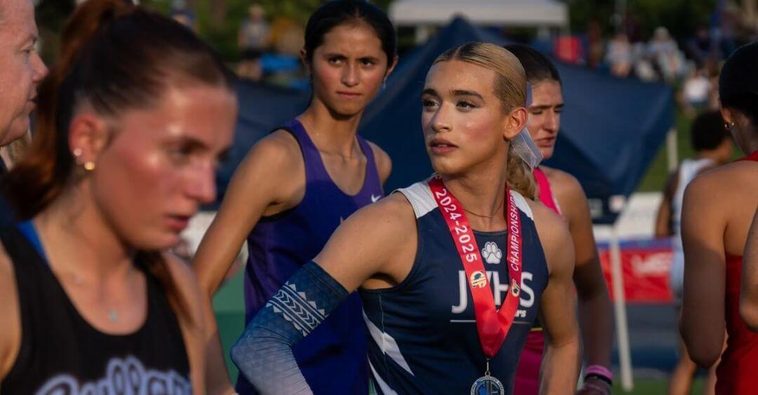
One example frequently cited occurred last year in Moorpark, where female athlete Reese Hogan finished second in the triple jump behind Hernandez but achieved a personal best performance. After the event, she was elevated to the top step under the same system now in question, drawing cheers from portions of the crowd who viewed her as the symbolic winner.
As California prepares for upcoming state finals in Clovis, the dispute shows no sign of slowing.
Hernandez is set to advance to the next stage of competition, while legal proceedings continue to unfold in federal court. Meanwhile, the broader political implications continue to grow, especially as Governor Newsom positions himself on the national stage ahead of future elections.
For critics, the situation reflects a widening gap between public acknowledgment of fairness concerns and the policies actually enforced on the ground. For supporters, it represents an effort to balance inclusion with competitive structure.
Either way, California’s approach to girls’ athletics has become a national focal point — and the outcome of its legal and cultural battle is still far from settled.

