
>> Continued From the Previous Page <<
Burns, whose legal expertise includes a background in Republican politics, sounded the alarm in his recent New York Post op-ed. He warned that the law represents “a political earthquake” for New York elections. “Jurisdictions can fall under the new rule’s shadow for multiple reasons — including arrest rates for citizens in ‘protected classes,’” Burns wrote, suggesting that the law’s broad triggers could place many jurisdictions under AG James’ control, even for seemingly mundane reasons.
For decades, New York’s elections have been managed by bipartisan election boards with equal representation from both major political parties. While not perfect, these boards have been seen as a check on partisan meddling. With the new law, however, many fear that this balance of power will be disrupted, allowing James, a vocal opponent of former President Donald Trump and other conservative causes, to tilt the scales.

“If a poll site needs to be moved or a voter list must be culled to remove deceased residents, that jurisdiction’s Board of Elections will have to seek AG approval first,” Burns wrote. He also noted that the law includes a provision allowing James to expand the range of local election board functions that require preclearance. The implications of this are vast, particularly in key battleground districts across the state.
The legislation covers not only New York City but also critical areas in upstate New York and Long Island. According to Burns, some of the most competitive congressional districts in the state — districts that could swing the balance of power in the 2024 elections — are now under the preclearance mandate. Long Island, the Hudson Valley, and even upstate counties like Erie, Monroe, and Albany are all in the crosshairs.
It’s worth noting that preclearance rules were originally put in place to prevent voter suppression in states with a history of disenfranchising minorities, particularly in the South during the Jim Crow era. However, in New York, the criteria for placing a county under this law’s purview seem far less dramatic. For instance, in Erie County, the inclusion is based on a decade-old court dispute over redistricting, not any egregious act of voter suppression.
Burns’ chief concern lies in the erosion of public trust in New York’s electoral system. At a time when confidence in election integrity is already at a low, the injection of partisan oversight could further destabilize faith in the process. “Our elections — and the public’s faith in them — will not be improved by the AG’s meddling,” he said.
In a phone interview with Fox News, Burns highlighted just how dangerous this shift could be: “It’s certainly quite a power grab by the attorney general as well.” He also pointed out that this move undermines the bipartisan nature of election boards, where both sides have historically had a stake in ensuring elections were fair and efficient.
With swing districts now facing AG oversight, the stakes are high for the upcoming presidential election. Burns warned that having a partisan elected official, especially one with a track record like James, in control of key election decisions could create chaos. “What’s better than having both sides have a stake in the outcome, both sides wanting to and needing to make sure that elections are run smoothly and fairly?” he asked.
For many, the law represents a shift in power that could significantly alter the landscape of New York’s elections. “If this doesn’t scare you, it should,” Burns concluded in his op-ed.
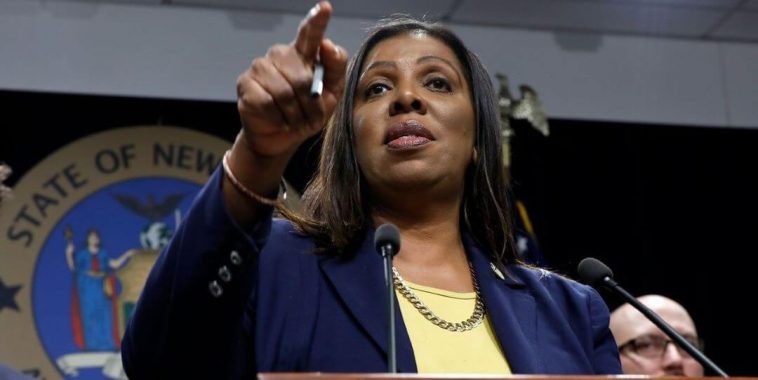
As the law takes effect, all eyes will be on New York’s election process — and on Letitia James, who now has unprecedented authority that could reshape the 2024 election in the Empire State.

