
The former senator’s remarks amount to a strong vote of confidence for Collins at a time when control of the Senate is expected to be a major battleground between Republicans and Democrats.
Manchin did more than praise his former colleague. He also announced plans to travel to Maine to help Collins campaign for another term.
“I’m gonna do everything I can to help,” he said.

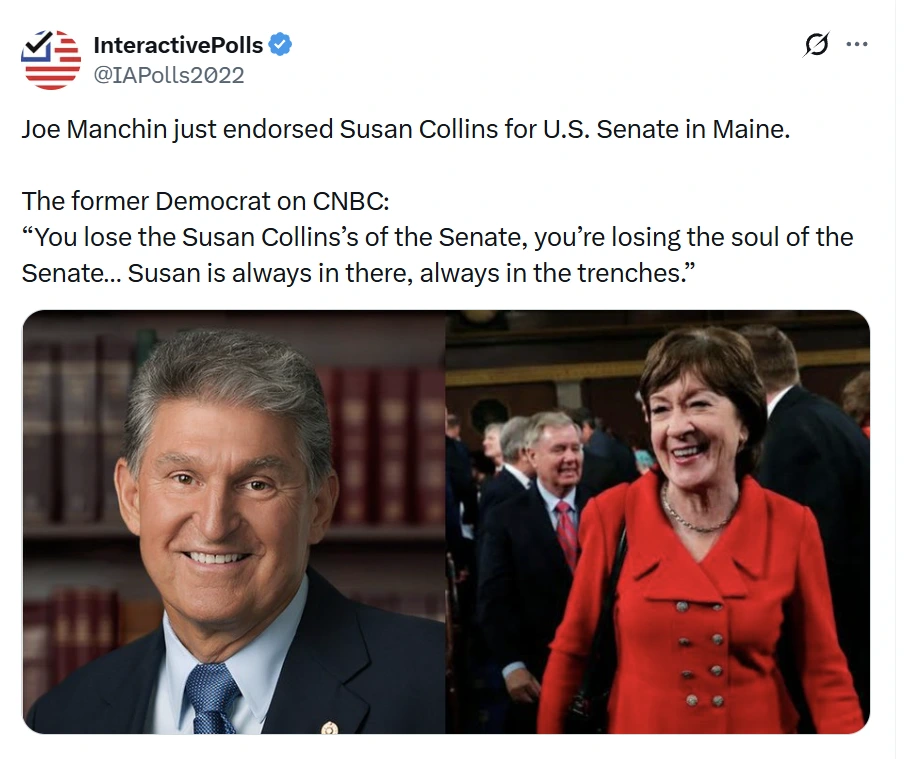
The endorsement is particularly noteworthy because Manchin and Collins have spent much of their political careers on opposite sides of the aisle. Despite their differences, both developed reputations for occasionally challenging their parties and participating in negotiations aimed at securing bipartisan agreements.
Manchin and Collins Share a Record of Bipartisan Deals
Their political partnership is not new. During their overlapping years in the Senate, the two lawmakers worked on several major legislative initiatives that brought Republicans and Democrats together.
Among the most significant was the bipartisan infrastructure legislation enacted in 2021. The measure directed federal resources toward transportation, broadband expansion and other infrastructure projects, requiring lawmakers from both parties to negotiate a compromise.
Manchin and Collins also supported the Bipartisan Safer Communities Act, which became law in 2022. The legislation expanded certain federal firearm restrictions and provided funding for mental health services and school safety programs.
Both senators were also involved in bipartisan efforts that led to the Electoral Count Reform Act. The legislation clarified congressional procedures for counting electoral votes following a presidential election, explicitly limiting the vice president’s role to a ceremonial function and raising the threshold for lawmakers seeking to object to a state’s electoral votes.
Their cooperation extended beyond individual bills. Manchin and Collins participated in the Common Sense Coalition, a bipartisan group that sought middle-ground solutions during contentious debates in Washington.
For Manchin, those experiences appear to have reinforced his belief that lawmakers should be judged by their willingness to negotiate and deliver results rather than by party labels alone.
This is not the first time he has backed Collins at the ballot box, either. Manchin endorsed the Maine Republican during her 2020 reelection campaign, demonstrating that their working relationship has endured across multiple election cycles.
His latest endorsement could provide Collins with another opportunity to appeal to voters who value political independence and bipartisan cooperation.
Collins Faces a Challenging Reelection Campaign
Collins is seeking a sixth term in the Senate and faces Democratic nominee Troy Jackson, a former president of the Maine Senate who secured his party’s nomination earlier this year.
The contest has attracted national attention as Republicans work to preserve their Senate majority and Democrats look for opportunities to flip seats.
Jackson has built his campaign around issues including healthcare, economic inequality, workers’ rights and the rising cost of living. He has also attacked Collins over abortion rights and her relationship with President Donald Trump.
Collins, meanwhile, is emphasizing her experience, seniority and record of occasionally breaking with Republican leadership when she believes circumstances warrant it.
During an October debate, the senator highlighted disagreements with Trump on tariffs, immigration enforcement and military policy. She also reminded voters that she voted to convict Trump during his second impeachment trial following the January 6 Capitol riot.
Jackson has countered that Collins’ disagreements with the president do not erase her support for other Republican policies. His argument is that voters should evaluate her overall legislative record rather than focus on isolated instances of independence.
Collins has defended her approach as a commitment to examining legislation and administration decisions individually instead of automatically following her party’s position.
That distinction could prove important in a competitive race where voters may weigh both national political divisions and concerns specific to Maine.
Manchin’s endorsement gives Collins an opportunity to reinforce her argument that she can work across party lines, even as she remains a Republican seeking reelection.
Republicans Sound Alarm Over Democratic Party’s Direction
The endorsement also comes amid a broader political debate over the ideological direction of the Democratic Party.
House Speaker Mike Johnson has recently argued that progressive activists and democratic socialist organizations are gaining influence over Democratic candidates and policy priorities.
During a CNBC interview, Johnson delivered a blunt assessment of what he sees as a significant shift within the opposition party.
“The insurgent left is consuming the Democrat Party,” Johnson declared.
Johnson’s comments reflect the Republican speaker’s political assessment, rather than an established outcome of Democratic electoral victories. Democrats have rejected Republican portrayals of their party, and substantial ideological differences remain among their elected officials and candidates.
Nevertheless, the debate over the influence of progressive politics has become another front in the struggle for control of Congress.
Candidates associated with democratic socialist organizations have increasingly participated in state and federal elections, giving Republicans an opportunity to argue that the Democratic Party is moving away from more moderate positions.
For Republicans, Collins’ candidacy presents a different image of political leadership: an experienced senator who has demonstrated a willingness to disagree with members of her own party while continuing to support Republican priorities.
Manchin’s endorsement reinforces that contrast, although his support alone does not determine how Maine voters will ultimately decide the race.
A High-Stakes Test for Bipartisan Politics
The 2026 Senate contest will test whether Collins can translate her reputation for independence and decades of legislative experience into another election victory.
Manchin’s decision to campaign on her behalf adds a prominent cross-party voice to that effort. His argument is straightforward: the Senate benefits when lawmakers remain willing to negotiate, even in an era of intense political polarization.
Whether that message resonates with enough Maine voters remains to be seen. Jackson is emphasizing issues that could appeal to voters dissatisfied with the current political establishment, while Collins is making the case that experience and a record of bipartisan dealmaking matter when choosing a senator.
With control of the Senate at stake, the contest will carry consequences far beyond Maine. The outcome could influence the legislative agenda, oversight priorities and political balance in Washington for the remainder of Trump’s presidency.
Manchin’s endorsement may not settle the race, but it underscores a central question facing voters in November: should senators be judged primarily by their party’s agenda, or by their individual records and willingness to work with political opponents?
For Collins, the support of a former Democratic senator offers a powerful argument for the latter—and another reminder that the battle for the Senate is about more than party loyalty alone.

