
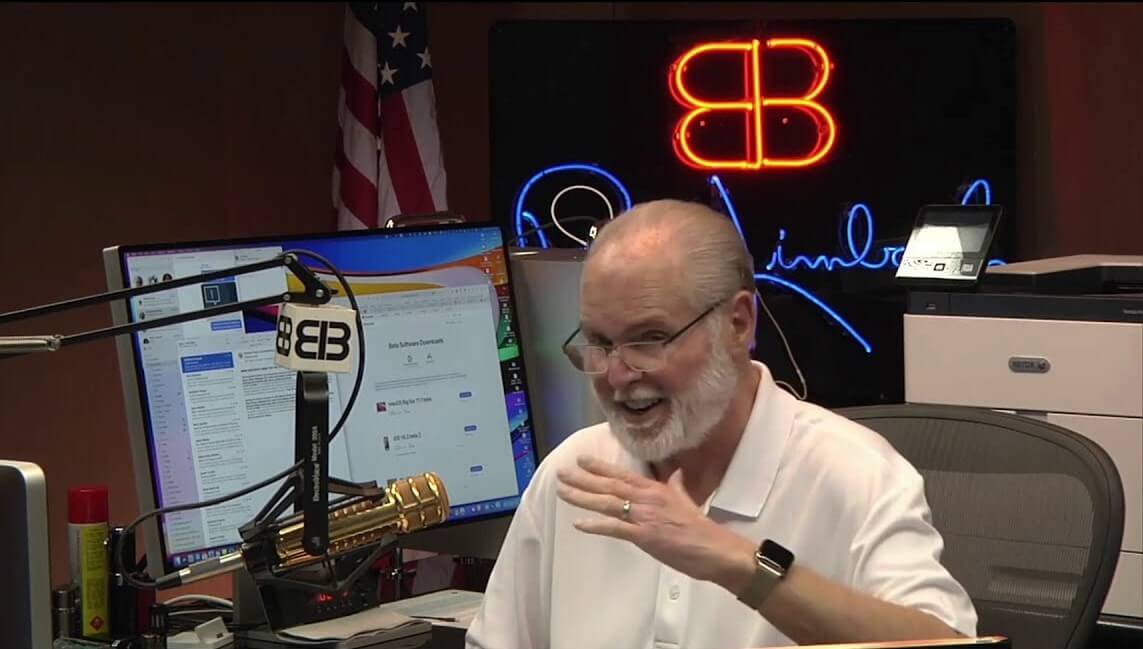
Discover the “true” Thanksgiving tale as told by Rush Limbaugh, the legendary conservative radio host. We are bringing back this classic story in remembrance of El Rushbo and in appreciation of this auspicious day. View the video below and read the transcript.
“So, my second book was See, I Told You So. The first book is The Way Things Ought to Be and the second book is See, I Told You So. “Chapter 6, Dead White Guys, or What the History Books Never Told You: The True Story of Thanksgiving.”
Don’t miss this! Carry faith with you everywhere with the Exclusive National Prayer Coin!

Presenting the next installment in the Rush Revere series! The first book to expose the true story of America’s origins, Rush Revere and the Brave Pilgrims, invites you to join in on the journey. These engrossing picture books are made to make sure that developing brains are taught the facts about the history of the United States. Don’t pass up this fascinating and instructive adventure!
Learn about the little-known history of Thanksgiving and the Native Americans who were instrumental in assisting the Pilgrims. A deeper understanding is offered in the engrossing children’s book Rush Revere and the Brave Pilgrims, which uncovers a story that is frequently obscured and misrepresented by conventional wisdom. Get ready to learn about and be astounded by the actual history of Thanksgiving.
The Pilgrims set out on a difficult trek across the Atlantic Ocean and eventually landed at this strange place. They were in a condition of ambiguity, having neither direction nor goal in mind. But when they came into contact with kind Indians, their luck changed. The Indians saved the Pilgrims when they saw how desperate they were and graciously volunteered to help. The Indians taught the settlers vital skills like farming and beaver trapping, as well as priceless information via their insight and leadership.

Enjoy Thanksgiving, a celebration of how the Pilgrims and Native Americans joined together over a feast that ultimately saved lives. America would not exist today if it weren’t for the Native Americans. Enjoy a large Thanksgiving dinner with your loved ones to help spread thankfulness.
Find out the interesting and real story that motivated me to write. The children’s version of the Revere book explores the amazing tale of Squanto, a young Native American, and the remarkable Native Americans who helped the Pilgrims.
While preparing for my program today, I came across a fascinating article on The Federalist. This is a website I visit often, and when I read this specific article, I had to laugh. It brought to mind the tales included in my books See, I Told You So and Rush Revere. The narrative explores the remarkable specifics of Squanto, including his identity, his significant deeds, and his ways of offering help.
I’m happy that The True Story of Thanksgiving is becoming more and more popular. Put succinctly, it’s spreading. Before getting into the specifics, let’s get right into it. The failure of socialism is revealed in The Real Story of Thanksgiving, which begins with the arrival of the Pilgrims at Plymouth Rock.
Take note! The United States’ future is in jeopardy. The threat of socialism is quite real in light of the recent Democratic Party election. We must take immediate action to stop them from taking Georgia’s two seats; else, our beautiful nation will become a communist state for all time. Take a stance and resist this frightening future.
ALERT! Major Water Restrictions In Effect!
We need everyone to realize that we have gone a long way. It’s not out of date, it’s not cliched, and it’s not a reason to make fun of people. If you ever mentioned the Soviet Union as “communist,” back when I started this program in the late eighties or early nineties, you would be laughed at.
“Ah, come on, Rush! You see a communist behind every rock,” … they made an attempt to make fun of you for not recognizing communists or communism. The ChiComs are Castro. Although I never gave in, many others did, and they’re still doing it now. In the event that you say, “The United States, the Democrat Party’s on the pathway to socialism,” They ridicule you. They make fun of you.
“Come on! You don’t believe that. You can’t believe that! That’s just silly,” and they attempt to quiet you by making fun of you and mocking you. But it’s true, people. Right now… “The story of the Pilgrims begins in the early part of the seventeenth century… The Church of England under King James I was persecuting anyone and everyone who did not recognize [the church’s] absolute civil and spiritual authority,” actually, the state.
“Those who challenged ecclesiastical authority and those who believed strongly in freedom of worship were hunted down…” This occurs in the 1600s in England. They “were hunted down and imprisoned, and sometimes executed for their beliefs. A group of separatists,” those who want no involvement in this, “first fled to Holland,” they liked wooden shoes and cheese, “and established a community.”
They spent eleven years there. “After eleven years, about forty of” These rebels who preferred cheese and wooden shoes, “agreed to make a perilous journey to the New World…” They were aware of it. Someplace fascinating and undeveloped, brand-new. I’m not preaching to you; they were aware that they would “face hardships,” troubles similar to yours and mine.
Just to let you know, we have no idea how much suffering these folks went through. We are unable to. These days, we have come too far. Life now would seem unbelievable to those who lived in the 1600s. (Laugh) Attempt to describe flying and jet travel. They could never comprehend it. They were aware that they would “face hardships,” but living freely and worshiping God in accordance with their own convictions and consciences was of utmost significance to them.
In England, people were not allowed to be free to do that. “On August 1, 1620, the Mayflower set sail. It carried a total of 102 passengers, including forty” of these Pilgrims, these separatists. Merely forty of them existed. They were “led by William Bradford. On the journey” over the Atlantic… You speak about anything that ought to be frightful and unsettling?
With 102 passengers, the Mayflower resembled a 50-foot boat in size. “On the journey, Bradford set up an agreement, a contract” if you will, “that established just and equal laws for all [40] members of the [Pilgrim] community, irrespective of their religious beliefs.” What their religious views were was irrelevant.
They had all agreed to abide by these laws. “Where did the revolutionary ideas,” Where did these laws originate? The subject of discussion is the Mayflower Compact. Bradford wrote just that. From the Mayflower Compact “[f]rom the Bible. The Pilgrims were a people completely steeped in the lessons of the Old and New Testaments.”
They were deeply religious individuals. They were deeply religious, regardless of what else is written about them (and even that is refuted). “They looked to the ancient Israelites for their example. And, because of the biblical precedents set forth in Scripture, they never doubted that their experiment would work.”
The Pilgrims embarked on their journey to the New World with complete confidence, unwavering in their beliefs. Even after the difficult and dangerous voyage, they never wavered in their belief that they would prosper when they got there. In November, the Pilgrims finally arrived at the New England coast after months at sea. William Bradford wrote in his thorough record that they encountered a grim reality: a bleak, frigid wilderness. Imagine modern-day New England, a region of forests, rocks, and unspoiled wilderness, engulfed in the bitter cold of November.
Not a buddy. Not a shelter. Absent civilization. Just emptiness. No lodgings. Not one inn. Not a place to change. No residences. This was real struggle. They had only just begun to pay a price for their right to freedom of religion.
Almost half of the immigrants, including William Bradford’s own wife, died from malnutrition, disease, and exposure to the weather during that first winter, which started in November. But we also can’t undervalue the importance of springtime. It was more than just a case of the seasons changing; it represented their tenacity and the incredible battle for survival that is beyond our comprehension.
Find out how American Special Forces’ tenacity and inventiveness stack up to those of the fabled Pilgrims. Those with military training can fully understand the sufferings endured during that first winter in the New World, something that the typical individual may find difficult to imagine. The Pilgrims overcame much adversity to live, and they were finally welcomed by Native Americans who provided invaluable assistance with farming and hunting. Get ready for an engaging story that could make some people rethink their assumptions. Animal rights activists, get ready for something different. While certain parts of this tale may not agree with your viewpoints, the events are historical.
The Pilgrims did not succeed even if Native Americans helped them with things like the Mayflower Compact and regulations. It begs the question, why? Understanding this is important because, in most current American history classes, the lesson ends with the Indians teaching the Pilgrims how to survive.
That’s where the feel-good narrative ends, but the story doesn’t end there. Though it isn’t the whole story, Thanksgiving is sometimes depicted as a time when Pilgrims gave thanks to Indians for sparing their lives. Thanksgiving was actually the Pilgrims’ sincere way of thanking God for their survival and everything that went along with it.
Find out the lesser-known details of the Pilgrims’ tale. Learn how their adventure was made possible by the sponsors that supported them. Find out about the commercial sponsors in Holland and London who gave them the assistance they required. Discover also how all the goods the Pilgrims made in the New World were combined into a single store, with a portion allotted to each member.
Everyone in this community had an equal portion of the bank’s assets. This included the dwellings they constructed and the cleared ground they worked. These belonged to the whole community. Fairness and equal distribution were prioritized. Basically, everyone had an equal stake in the common resources rather than possessing anything individually.
Join the Pilgrims to learn about the beginnings of organic farming and communes. These pioneers planted their own organic crops and established their own communal settlement, laying the groundwork for the communes that would spring up in California in the 1960s and 1970s. Learn about their dedication to a simpler, unfiltered lifestyle and natural living. Explore the origins of organic veggies and delve into history with the Pilgrims.
Presenting William Bradford: the forward-thinking leader who saw that the status quo was not working. He was convinced of the negative effects of socialism and collectivism on the colony. Numerous lives had already been lost due to the severe winter, and the labor force had suffered considerably. Bradford did something bold because he was determined to make a difference. Watch this space to find out his game-changing answer.
BREAK TRANSCRIPT
RUSH: The Pilgrim community’s governor, William Bradford, saw that nothing was working. There was a problem with the Mayflower Compact. It was ineffective to give each person a single share of stock in the common bank and store. Teamwork. The Pilgrims experienced the same level of expense and destruction as anybody who has ever attempted it.
Bradford made the decision to clean it. He tossed it away and did something audacious. He gave every household a piece of land. A piece of land was provided to each family. They were free to control and deal with it whatever they pleased. They may grow big, stupid, happy, and lazy by just sitting on it. They could develop it and produce maize or anything else on it if they so desired. They might expand upon it if they so desired. They could do whatever they pleased with it, even convert it into a quasi-business.
He unleashed the marketplace’s power under capitalism. long before the birth of Karl Marx. The Pilgrims discovered and experimented with what could only be characterized as socialism, and they realized that it didn’t work, long before Karl Marx was a sperm cell in his father’s thoughts. It wasn’t known by that name back then. But that’s precisely what happened. Each person received an equal portion. Do you know what took place? Not a single thing was done. There was not a reason to. Nothing was successful. Nothing took place.
“What Bradford and his community found was that the most creative and industrious people had no incentive to work any harder than anyone else, unless they could utilize the power of personal motivation! But while most of the rest of the world has been experimenting with socialism for well over a hundred years — trying to refine it, perfect it, and re-invent it — the Pilgrims decided early on to scrap it permanently. What Bradford wrote about this social experiment should be in every schoolchild’s history lesson. If it were, we might prevent much needless suffering,” if the actual Thanksgiving tale had been taught for a very long time.
BREAK TRANSCRIPT
RUSH: So, William Bradford, upon the establishment of a common store for all parties, the Mayflower Compact… Their goal was to remain impartial. They intended for everyone to own a single common share of whatever the Pilgrims created, but that plan failed miserably. It was unsuccessful.
Because there was no motivation, there was no prosperity and no creativity. Bradford wrote the following on the setback: “‘For this community [so far as it was] was found to breed much confusion and discontent…’” To put it another way, they were unhappy. “‘[T]his community was found to breed much confusion and discontent and retard much employment that would have been to their benefit and comfort.’”
Put otherwise, nobody was employed.
The manner in which they arranged it killed and dissuaded labor.
It wasn’t necessary.
“‘For young men that were most able and fit for labor and service’” sat around and did nothing. “‘[T]hey should spend their time and strength to work for other men’s wives and children without’” receiving compensation for it? Why ought they to do such action? Thus, they didn’t. “‘[T]hat was thought injustice.’ Why should you work for other people when you can’t work for yourself? What’s the point? Do you hear what he was saying, ladies and gentlemen?
“The Pilgrims found that people could not be expected to do their best work without incentive. So, what did Bradford’s community try next? They unharnessed the power of good old free enterprise by invoking” capitalism, “the principle of private property,” as far back as the sixteenth century. It was amazing. “Every family was assigned its own plot of land,” and they were free to use it anyway they pleased.
“‘This had very good success,’ wrote Bradford, ‘for it made all hands industrious, so as much more corn was planted than otherwise would have been.’” Therefore, it took off like crazy when profit and the chance to succeed were presented. That is the core of the Thanksgiving True Story, my friends. “Now, this is where it gets really good, folks, if you’re laboring under the misconception that I was, as I was taught in school.
“So they set up trading posts and exchanged goods with the Indians” after their enjoyment of this affluence. Their success was not attributed to the Indians. It’s not intended to offend anyone. There is no denying that the Indians helped bring them here. But the failure of the common store brought affluence to these early settlers. Socialism was ineffective.
The unanticipated emergence of capitalism was a result of experience rather than education. The introduction of individual incentive, the ability to keep what one makes and sell what is not required, was the catalyst for an unparalleled economic frenzy, even though the Native Americans were never specifically taught this notion. This is only a historical truth, and it is not meant to diminish someone in any way.
I’ll get to some of the many helpful things the Indians accomplished in a moment, but it all started with their own diligence. “[T]hey set up trading posts and exchanged goods with the Indians.” They bought things from them, and those “profits allowed them to pay off their debts to the merchants,” their supporters in Holland and London, and guess what?
Because of the colony’s success in attempting what was effectively capitalism after giving up socialism, knowledge of the enormous wealth that was available in the New World spread across the Old World. And you can probably predict what occurred. There was an influx of newcomers to the New World. “[T]he success and prosperity of the Plymouth settlement attracted more Europeans and began what came to be known as the ‘Great Puritan Migration.’”
Enjoy wealth and tell others about its richness on both sides of the Atlantic. Just go; take advantage of the chance. The knowledge gained: The True Story of Thanksgiving describes how William Bradford and the Pilgrims gave thanks to God for all of their benefits. They persevered through a hard winter and an abortive attempt at socialism, eventually achieving triumph.
It was unsuccessful.
Amazingly, things didn’t start to work until they gave up on it. And in order to prevent any miscommunications or damaged sentiments, I want to stress this point. Upon the arrival of the Pilgrims, the Native Americans, sometimes known as the original occupants or tribespeople, proved to be exceedingly helpful and hospitable. But their contribution to the prosperity that followed was negligible, if not entirely absent.
Through the aid of the Mayflower Compact, learn the little-known history of the Pilgrims’ amazing ascent to affluence. Even though the Indians were instrumental in teaching the Pilgrims life skills like fishing, it was ultimately the cohesive Pilgrim community that thrived beyond all expectations. Discover how their choice to alter their organizational structure resulted in indubitable success and productivity.
Find out how this term traveled from the European Old World to the Atlantic Ocean.
Learn the amazing story of how Rush Revere and the Brave Pilgrims, the popular children’s book included in The Federalist, came to be thanks to the Indians’ vital support. Discover the full scope of the Indians’ assistance as you delve into the in-depth investigation of their important and crucial role.
We read about Squanto, a Native American, in Rush Revere and the Brave Pilgrims. As I already mentioned, “During the winter of 1620, only 44 out of the original 102 [Pilgrims] survived, including their first elected governor of the colony, John Carver,” and it was “an Indian named Squanto came to their rescue.” Rush Revere and the Brave Pilgrims, as I said, discuss this in considerable length.
“Squanto was no ordinary native. Early settlers in 1610 had captured him and sold him into slavery. A group of Catholic friars freed him and brought him to England, where he learned to speak English. In 1618, serving as an interpreter on an English ship, he was brought back to the New World.” It was Squanto, the Pilgrim story’s well-known Native American individual. Squanto was the one who “taught the Pilgrims how to plant and fish,” how to skin beavers. It was Squanto who “broker[ed] a peace treaty between the Pilgrims and other Indian tribes.”
There were several Indian tribes. It was not amicable. It was not harmonious with the natural world. Contrary to what multiculturalists would have you think, it was nothing like that. There were disputes, conflicts over dominance, and conflicts over territory. It was a person. Everyone, including the Pilgrims and the Indians, was fighting for survival and dominance. The key was to be able to survive. Furthermore, there was no certainty.
Now, a large number of the Pilgrims genuinely thought that Squanto had been sent by God to save them. And they had the same belief as the Pilgrims: they could never have prospered or lived without Squanto. And in 1621, they had an incredible harvest, which is the basis for the Thanksgiving tale taught in public schools. The Pilgrims and the Native Americans came together for a massive feast, as documented in the history books.
However, that is once more not The True Story of Thanksgiving. That is the brand of textbooks. Although it did occur, it’s much more than that. And I enjoy using this annual occasion to clarify the facts, particularly in light of the purported fallout from this election. Because this is so amazing that word of it is getting out there, even at The Federalist. “One of the most important legacies of early settlers is that they experimented with socialism in the 1620s, and it didn’t work. Private property rights and personal responsibility, two pillars of a free market economy, saved the Plymouth colony from extinction and laid the economic foundation for a free and prosperous nation that we all enjoy today.”
And that is exactly right. And that is The True Story of Thanksgiving. And that has been what should have been shared with you every Thanksgiving for the past 31 years.”

