
>> Continued From the Previous Page <<
“Moreover, as the Utah Supreme Court recognized, even in highly publicized cases, a defendant’s right to a fair trial can be protected through the regular time-honored process for selecting jurors, like enlarging the voir dire of potential jurors, utilizing a detailed juror questionnaire and conducting a thorough voir dire of potential jurors.”
The decision means that most filings and proceedings tied to the upcoming hearing will remain open to the public and media, a significant blow to the defense strategy.

Graf also rejected another request from Robinson’s legal team that sought to prohibit cameras in the courtroom during the hearing. While the judge denied that motion, he ordered the defense to submit a redacted version of their request by March 30.
The courtroom exchange revealed how aggressively Robinson’s attorneys are attempting to challenge the media environment surrounding the case.
Defense attorney Staci Visser argued that releasing early evidence to the public could permanently influence potential jurors before the trial even begins.
“So what we’re talking about is releasing preliminary evidence into the public sphere that has the potential to impact jurors,” Visser said. “And it is important enough that we are concerned that it will sway people’s opinions one way or the other.”
She continued to emphasize that the defense fears jurors may form opinions long before the trial starts.
“I want to make clear that our concern here is with selecting an impartial jury,” Visser added. “Really, it goes both ways. Whether the evidence is good for my client or bad for my client, whatever it is, it makes it harder to find impartial jurors if they are entrenched in an opinion about our client’s guilt or innocence either way.”
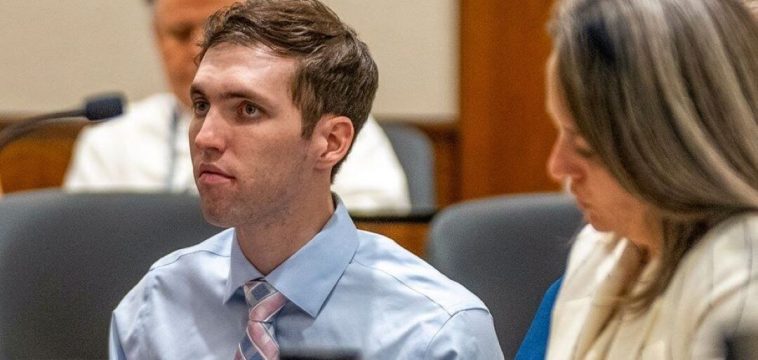
Robinson appeared in court wearing a blue dress shirt and tie during Friday’s proceedings. Observers noted he occasionally took notes while his attorneys presented their arguments.
The suspect faces extremely serious consequences if convicted. Prosecutors have indicated Robinson could face the death penalty for the September 10, 2025 killing of Kirk at Utah Valley University.
The defense has signaled it intends to present a significant amount of material during the April hearing focused on what it calls misleading media narratives and alleged privacy violations connected to the case.
According to court filings submitted by Robinson’s attorneys:
“Specifically, Mr. Robinson seeks to take evidence in a closed setting regarding the unfairly prejudicial and misleading media coverage and the improper statements of government officials in order to avoid republicizing the same. Mr. Robinson also asks this court to take evidence regarding the privacy violations detailed in the ‘motion to exclude cameras’ in a closed setting, to, again, avoid reiterating the violative material.”
Defense attorney Michael Burt argued the media coverage surrounding the case has already reached a level that could make a fair trial extremely difficult.
“We’ll show both that we have categories of prejudice that are recognized as presumptively prejudicial, and we’ll show that beyond that, the overall picture of this case is one of extreme prejudicial pretrial publicity that justifies the kind of relief we’re asking for,” Burt said.
Robinson’s legal team plans to present what they describe as some of the most damaging examples of media coverage during the upcoming hearing.
“While there is simply not enough time to present all of what is referenced in the ‘motion to exclude cameras,’ the compilation anticipated will highlight the most egregious and most concerning media coverage impacting Mr. Robinson’s case,” said the defense.
Prosecutors, however, strongly opposed the attempt to restrict public access.
Christopher Ballard argued that the justice system depends on transparency and that the public has a right to see how the case unfolds.
“We are not media lawyers, we are not representing the interests of the media,” Ballard said. “Our client is the people of the state of Utah who do have an interest in the public nature of these proceedings.”
With the judge’s ruling now in place, the April 17 evidentiary hearing is expected to become a major flashpoint in one of the most closely watched criminal cases in the country.
The outcome of that hearing could shape the path toward trial in a case that has already ignited intense national debate over politics, media coverage, and the limits of pretrial publicity in America’s justice system.

