
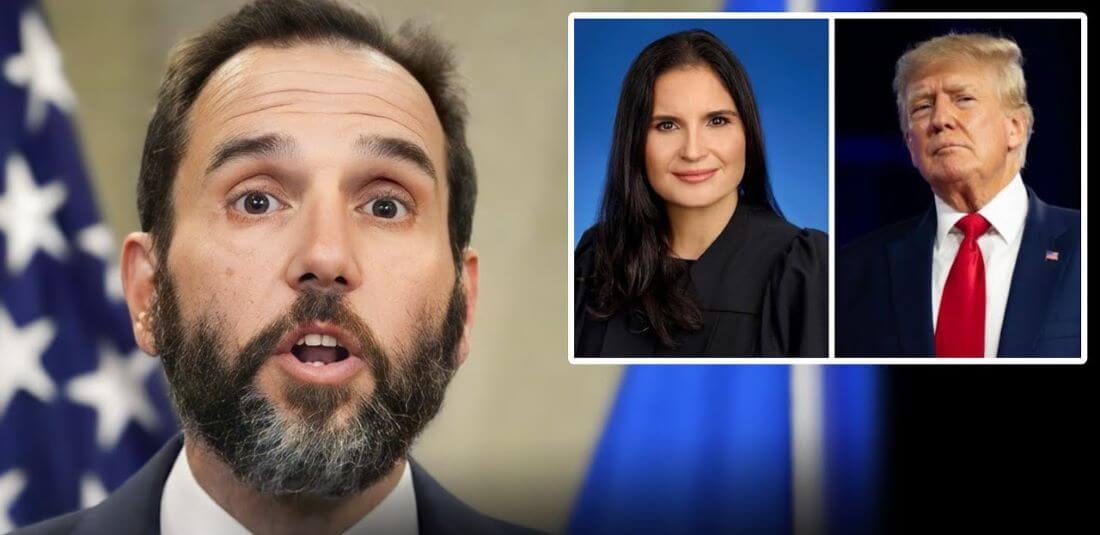
The Department of Justice’s recent victory in the DC appeal court was somewhat mitigated by Judge Aileen Cannon’s partial approval of Trump’s request to disclose particular discovery papers. Many had expected this judgment to go against Jack Smith’s desire for privacy.
Trump’s bid to have his federal election interference lawsuit dismissed was denied by the D.C. Circuit Court of Appeals, which ruled that presidential immunity does not apply.
Don’t miss this! Carry faith with you everywhere with the Exclusive National Prayer Coin!

Judge Cannon of Florida made the crucial choice to reveal some discovery information that Smith wished to remain confidential, highlighting the “strong presumption of public access in criminal proceedings.”
“Following an independent review of the Motion and the full record, the Court determines, with limited exceptions as detailed below, that the Special Counsel has not set forth a sufficient factual or legal basis warranting deviation from the strong presumption in favor of public access to the records at issue,” wrote Cannon.
Trump nominated Cannon to the US District Court for the Southern District of Florida, and the Senate approved him. In 2020, she took the judicial oath.
Smith sought to prevent information from leaking possible witnesses’ identities or other personally identifiable information or from igniting concerns about “witness safety and intimidation.”
ALERT! Major Water Restrictions In Effect!
“Although substantiated witness safety and intimidation concerns can form a valid basis for overriding the strong presumption in favor of public access, the Special Counsel’s sparse and undifferentiated Response fails to provide the Court with the necessary factual basis to justify sealing,” she documented.
“Notwithstanding the conventional filing procedure outlined in Local Rule 5.4(c), there shall be no filing under seal of any unclassified material in this case unless the party seeking to make a filing under full or partial seal first has sought and obtained permission from the Court through a motion for leave to file under seal,” the ruling maintained.
“The motion for leave shall be filed publicly except in clear and supported cases of risk to personal safety or national security.”
Due to Cannon’s involvement in the well-known lawsuit involving the former president Trump, she attracted worldwide notice. In the summer of 2022, she was tasked with supervising the legal procedures surrounding the FBI’s investigation of Trump’s Mar-a-Lago residence in Palm Beach, Florida. The handling of secret materials was the subject of an inquiry, which included this search.
The search warrant was approved by a different judge and said that the FBI was looking into any legal infractions pertaining to the Presidential Records Act and the handling of secret material.
Judge Cannon’s decisions in the case garnered the majority of her attention and criticism. Granting Trump’s request for a special master to examine the seized documents was one important move that put a temporary stop to federal investigators looking into the matter further.
The decision by Judge Cannon was noteworthy because it was a win for Trump’s legal team, who argued that the search was overly broad and raised questions about the potential illegal inspection of confidential data. Judge Cannon’s ruling was challenged by the Department of Justice, which claimed that the investigation may be hampered and that the appointment of a special master was not required.

