
>> Continued From the Previous Page <<
Rep. Valadao, one of the lead sponsors, emphasized the real-world impact of organized theft on American communities and small businesses, particularly in California’s Central Valley. “Organized retail crime and cargo theft are hurting small businesses and families across the Central Valley,” Valadao said. “These are coordinated criminal operations that put public safety at risk, disrupt supply chains, and drive up costs for consumers.”
He further stressed that the new proposal would provide law enforcement with stronger authority to pursue and dismantle these networks. “The CORCA Act gives law enforcement stronger tools to investigate and dismantle organized theft rings, and I’m especially proud to see language from my Safeguarding our Supply Chains Act included,” he added.

Valadao also highlighted the timing of the vote, stating, “This Police Week, I’m honored to help pass this bipartisan bill to hold criminals accountable and support the law enforcement officers working every day to keep our communities safe.”
The legislation includes a series of enforcement expansions outlined in a press release from supporters. Among them are provisions to strengthen criminal forfeiture authority in cases involving interstate transportation or sale of stolen goods, broaden money laundering statutes, and enable prosecution of organized retail and supply chain theft groups that use interstate or foreign commerce to facilitate illegal activity. The bill would also establish an Organized Retail and Supply Chain Crime Coordination Center within Homeland Security Investigations and the Department of Homeland Security.
Lawmakers and law enforcement officials have warned that increasingly sophisticated criminal enterprises are fueling much of the theft activity, with stolen goods often being resold through online platforms or storefront operations, generating illicit profits that may fund additional criminal activity.
Data cited by the National Retail Federation underscores the scale of the problem, reporting that retail theft surged by 93% between 2019 and 2023, with estimated losses reaching $121.6 billion in 2023 alone.
At the same time, cargo theft targeting rail systems, highways, warehouses, and distribution centers has continued to rise. According to CargoNet, incidents increased by 27% in 2024 compared to the previous year, signaling a growing threat to national supply chain stability.
Authorities note that modern cargo theft operations range from physical hijackings of shipping containers to complex cyber-enabled schemes designed to reroute shipments to fraudulent destinations, resulting in massive financial losses and widespread disruption across logistics networks.
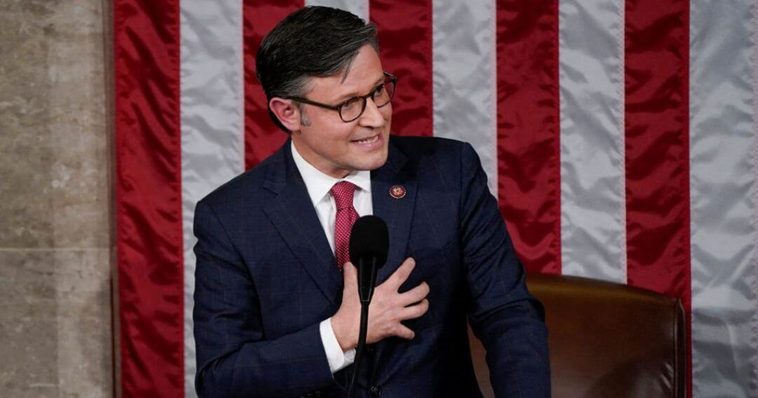
Separately, House Speaker Mike Johnson (R-La.) has recently indicated that additional legislation is being prepared to address funding concerns surrounding the Department of Homeland Security, which has been partially impacted by ongoing budget disputes.
Johnson has argued that maintaining strong immigration enforcement remains central to any funding agreement. “We have to make sure that immigration law is enforced, and the border is safe and secure,” he said, while also criticizing earlier Senate drafting efforts as insufficient.
The Senate would still need to approve any House-passed measure, setting up the potential for further partisan conflict, even as bipartisan momentum builds around cracking down on organized retail theft and supply chain crime.

