
>> Continued From the Previous Page <<
“One member of that team asked by a reporter, how many of the four points by which Obama won, how many of those points did he get from the tech team? And the guy said, Elon Kregel, I believe his name is, it was actually quoted, and he said, ‘two of the points came from us.’” This admission raises concerns about how much influence Google has over election outcomes. If this estimate is correct, a significant portion of Obama’s victory may have been orchestrated by unseen forces.
As Epstein continued, he explained the vast scale of manipulation that Google may have exerted by the 2016 election. “By 2016, I had calculated that Google could shift, and it would be toward Hillary Clinton, of course, whom I supported at the time, that Google could shift between 2.6 and 10.4 million votes to Hillary Clinton in that election with no one knowing. She won the popular vote by 2.8 million votes. If you take Google out of that election, the popular vote would have been tied.”

This startling calculation suggests that the 2016 election could have ended differently without Google’s influence. Epstein, a Clinton supporter, admitted that the company’s algorithms might have had the power to determine the outcome of the popular vote, raising ethical questions about Big Tech’s role in democracy.
In recent years, Epstein has conducted extensive research into Google’s ability to manipulate voters through “ephemeral experiences,” a term describing content that influences opinions without leaving a lasting trace. In a 2022 article for the Daily Caller, Epstein revealed that Google and other tech giants are shifting opinions using this subtle method.
“We have so far preserved more than 1.9 million ‘ephemeral experiences’ – exposure to short-lived content that impacts people and then disappears, leaving no trace – that Google and other companies are able to use to shift opinions and voting preferences, and we expect to have captured more than 2.5 million by Election Day,” Epstein wrote.
Ephemeral experiences are difficult to detect and, therefore, harder to regulate. Emails leaked in 2018 showed that Google employees were aware of how these tactics could be used to change people’s views, particularly regarding President Trump and his policies, including the travel ban that was widely labeled as a “Muslim ban” by the media and tech platforms.
By 2020, Epstein had developed a system to track these ephemeral experiences. He claims that Google was responsible for shifting millions of votes toward Joe Biden. “Our data show that Google shifted at least 6 million votes to Joe Biden who won the popular vote by about 8 million. So again, take Google out of the equation, that would have been pretty much a tie in the popular vote, and Trump would have won 11 out of 13 swing states instead of five.”
TRUMP LOVES IT: Get the Presidential Blanket FREE Today! Supplies Running Out – Grab Yours NOW! 🕒👇
The implications of these findings are enormous, suggesting that Big Tech companies like Google may have the power to swing entire elections. If left unchecked, this could undermine the very foundations of democracy.
As Epstein pointed out, the rise of this unchecked power is not entirely unexpected. He referenced former President Dwight D. Eisenhower’s famous farewell speech, where the president warned about the potential rise of a technological elite. Eisenhower’s words seem prophetic in today’s world, where a handful of companies hold enormous sway over public policy and election outcomes.
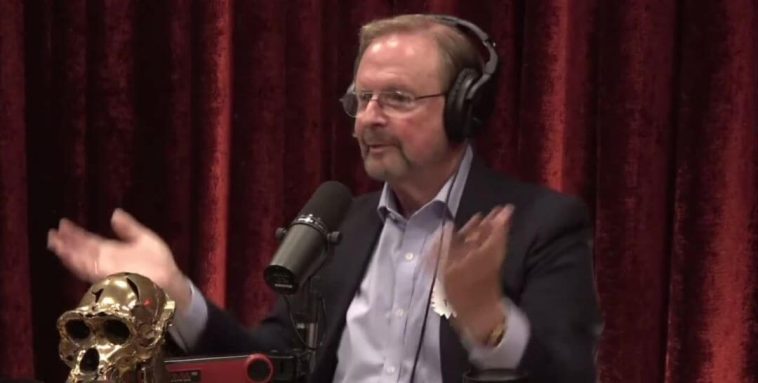
“So going forward from roughly 2012, I think the free and fair election has been an illusion, an illusion,” Epstein told Rogan. He emphasized that the warnings Eisenhower gave over half a century ago about the military-industrial complex now extend to tech companies. “The technological elite are now in control.”
Epstein’s research and warnings paint a disturbing picture of the future of elections. As tech giants like Google continue to grow in influence, the question arises: Are free and fair elections still possible in the digital age? For Epstein, the answer is clear: Without action, the future of democracy is at risk.

