
>> Continued From the Previous Page <<
Wang reportedly told Dar that Pakistan should “maintain confidence” and “step up mediation efforts” between the U.S. and Iran.
The Chinese official also highlighted concerns surrounding the Strait of Hormuz, one of the world’s most strategically critical shipping lanes, amid fears that regional instability could threaten global energy markets.

Wang “commended Pakistan for encouraging dialogue between the United States and Iran and for assisting in extending the provisional ceasefire,” a Chinese Foreign Ministry official said in a summary of the phone discussion.
He expressed hope that “Pakistan will maintain confidence, step up mediation efforts, and contribute to properly resolving the issue of opening the Strait of Hormuz and the early restoration of regional peace, which is also the common aspiration of the international community.”
Chinese Foreign Ministry spokesperson Lin Jian later reinforced Beijing’s position publicly.
“China will continue to support Pakistan’s mediation efforts and make its own contribution toward this end,” Lin said.
Pakistan has increasingly emerged as a go-between in recent months as tensions between Iran and the United States escalated following stalled negotiations and mounting military concerns in the region.
Even after controversy erupted over reports that Pakistan permitted Iranian military aircraft to remain stationed on its airfields, Islamabad has continued trying to steer both sides back toward diplomatic discussions.
Those efforts, however, appeared to lose momentum shortly before Trump’s arrival in China.
Just two days earlier, Trump blasted Iran’s response to the latest American peace proposal, calling Tehran’s answer “totally unacceptable.” The sharp rebuke fueled speculation that negotiations could be nearing collapse at a time when global leaders are scrambling to avoid broader regional conflict.
Meanwhile, Trump’s visit to China has drawn enormous international attention not only because of the Iran issue, but also because of the heavyweight business delegation traveling alongside the president.
Among those aboard Air Force One was Elon Musk, whose growing influence on trade and technology policy has become impossible to ignore.
Fox News star Sean Hannity was also part of the delegation.
One of the biggest surprises came when Jensen Huang reportedly joined the trip during a refueling stop in Anchorage, Alaska. Huang’s addition was especially notable after earlier reports claimed he was not included in the official business entourage.
Trump himself later confirmed on Truth Social that Huang was indeed aboard Air Force One.
The president also revealed a stunning list of American corporate leaders participating in the trip, signaling the enormous economic stakes surrounding the Beijing summit.
Executives accompanying Trump reportedly included Tim Cook of Apple, Larry Fink, Stephen Schwarzman, Kelly Ortberg, Jane Fraser, David Solomon, Cristiano Amon, and several others representing America’s financial, aerospace, and technology sectors.
Trump made clear before landing that economic negotiations would be front and center during his discussions with Xi.
In a Truth Social post, Trump said one of his first priorities would be convincing China to “open up” its markets to American companies. He also blasted a CNBC report claiming Huang was absent from the trip, saying the report was inaccurate.
Beyond trade, officials from both countries are expected to tackle several volatile geopolitical flashpoints during the summit, including Taiwan, artificial intelligence, and the ongoing Iran crisis.
Beijing has reportedly made Taiwan policy one of its top priorities heading into the talks, while Trump is expected to press Chinese officials on trade fairness and the security of the Strait of Hormuz.
Trump originally announced plans for the Beijing visit during his October meeting with Xi at the Busan summit in South Korea.
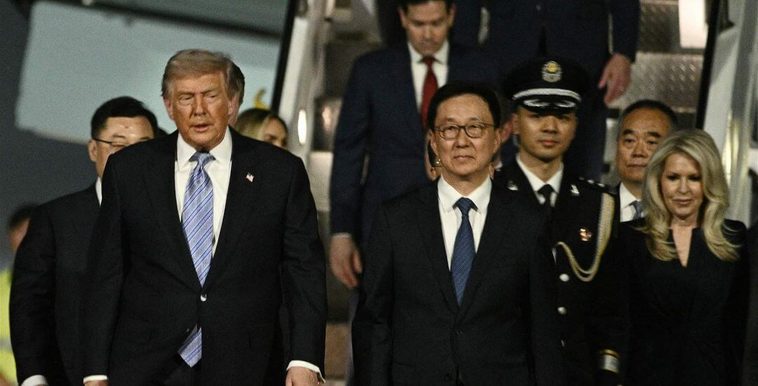
Air Force One officially arrived at Beijing Capital International Airport at approximately 7:51 a.m. ET. After taxiing for several minutes, Trump emerged from the aircraft for a formal welcome ceremony.
The president was greeted by Chinese Vice President Han Zheng, U.S. Ambassador to China David Perdue, Chinese Ambassador to the United States Xie Feng, and Executive Vice Minister of Foreign Affairs Ma Zhaoxu.
The arrival ceremony featured hundreds of Chinese youth participants, a military honor guard, and a military band as children shouted greetings welcoming the American president to Beijing.

