
“We power 1.5 million homes and businesses. Everything’s on the table. I’ll do whatever it takes,” Ford said at a news conference.
Ford then escalated his rhetoric even further.
“You won’t get a grain of sand out of Ontario,” he added.

Ontario is a major supplier of electricity to parts of the United States, with power connections serving Michigan, New York and Minnesota. Ford suggested that those exports could now become a bargaining chip in the growing dispute.
In addition to electricity, Ford also raised the possibility of limiting American access to critical minerals controlled or produced by Ontario.
The comments came as the Canadian government in Ottawa was already preparing its own retaliatory measures in response to the latest U.S. tariffs. Canadian officials had announced plans to answer Washington’s actions with tariffs of their own, but Ford’s decision to place energy and mineral exports on the table marked a significant escalation.
The dispute quickly turned personal.
Trump responded on Truth Social with a blistering attack on Ford, referring to him as the “overall unimpressive brother of the late, great, Rob Ford,” the former Toronto mayor who died in 2016.
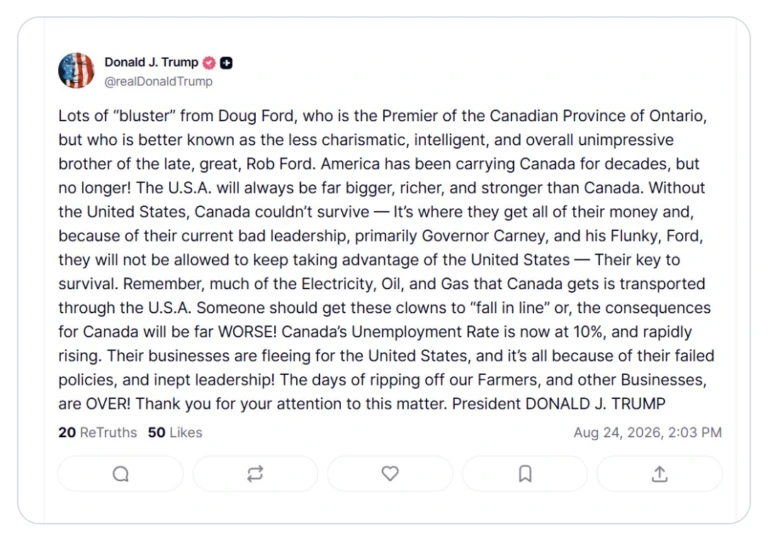
The president also placed responsibility for the deteriorating relationship on Canadian Prime Minister Mark Carney and Ford, accusing the country’s leaders of creating their own problems through poor leadership.
Trump blamed Canada’s position on “bad leadership” from Carney and “Flunky Ford.”
He urged the Canadian officials to “fall in line.”
Ford, however, was in no mood to soften his position.
“kiss my a–.”
The public exchange underscores just how quickly the trade fight has moved beyond negotiations over tariffs and into a broader political confrontation between leaders on both sides of the border.
This is also not the first time Ford has threatened to use Ontario’s electricity exports as a weapon in a dispute with Washington.
During an earlier trade conflict last year, Ford similarly suggested that Ontario could restrict power flowing into the United States. The tensions eventually cooled after Ford met with Commerce Secretary Howard Lutnick, leading to bilateral discussions that helped prevent the situation from escalating further.
Whether the same type of resolution can be reached this time remains to be seen.
The latest dispute now carries potentially serious consequences for businesses, workers and consumers on both sides of the border. A prolonged tariff war could increase costs for Canadian exporters and American importers while raising concerns about supply chains and energy security.
Canada’s Conservative Party leader Pierre Poilievre is also calling for greater transparency from the government as the confrontation intensifies.
“As Canadians are vulnerable to an escalating trade war with the United States, Parliament must be reconvened. Canadians deserve answers on how trade talks collapsed, what tariffs will cost their families, and how their jobs will be protected,” Poilievre said Monday in a post on X.
His statement reflects growing concern that the political battle could soon have direct consequences for ordinary Canadians.
For now, neither side appears ready to back down.
Trump has responded to Canada’s resistance with steep tariffs and increasingly sharp rhetoric, while Ford is signaling that Ontario is willing to target resources the United States relies on, including electricity and critical minerals.
What began as another dispute over trade policy is now threatening to develop into a much broader economic showdown.
And with Ford declaring that “Everything’s on the table,” the pressure is mounting on both Washington and Ottawa to determine whether negotiations can be revived before the tariff battle expands even further.

