
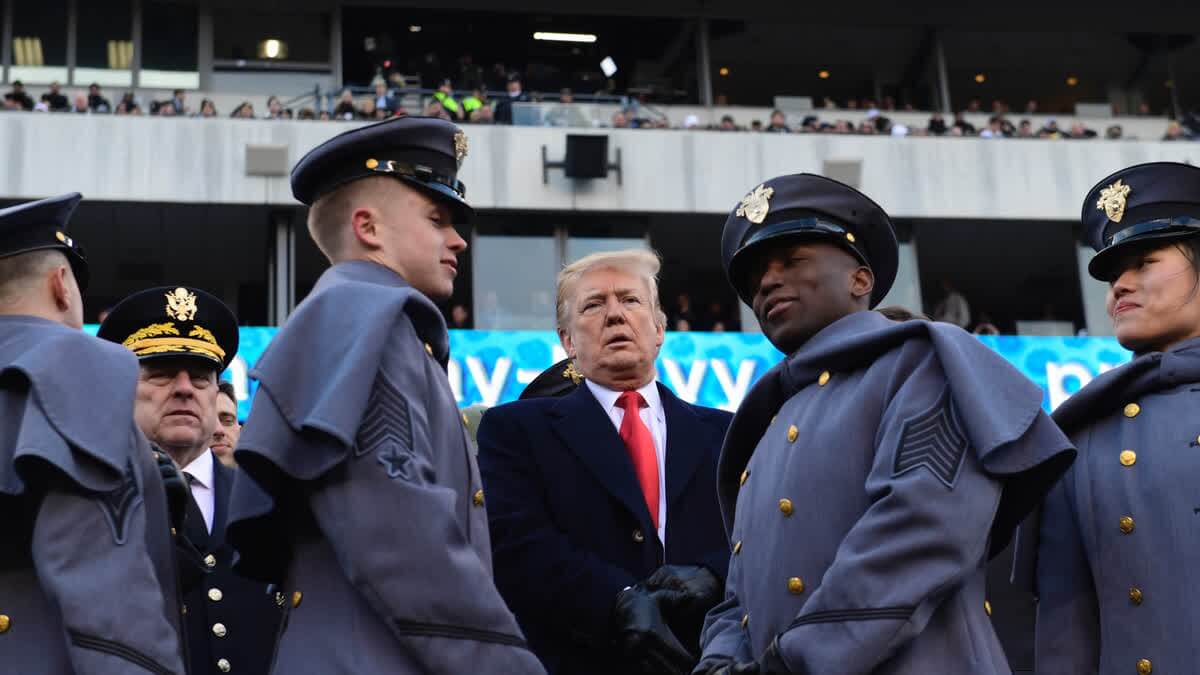
Trump makes a startling admission on his presidency: How he was prohibited from employing the military to quell violent demonstrations in cities controlled by Democrats
The front-runner for the Republican presidential nomination in 2024, referring to Chicago and New York City as “crime dens,” said to his audience, “The next time, I’m not waiting. One of the things I did was let them run it, and we’re going to show how bad a job they do,” he said. “Well, we did that. We don’t have to wait any longer.”
Don’t miss this! Carry faith with you everywhere with the Exclusive National Prayer Coin!

It’s unclear what Trump would like to do with the military if he wins a second term. He and his group have, nonetheless, made suggestions that they may use their authority to summon units whenever they see fit. This would be different from the way the military has traditionally been deployed within the country. In the event that Trump wins reelection, he has already laid out a radical program that includes visa restrictions and mass deportations aimed at particular nations where the main population is Muslim.
Legal and military experts claim that a statute enacted in our country’s early years may give President Trump virtually limitless authority.
Presidents can use the Insurrection Act to their advantage and use active-duty or reserve military forces to put an end to internal unrest inside states. There was just one drawback to this unchallenged power: the president had only to request that everyone engaged leave.

“The principal constraint on the president’s use of the Insurrection Act is basically political, that presidents don’t want to be the guy who sent tanks rolling down Main Street,” stated Joseph Nunn, a Brennan Center for Justice national security specialist. “There’s not much really in the law to stay the president’s hand.”
Despite being asked many times to comment on the source of authority for Trump’s intentions, the campaign spokesperson for the president said nothing.
Learn about the history of the legislation that Congress enacted in 1792, just four years after the adoption of the Constitution. Discover how it incorporates a number of legislation from the late 1700s through the 1870s, a time when there was little local law enforcement.
“It is a law that in many ways was created for a country that doesn’t exist anymore,” he said.
Find out about a remarkable exemption to the well-known Posse Comitatus Act, which limits the use of military force in law enforcement.
ALERT! Major Water Restrictions In Effect!
One of Trump’s audacious proposals for the presidency is to station military forces in high-crime areas and at the border. In addition, he wants to fight international drug traffickers with the military. Prominent Republicans like former U.N. ambassador Nikki Haley and Florida governor Ron DeSantis endorse these policies.
Threats like these have unleashed a tsunami of uncertainty and forced a crucial conversation about presidential power, military vows, and possible friends Trump may find.
Former national security advisor to the president, retired Army Lt. Gen. Michael Flynn, was mentioned by Trump. Flynn suggested that Trump seize voting equipment and send the military to some states so that the 2020 election could be held again.
The incoming chairman of the Joint Chiefs of Staff at the Pentagon, Gen. Charles Q. Brown, would probably object to any attempt to deploy the Insurrection Act and the military for domestic law enforcement. He was one of the eight Joint Chiefs members that wrote a letter to military forces during the U.S. Capitol uprising on January 6, 2021. The message referred to the activities of that day as “sedition and insurrection” and stressed the vows they had taken.
Nonetheless, there is still a lot of support for Trump and his party among veterans. According to AP VoteCast, a comprehensive nationwide survey of over 94,000 voters, 59% of American veterans of the armed forces supported Trump in the 2020 presidential contest. 57 percent of veterans of the armed forces backed Republican candidates in the 2022 midterm elections.
According to Nunn, there have been 40 presidential proclamations citing the statute, some of which have been issued more than once for the same problem. Three times, in Baltimore, Chicago, and Washington, Lyndon Johnson invoked it in reaction to the rioting that followed Dr. Martin Luther King Jr.’s 1968 killing.
Presidents Johnson, Kennedy, and Eisenhower employed the statute to shield desegregating students and activists during the Civil Rights Movement. After the governor of that state called in the National Guard to keep the black students out of Central High School, Eisenhower dispatched the 101st Airborne to Little Rock, Arkansas, to guard the integration of the pupils.
The last president to employ the Insurrection Act was George H.W. Bush, who did so in reaction to riots in Los Angeles in 1992 following the acquittal of white police officers who had physically assaulted black driver Rodney King in a well-documented incident.
In a Trump administration, repeated attempts to use the act may exert pressure on military chiefs, who might be held accountable for their deeds even if they were carried out on the president’s orders.
Do the military’s training programs for aspiring officers have enough creativity? asks Michael O’Hanlon, the Brookings Institution’s head of international policy studies. He draws attention to how uncomfortable military people are with uncertainty, especially when force is involved.
“There are a lot of institutional checks and balances in our country that are pretty well-developed legally, and it’ll make it hard for a president to just do something randomly out of the blue,” O’Hanlon, a specialist in military force and U.S. defense policy, stated. “But Trump is good at developing a semi-logical train of thought that might lead to a place where there’s enough mayhem, there’s enough violence and legal murkiness” to call in the military.
The first American military academy alumnus to represent the West Point-area congressional district, Democratic Representative Pat Ryan of New York, stated he took the oath three times while attending the academy and once more during his stint in the military. According to him, a significant portion of the curriculum focused on an officer’s obligations to the Constitution and the subjects of their authority.
“They really hammer into us the seriousness of the oath and who it was to and who it wasn’t to,” he said.
Although Ryan believed that everyone understood it, he claimed that January 6th “was deeply disturbing and a wake-up call for me.” In relation to the event, a number of active-duty military officers and veterans were charged with offenses.
Although the ties were concerning, he stated that he believes a relatively tiny portion of the military consists of people who share similar beliefs.
According to William Banks, a national security law specialist and law professor at Syracuse University, a military officer is not required to obey “unlawful orders.” Due to the possibility of being charged with engaging in illegal activity, this might put leaders of units called upon for domestic policing in a challenging situation.
“But there is a big thumb on the scale in favor of the president’s interpretation of whether the order is lawful,” Banks said. “You’d have a really big row to hoe, and you would have a big fuss inside the military if you chose not to follow a presidential order.”
Nunn suggests steps to restrict the application of the legislation and maintains that military members cannot be coerced into breaking it.
“Members of the military are legally obliged to disobey an unlawful order. At the same time, that is a lot to ask of the military because they are also obliged to obey orders,” he said. “And the punishment for disobeying an order that turns out to be lawful is your career is over, and you may well be going to jail for a very long time. The stakes for them are extraordinarily high.”

