
>> Continued From the Previous Page <<
Her defense comes as Congress continues to press for clarity on the scope and completeness of the Epstein file disclosures, with both Republicans and Democrats questioning whether additional documents remain unreleased.
Bondi did acknowledge that the massive document review process was not without errors. She pointed specifically to redaction failures in which sensitive victim information was inadvertently exposed during portions of the release. Still, she described the overall effort as an enormous and unprecedented undertaking.

“We demonstrated an unprecedented commitment to transparency in the Department’s search for, collection, and review of the Epstein files,” Pam Bondi said, noting that approximately three million pages of material were ultimately reviewed and released.
According to accounts from the interview, Bondi told investigators she had delegated key oversight responsibilities for the document production process to then-Deputy Attorney General Todd Blanche, who now serves as acting attorney general.
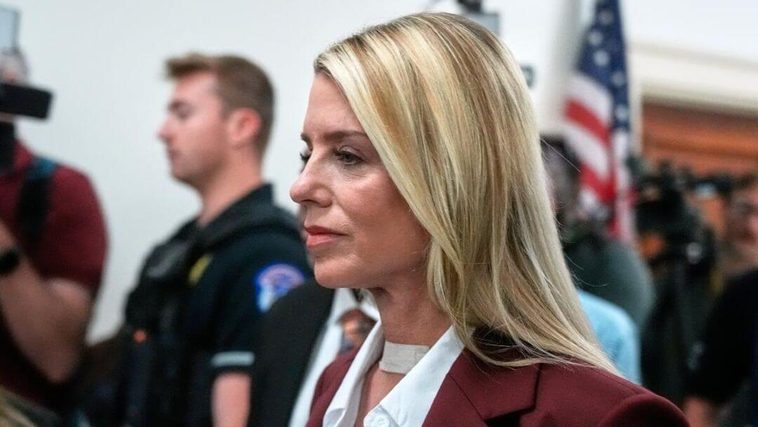
The hearing marked Bondi’s first extensive public defense of the Epstein-related handling since leaving office in April. She arrived on Capitol Hill visibly recovering from recent medical treatment, including wearing a bandage on her neck following thyroid cancer care.
Republican lawmakers on the panel largely focused their questioning on whether additional records could still be legally released and whether the department had fully complied with disclosure requirements under the Epstein Files Transparency Act.
Committee Chairman James Comer said lawmakers were determined to get answers on what materials remain withheld and whether more transparency is possible.
“We’re going to try to determine whether or not there can be more documents legally turned over,” James Comer said ahead of the interview. “I want every document. I don’t want anything held back.”
Democrats, meanwhile, used the closed-door setting to challenge Bondi’s refusal to discuss private communications involving President Donald Trump. According to lawmakers present, Bondi declined to answer questions about any such conversations, citing executive privilege and longstanding protections applied to high-level presidential communications.
Rep. Melanie Stansbury accused Bondi of withholding potentially relevant information tied to the government’s handling of Epstein-related records, intensifying partisan tensions during the session.
Other Democrats criticized the decision to hold the hearing behind closed doors, arguing that the public should have been able to observe testimony on such a high-profile investigation.
The debate over Trump’s historical ties to Epstein resurfaced repeatedly during questioning, with Democrats arguing Bondi could have addressed the matter more directly but chose not to.
At the same time, recently released Justice Department materials have reportedly complicated some of the long-standing narratives surrounding Trump’s relationship with Epstein. One document cited in earlier disclosures indicated Trump was among the first individuals to raise concerns with Palm Beach authorities about Epstein’s conduct.
Records state that in 2006, Trump contacted Palm Beach Police Chief Michael Reiter while Epstein was under investigation, allegedly stating, “Thank goodness you’re stopping him; everyone knows he’s been doing this.”
Other documents also reportedly describe Trump acknowledging encounters with Epstein in the presence of teenage girls and subsequently distancing himself from him.
Bondi also addressed questions related to convicted Epstein associate Ghislaine Maxwell. According to sources familiar with her testimony, she stated she opposes any form of clemency and believes Maxwell should serve her full sentence without interruption.
Maxwell is currently serving a 20-year federal prison sentence following her conviction on sex trafficking charges connected to Epstein’s criminal network.
The controversy surrounding the handling of Epstein-related materials comes roughly 15 months after Bondi initially pledged to release additional records, and months after Congress passed the Epstein Files Transparency Act requiring the Justice Department to disclose investigative documents.
Despite ongoing disputes over what remains unreleased, Bondi maintained that the Justice Department’s actions represent the most extensive public disclosure effort related to the Epstein case in U.S. history.

