
>> Continued From the Previous Page <<
“In a pursuit of a world without borders, we opened our doors to an unprecedented wave of mass migration that threatens the cohesion of our societies, the continuity of our culture, and the future of our people,” Rubio said.
A major theme of Rubio’s speech focused on shared religious heritage. He emphasized that Christianity is not merely a private belief system, but a civilizational foundation that shaped laws, moral norms, and institutions on both sides of the Atlantic. America, he noted, was built by Europeans who brought with them “the memories and the traditions and the Christian faith of their ancestors as a sacred inheritance.”

Rubio further highlighted the diverse European roots that helped shape the United States — from English common law to the Scots-Irish spirit of independence, German farming traditions, and French exploration. His point was simple but deliberate: America did not emerge in isolation. It is the product of centuries of European culture transplanted to a new continent.
That historical argument extended to the mythology of the American West. In a line that would later spark controversy, Rubio said, “Our horses, our ranches, our rodeos — the entire romance of the cowboy archetype that became synonymous with the American West — these were born in Spain.”
The statement reflected well-documented history. Long before Hollywood cowboys, Spanish vaqueros developed the techniques, equipment, and traditions that later evolved in the American Southwest. Historians have repeatedly confirmed this lineage, though critics of Rubio’s speech seemed less interested in historical accuracy than political signaling.
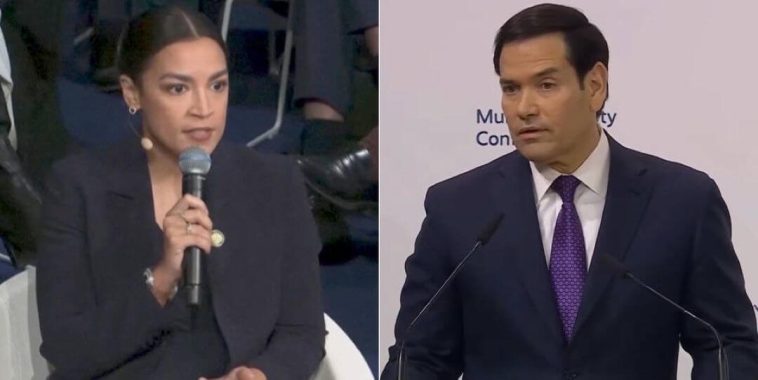
Inside the conference hall, Rubio’s remarks were met with enthusiastic applause. Outside of it, however, progressive activists and politicians reacted sharply — none more visibly than Ocasio-Cortez.
Speaking at a separate event in Berlin hosted at TU Berlin, alongside German parliamentarian Isabel Cademartori, Ocasio-Cortez was asked about economic inequality. Instead of addressing fiscal policy, she pivoted to Rubio’s speech.
“You are starting to see the ascent of the right, even in places like Munich,” Ocasio-Cortez said. “Marco Rubio’s speech was a pure appeal to Western culture.”
She then mocked Rubio’s cowboy reference, telling the audience, “My favorite part was when he said that American cowboys came from Spain. I believe the Mexicans and descendants of African slave— enslaved peoples would like to have a word on that.”
Critics were quick to point out that Rubio never denied the role of Mexico or African Americans in shaping cowboy culture. Rather, he referenced the historical origins of those traditions — origins that began in Spain and were carried through Spanish colonial expansion. Many saw Ocasio-Cortez’s remarks as a deliberate mischaracterization.
Ocasio-Cortez reframed the discussion through a class-based ideological lens, arguing that politics should be “material, it’s class-based, it’s common interest,” while condemning what she called “the hypocrisy towards the global south.”
Yet observers noted that Rubio’s speech was never about class warfare. It was about preserving a shared civilizational identity at a time of global instability, mass migration, and cultural fragmentation. His argument was that history, faith, and mutual sacrifice are what bind Western nations together — and that ignoring those realities weakens the alliance.
Rubio exited the Munich stage to a standing ovation. Ocasio-Cortez exited her event facing criticism that her response, focused on ideological grievance, missed the central message entirely.

