
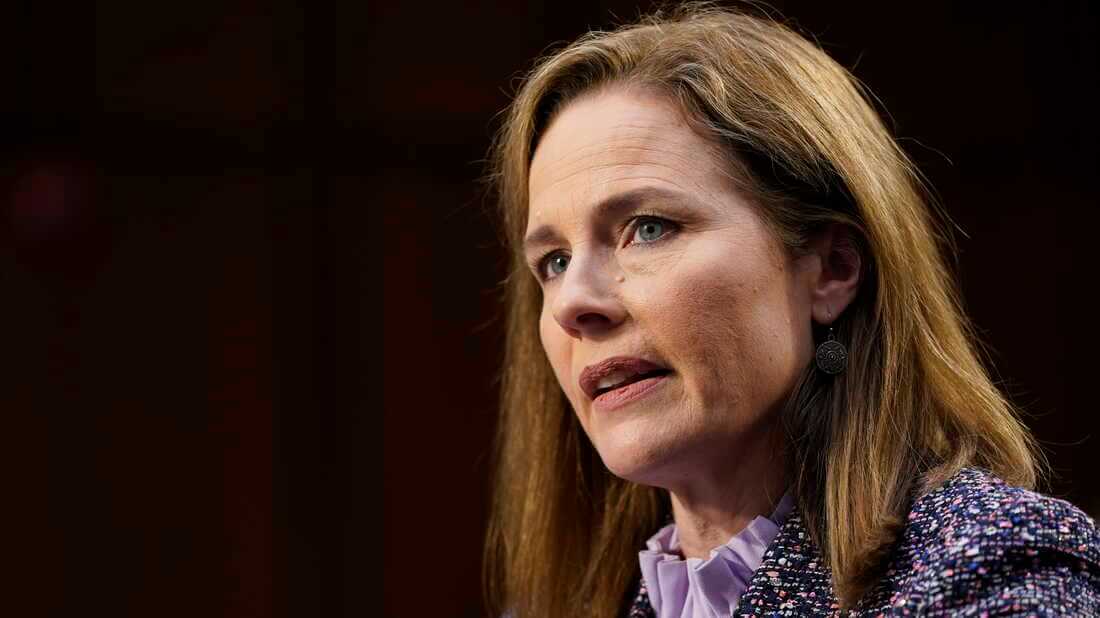
The conservative majority of the Supreme Court has come under fire for its decision to overturn Roe v. Wade’s precedent, which provoked a ferocious outcry from activists throughout America.
The uproar was just the beginning of what will happen next.
Justice Amy Coney Barrett of the Supreme Court recently learned something unflattering from an unexpected source.

JUST IN: Trump 24K Golden Dollars – Available Now!
In a landmark decision, the Supreme Court recently supported the Food and medication Administration’s application to authorize the abortion medication mifepristone, advancing reproductive rights in America.
Due to the FDA’s inability to show the safety of mifepristone when used with novel prescription techniques, a U.S. District Judge has blocked the drug’s approval.

The FDA has granted physicians previously unheard-of discretion to provide pregnant patients access to mifepristone in a ground-breaking decision. This judgment has rendered several pro-life legislation in numerous states outdated and gives people more freedom to choose their own reproductive health wherever they may be.
The Fifth Circuit Court of Appeals has declared in a historic judgment that physicians may perform pharmacological abortions using mifepristone up until seven days into a pregnancy. By upholding a nearly 20-year-old permission for this procedure, this decision was made feasible, creating a precedent and providing comfort to people in need of reproductive health care.
A Supreme Court majority allowed previously blocked legal proceedings to proceed as the case advanced.
The phrase “shadow docket” was first used in 2015 by William Baude, a professor of law at the University of Chicago, to describe a number of judgments that were made but kept secret by a discreet authority.
The shadow docket is defined by Baude as:
Beyond the usual merits issues, the Supreme Court rendered a number of decisions that have largely gone unreported but are essential to comprehending its operations. Even the Justices are unsure if they all concur on these shadow docket decisions, which give stays and injunctions with no clear legal basis, raising numerous questions. We must take the time to research this branch of government’s less well-known actions as well if we want to understand it completely.
With their shadow docket, the Supreme Court puts cases out of the public sight so they can quickly decide on important policy matters. They have seven days to decide whether to refuse to hear a case or to approve the government’s request for an emergency stay of lower court orders.
Elena Kagan and Sonya Sotomayor, two liberal Supreme Court justices, had publicly criticized his methods for numerous years, and their objections ultimately had to be taken seriously.
Justices Samuel Alito and Clarence Thomas distinguished themselves by dissenting from the Supreme Court’s decision on mifepristone.
Given his staunchly conservative background, no one was surprised by Alito’s momentous decision to reverse the cherished Roe v. Wade judgment, which demonstrated his anti-abortion attitude.
In his forceful dissent, Justice Alito called Justices Kagan, Sotomayor, and Barrett hypocrites, which sent shockwaves across the court.
Justice Alito harshly scolded the trio for questioning a murky legal procedure, but he quickly welcomed it as a chance to support a medicine that allows abortionists to get around Republican politicians’ Pro-Life laws.
“I did not agree with these criticisms at the time, but if they were warranted in the cases in which they were made, they are emphatically true here,” Justice Alito wrote.
Learn more about this fascinating story by staying up to date with USA First Reporting newest news!

