
>> Continued From the Previous Page <<
Because what the AI-assisted rewrite actually did was not cosmetic—it fundamentally changed the framing of law enforcement terminology.
In the original DHS language, the individuals involved were described in blunt legal terms. After the AI processing, key descriptors were softened or removed entirely. For example, “Criminal illegal aliens” became “individuals.”

In another instance, “Criminal illegal alien” became “national.”
Even more controversially, the phrase “released by Biden” was removed entirely from the edited version, effectively stripping away any explicit reference to federal policy responsibility.
Critics argue this was not a simple editorial cleanup, but a deliberate reframing of language that softened criminal and immigration status while removing politically sensitive attribution.
As one analyst described it, this was not an autocorrect issue or a harmless rewrite. It represented what appears to be a structured editorial decision to pass official federal law enforcement language through an AI filter that systematically removed terms considered politically charged.
The underlying arrests that triggered the DHS statement occurred Thursday outside the Rancho Cucamonga courthouse in California. According to federal authorities, at least one suspect had to be pursued on foot before being taken into custody.
ICE and CBP officials said the operation specifically targeted individuals with prior immigration violations and criminal histories.
One of those arrested was identified as Godofredo Chiquete-Lopez, a Mexican national who originally entered the United States on a tourist visa and remained in the country for more than 16 years beyond its expiration. Authorities say Chiquete-Lopez had previously been arrested for assault with a deadly weapon and hit-and-run offenses.
Despite an ICE detainer being issued and sent to San Bernardino authorities, that request was not honored. He was released back into the community.
Another individual, Alexander Pacheco-Sabogal of Colombia, also had a prior battery arrest and an outstanding immigration detainer that was ignored. DHS records indicate he was previously released into the United States in 2022 near San Luis, Arizona under Biden administration policies. He was later ordered removed by an immigration judge in 2023 after failing to appear at his hearing.
A third man, Cesar Andres Mendez-Garzon, also from Colombia, entered the country illegally in 2023 near Lukeville, Arizona and was released. He was subsequently ordered removed in 2025 after failing to appear for court proceedings.
In total, authorities point to a pattern of ignored detainers and repeated releases despite prior arrests or pending immigration cases.
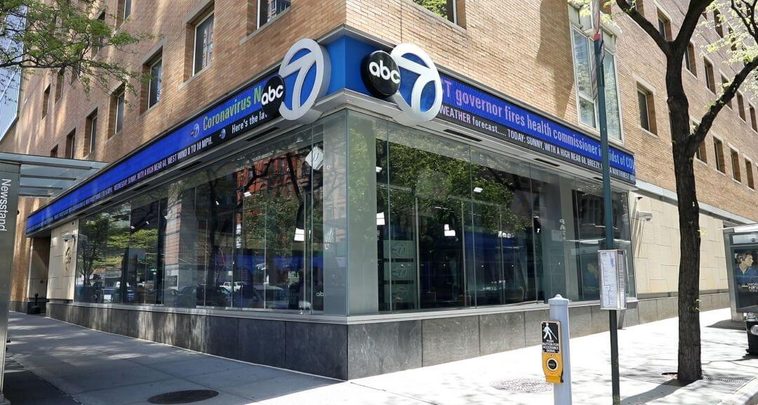
The controversy escalated further when ABC7 aired commentary from an immigration advocate, Hector Pereyra of the Inland Coalition for Immigrant Justice, who warned that the courthouse arrests “could lead to an escalation of violence because federal agents are being trained to escalate.”
At the same time, ABC7 aired its AI-edited DHS statement, which critics say stripped away the full weight of the federal government’s warning.
The original DHS statement included the line: “7 of the top 10 safest cities in the United States cooperate with ICE. Sanctuary policies have consequences, and unfortunately, they are the murder, rape, assault, robbery, or drug overdose of American citizens.”
That language, however, did not appear in the edited framing used by ABC7 in its initial reporting.
Instead, critics argue, the sanitized version reduced individuals with serious criminal histories and immigration violations to vague terminology, including the term “individual.”
After DHS publicly challenged ABC7 online and accused the outlet of falsely claiming no response had been received—a claim DHS described as misleading—the affiliate later updated its website to include the full, unedited statement.
For critics of mainstream media practices, the incident is being held up as a striking example of how artificial intelligence, combined with editorial discretion, can reshape politically sensitive reporting in real time.
Supporters of press accountability argue that the issue is not just about AI usage, but about transparency: who decides what language gets softened, what details get removed, and what the public ultimately gets to see.
DHS has made its position clear. The agency believes sanctuary policies carry real-world consequences and has repeatedly tied those consequences to violent crime and public safety risks.
ABC7, meanwhile, is now facing scrutiny over how and why official federal language was altered before publication—and whether AI was used not just as a formatting tool, but as a filter that changed the story itself.

