
>> Continued From the Previous Page <<
Security sources have described the situation as Hezbollah’s “biggest security breach” since their ongoing conflict with Israel began. While the exact cause of the detonations remains unclear, many are speculating that this could be the result of an Israeli operation, likely involving Mossad. Reuters quoted three security sources confirming that the pagers, critical for Hezbollah’s internal communications, had been recently imported.
In a major embarrassment for Hezbollah, even their key ally Iran has not been spared. Iranian media reported that Mojtaba Amani, the Iranian ambassador to Lebanon, was among those injured in the blasts. This has only deepened the sense of failure for Hezbollah, whose ties with Iran have been instrumental in sustaining their military operations and technological communications network.

The backfiring of these Iranian-supplied communication devices has raised serious questions about Hezbollah’s operational security. Despite their well-established relationship with Iran, which supplies them with arms and technology, this incident has exposed vulnerabilities that could have long-term consequences for the group.
Lebanon’s Prime Minister Najib Mikati, during a cabinet meeting on Tuesday, strongly condemned what he called “criminal Israeli aggression.” His statement, broadcast by the state-run NNA news agency, framed the attack as not only a violation of Lebanon’s sovereignty but a “crime by all standards.” Mikati’s government has already reached out to the United Nations and other international bodies, calling for immediate action.
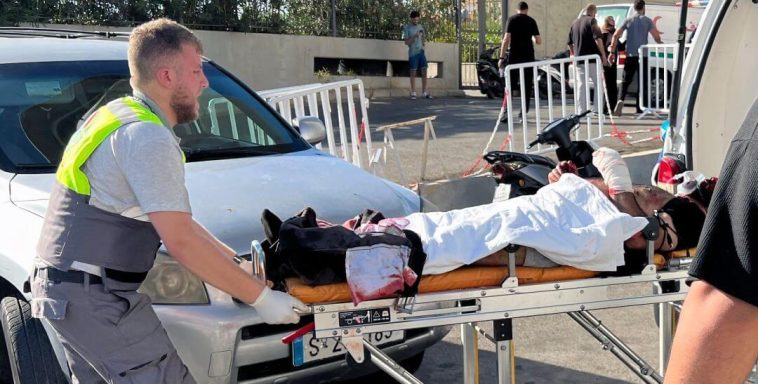
The Lebanese Red Cross, along with the crisis operations center run by the health ministry, has mobilized over 50 ambulances and 300 emergency medical personnel. The operation center asked all medical workers to head to hospitals to treat the injured. Medical authorities also issued a critical warning—under no circumstances should medical personnel use pagers.
Given the number of wounded, Lebanese hospitals have been pushed to their limits. With the pagers seemingly at the center of the chaos, authorities are still investigating how the devices were detonated. Some reports speculate that Israel could have orchestrated the explosions remotely, though this remains unconfirmed.
In a rare acknowledgment of their losses, Hezbollah issued a statement confirming the death of two of their fighters and a young girl. “At approximately 3:30pm on Tuesday 09-17-2024, a number of message receiving devices known as ‘pagers’ exploded, which were owned by a number of workers in various Hezbollah units and institutions,” the group announced. Despite their losses, Hezbollah refrained from explicitly blaming Israel for the explosions, though speculation runs high.
This acknowledgment has only fueled the belief that Hezbollah may have suffered a carefully orchestrated blow, perhaps engineered by Israel’s intelligence services.
In addition to Israel being implicated in the incident, Lebanon’s Information Minister Ziad Makary announced that the government is reaching out to international authorities to demand accountability. While Hezbollah has yet to pin the blame squarely on Israel, the Lebanese government wasted no time in calling it an act of aggression.
As investigations continue, Lebanon finds itself grappling with both the human cost and the geopolitical fallout from the explosions. For Hezbollah, the damage extends beyond the battlefield—it now faces public embarrassment, strained relations with Iran, and a potential shift in how it conducts its operations.
Watch the videos below:

