
>> Continued From the Previous Page <<
Now, Harris’ site includes a pledge that directly targets middle-class voters. One of the key promises is to cut taxes for middle-income families by ensuring “no one earning less than $400,000 a year will pay more in taxes.”
The site further details their plan to tax the wealthiest Americans and large corporations in what it frames as an effort to “build up the middle class while reducing the deficit.” Harris and Walz pledge to roll back Trump-era tax cuts, establish a billionaire minimum tax, and significantly increase the tax on stock buybacks. Their goal, as outlined, is to ensure that “the very wealthy are playing by the same rules as the middle class.”

It’s worth noting that even after the tax reforms during Trump’s presidency, which benefited more than 85 percent of earners, the wealthiest 10 percent of Americans still pay the majority of income taxes. Critics argue that Harris’ plan to further tax the rich may not address the full spectrum of economic concerns, especially for working families already struggling with inflation.
One section of Harris’ website proposes raising the long-term capital gains tax to 28 percent for individuals earning more than a million dollars annually. The reasoning is that “when the government encourages investment, it leads to broad-based economic growth and creates jobs, which makes our economy stronger.” However, whether this approach would spark economic growth or hamper investment remains a point of debate among economists.
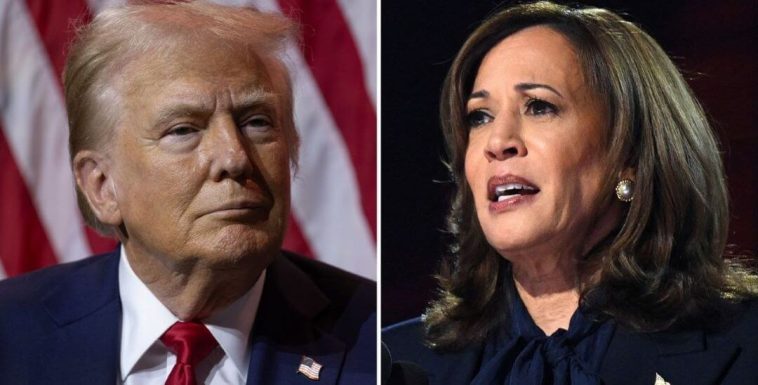
In a pointed critique of her opponent, Harris contrasts her “lowering costs” agenda with what she describes as Trump’s plans to “weaken the middle class” and increase costs. The website claims that Trump’s policies would raise prices, weaken Social Security and Medicare, eliminate the Department of Education, and dismantle healthcare programs like the Affordable Care Act. Harris accuses Trump of planning to “jack up prices” on essential goods, raising rent costs and mortgages by thousands annually.
A major talking point in Harris’ platform is her opponent’s so-called “Project 2025 Agenda.” The initiative, linked to the conservative Heritage Foundation, is fiercely criticized on the site. Harris claims that the agenda is aimed at consolidating power in the executive branch and would allow Trump to “rule as a dictator on day one.” She also asserts that the former president would seek to restrict abortion access and limit fertility treatments, such as in vitro fertilization (IVF).
Trump Fans Are Loving This Keychain – Get Yours While Supplies Last! 🙌 Secure Yours Today!
Yet, Trump has publicly distanced himself from much of Project 2025. In fact, he has repeatedly denied being involved in its development, and he has gone on record saying that he has no plans to ban abortion. He has even suggested that he would support government or insurance coverage for fertility treatments.
On economic matters, Harris further claims that Trump’s proposals would cost American families at least $3,900 per year by imposing a Trump-backed sales tax on imported goods like gas, food, and medicine. Additionally, she argues that his plans would raise rents and add $1,200 to the typical American mortgage. These claims come at a time when inflation has soared under the Biden-Harris administration, prompting questions about whether Harris can convincingly offer a better alternative.
Lastly, Harris accuses Trump of planning to bring the Department of Justice (DOJ) and the FBI under his personal control if re-elected, giving him “unchecked legal power” to target political opponents. However, critics point out that under the Biden-Harris administration, the DOJ has aggressively pursued Trump, while during Trump’s presidency, he did not use the DOJ to prosecute his former opponent, Hillary Clinton, despite his campaign rhetoric about her alleged legal violations.
As the upcoming debate looms, Harris’ newly revealed policies will no doubt be under intense scrutiny. Her plans are ambitious, but questions remain about their viability and their potential impact on an electorate deeply divided over issues of taxes, justice, and economic recovery. Meanwhile, Trump continues to push back on claims made by the Harris campaign, positioning himself as a defender of middle-class Americans. This debate is set to be one of the most consequential in recent history, with both candidates vying for a path forward that will resonate with voters across the nation.

