
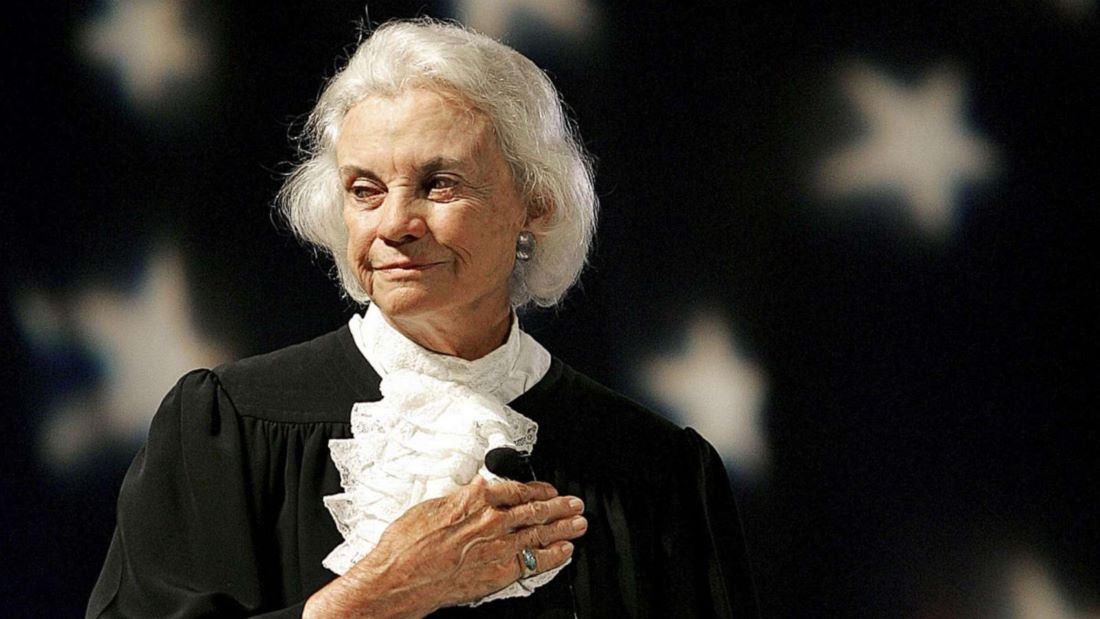
Sandra Day O’Connor was a pioneering American woman. Ronald Reagan’s nominee to the Supreme Court, who helped pave the way for later female justices, tragically passed away on Friday morning at the age of 93.
In its announcement, the court honors O’Connor for her historic accomplishments as the nation’s first female Supreme Court justice. When she was nominated in 1981, President Reagan said she possessed traits that her predecessors had also noted, including temperament, fairness, intelligence, and a dedication to the public good.
Don’t miss this! Carry faith with you everywhere with the Exclusive National Prayer Coin!

O’Connor courageously talked about her battle with dementia, more precisely Alzheimer’s disease, in 2018. Her capacity to perform basic physical functions was gradually taken away by this debilitating illness.
WATCH:
“While the final chapter of my life with dementia may be trying, nothing has diminished my gratitude and deep appreciation for the countless blessings of my life,” she wrote.

Justice O’Connor saw the Supreme Court shift to a more conservative position, which led to the 1992 decision that was crucial to the survival of Roe v. Wade and the abortion rights being overturned. As the court’s swing vote during her tenure, she was crucial in maintaining affirmative action and limiting the federal government’s ability to hold terrorist suspects in detention during wartime. Still, she sided with the conservative court wing in 2000, helping former President George W. Bush secure a historic win.
In an interview with CNN, former clerk Marci Hamilton disagreed with the idea that O’Connor was a weak and unresolved voice on the court.
“Those would be the people who have never met her,” Hamilton said. “Anyone who has met her knows that she makes up her own mind and is not at all concerned where anyone else is on the spectrum.”
O’Connor’s difficult decision to step down from the court in 2005 made it possible for President Bush to name conservative Samuel Alito to the position. Even though she was having a difficult time taking care of her husband, who had Alzheimer’s disease, O’Connor regretted her resignation and accepted that it would cause the court’s judicial philosophy to move to the right.
Regarding the significance of her appointment as the country’s first female justice of the Supreme Court, she stated that she hoped to use her tenure to promote a new understanding of the place of women in positions of authority. Five more women have since assumed the court’s bench, suggesting that this goal has been realized.
ALERT! Major Water Restrictions In Effect!
“Let me tell you one reason why I think it’s important, and that is for the public generally to see and respect the fact that in positions of power and authority, that women are well-represented,” O’Connor said in a 2003 interview with CNN. “That it is not an all-male governance, as it once was.”

