
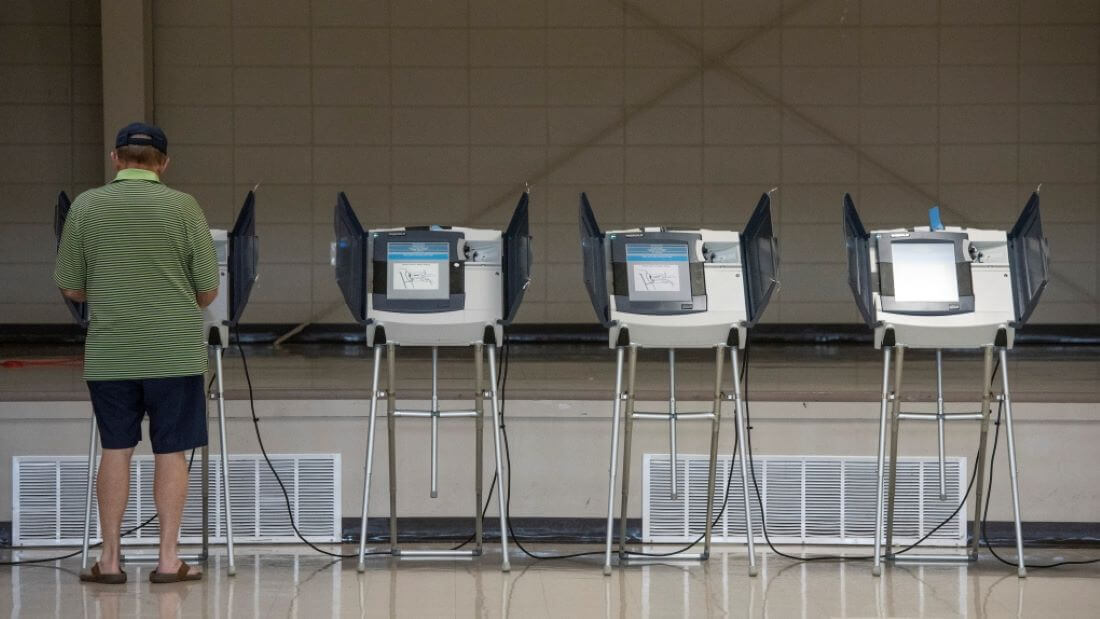
Electronic voting machines are the subject of controversy when a close contest for parish sheriff in northwest Louisiana comes down to an unexpected result: the Democratic candidate just beats out the Republican contender by one vote.
Breaking News: Henry Whitehorn (D) defeated John Nickleson (R) by a mere vote margin with 21,621 votes in a suspenseful election.
Don’t miss this! Carry faith with you everywhere with the Exclusive National Prayer Coin!

John Nickelson, the Republican candidate, ignites enthusiasm by utilizing social media to mobilize supporters and request a recount.
“This extraordinarily narrow margin … absolutely requires a hand recount to protect the integrity of our democratic process, and to ensure we respect the will of the people,” On Wednesday, John Nickelson, the Republican nominee for Caddo Parish Sheriff who was trailing by only one vote in the previous week’s race, sent a message on social media.
In the wake of the hotly fought 2020 election, The Associated Press bravely investigates election integrity, providing insight into the contest.

“The tight race shines a spotlight on Louisiana’s recount process and its outdated voting machines, which do not produce an auditable paper trail that experts say is critical to ensuring election results are accurate,” The race was covered by the Associated Press. “States’ recount abilities have proven to be exceedingly important, especially following the 2020 presidential election when multiple battleground states conducted recounts and reviews to confirm President Joe Biden’s victory.”
Prepare for the recount on Monday! To ensure there are no anomalies, we will be closely examining the absentee votes. These mailed-in ballots account for only 17% of all votes cast, yet they represent the only paper record in Louisiana’s voting system.
Rethinking in-person, paperless voting Imagine if a recount is as easy as clicking refresh.
“(Election officials) test the machines beforehand and they test the machines afterwards, so it’s not blind faith going into this. … There are protections in place,” According to David Becker, a former lawyer in the Civil Rights Division of the Justice Department who now works for the nonprofit Center for Election Innovation & Research, working with election officials.
“That said, a recount of a paperless vote is essentially the equivalent of hitting the button again. … You’re basically getting a report on the tabulation again.”
ALERT! Major Water Restrictions In Effect!
Millions of people are angry about close contests being decided in dubious methods, so don’t expect it to allays their concerns.
Enter the world of Louisiana voting, which continues to use touch screen, paperless machines that were purchased over ten years ago. These gadgets, which were formerly state-of-the-art, are now solely used throughout the state.
Secretary of State Kyle Ardoin and other election authorities in Louisiana maintain that the state’s elections are safe and supported by strong security measures. However, there has been constant examination and criticism of the use of computerized voting machines without a paper record.
In the 2020 election, recounts were conducted in a number of pivotal states, including Arizona, Pennsylvania, and Wisconsin, along with in-depth analyses of the results.
In response to Donald Trump’s request for a recount, Georgia’s electoral authorities have recertified the state’s presidential election results. Every vote cast—nearly 5 million—was carefully scrutinized.
A major modification was been made to Georgia’s electoral system. Just before the election, Georgia obtained a new Ballot Marking Device system, replacing its twenty years of use of paperless voting machines like to those in Louisiana. The majority of Georgia voters who cast ballots in person supported this new technique, which produces paper ballots with an easy-to-read summary of the results and a QR code for quick vote counting.
“Can you imagine what would have happened in Georgia if they had still had digital voting machines in 2020?” Becker asked.
Election security vulnerabilities in Georgia still exist, despite the usage of ballot marking devices.
With sufficient evidence, Judge Amy Totenberg agrees that Georgia’s computerized voting equipment have serious problems.
The District Court Judge determined that there is enough reason to suspect that there may be “cybersecurity deficiencies that unconstitutionally burden Plaintiffs’ First and Fourteenth Amendment rights and capacity to case effective votes that are accurately counted.”
A thrilling trial without a jury is scheduled for January 9, 2024!
Celebrity judge Totenberg sets the scenario for a high-stakes bench trial that, with prompt action from the state legislature, may result in a compromise.
“The Court cannot wave a magic wand in this case to address the varied challenges to our democracy and election system in recent years, including those presented in this case,” she wrote. “But reasonable, timely discussion and compromise in this case, coupled with prompt, informed legislative action, might certainly make a difference that benefits the parties and the public.”
Crucially, the court rejected the notion that concerns about Georgia’s voting machines’ security are only the product of “conspiracy theories.”
“The Court notes that the record evidence does not suggest that the Plaintiffs are conspiracy theorists of any variety. Indeed, some of the nation’s leading cybersecurity experts and computer scientists have provided testimony and affidavits on behalf of Plaintiffs’ case in the long course of this litigation,” The court noted in a footnote.
It is now permissible to cast doubt on voting equipment and election integrity. Let’s now watch how they fare in the forthcoming election in 2024.

