
>> Continued From the Previous Page <<
Researchers involved in the project believe the mission could provide definitive answers to a debate that has lasted generations.
In a statement announcing the development, the team expressed hope that the new investigation may deliver “irrefutable proof” that the site represents the final resting place of Noah’s Ark.

The announcement has energized many Christians and biblical historians who have long argued that the Durupinar Formation deserves serious scientific attention rather than automatic dismissal.
One of the most vocal supporters of the effort, Noah’s Ark Scans fundraiser Lauren Witzke, emphasized the significance of the project.
“This is not merely a scientific expedition; this is confirmation that one of the most scoffed-at stories in history, Noah’s Ark, is real, as is the God who inspired it and, in His wrath and mercy, sent the flood for which it was needed.”
The site itself sits roughly 18 miles south of Mount Ararat, Turkey’s highest mountain. According to local accounts, the unusual formation became visible after severe weather and earthquake activity in 1948 stripped away layers of surrounding soil and mud.
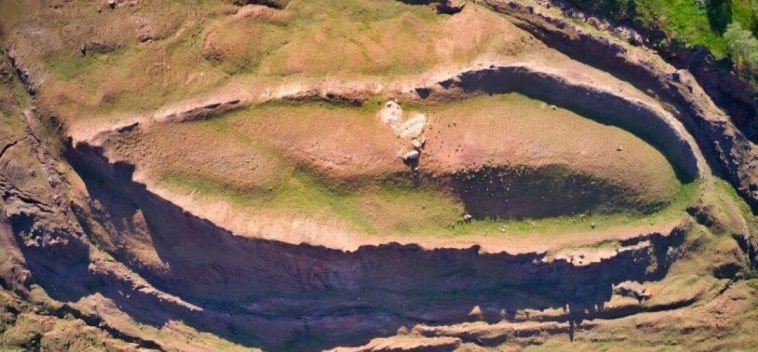
What immediately caught the attention of researchers was the structure’s remarkable resemblance to a massive ship.
Supporters of the ark theory point out that the dimensions closely mirror the measurements recorded in Scripture. The Bible describes Noah’s Ark as being 300 cubits long, 50 cubits wide, and 30 cubits high. Converted into modern measurements, those dimensions are approximately 515 feet by 86 feet by 52 feet.
Investigators argue that the Durupinar Formation aligns surprisingly well with those proportions.
The shape is not the only feature attracting attention.
Previous ground-penetrating radar surveys reportedly detected what researchers describe as angular structures, straight lines, chambers, and large underground voids. According to the team, these patterns appear inconsistent with what would normally be expected from natural geological processes.
Researcher Andrew Jones has repeatedly pointed to the formation’s shape as one of the strongest arguments against a purely natural explanation.
“Naturally, an object would not form this way with the pointed end uphill,” said Jones.
“Per fluid dynamics, if this was an obstruction naturally forming around a rock in the earth or mud flow, then the pointed end would be downhill and the rounded end would be uphill.”
Jones also claims the team has identified what appears to be an underground passage leading into a much larger interior space.
“Some people have theorized that Noah’s Ark had a multi-level big atrium to let the light and air circulate between the three decks,” said the researcher.
According to radar data collected by the group, one underground void begins roughly 14 feet below the surface and extends for nearly 40 feet before descending deeper into what may be a significantly larger chamber.
“The tunnel then drops another 26 feet, connecting to a massive central room that we’re seeing in the radar scans,” he said.
“Our assumption is that this could be part of Noah’s Ark, possibly the central hall and some of the decks. There’s definitely something preserved underground.”
The team also cites soil testing as evidence that something unusual may exist beneath the formation.
Samples collected from inside the structure reportedly contained different chemical characteristics than surrounding soil. Researchers found lower alkalinity levels, increased organic material, and elevated potassium concentrations.
Jones argues these findings are consistent with the decomposition of ancient timber buried beneath the site.
“Tests show these soil differences (pH, organic matter and potassium) are real, with less than a five percent chance they’re random, giving 95 percent confidence that something like a decayed wooden ship is causing them,” he added.
Another key element of the debate centers on geography.
Many critics argue that Noah’s Ark should be located on the summit of Mount Ararat itself. Jones counters that the biblical text never specifically identifies a single mountain peak.
“In the Biblical account, it doesn’t say Noah’s Ark landed on Mount Ararat; it says the mountains, plural, of Ararat,” Jones explained.
“Back in those days, Ararat was an ancient kingdom. So it would be like saying today that Noah’s Ark landed in the mountains of Colorado. It’s referring to a region of mountains, not one specific peak, and our site fits within that location.”
Interest in the Ararat region stretches back centuries. Early Christian traditions linked the area to Noah’s Ark as far back as the fourth century. First-century Jewish historian Josephus also wrote that remnants of the vessel could still be seen in the mountains of Armenia.
Whether the upcoming investigation validates those ancient claims or simply identifies a remarkable natural formation remains to be seen.
But with government approval now secured and sophisticated technology preparing to probe the site in unprecedented detail, researchers believe the world may soon receive the strongest evidence yet in one of history’s most enduring mysteries.
For believers, the findings could become one of the most significant archaeological discoveries of the modern era. For skeptics, it may finally provide the scientific scrutiny they have long demanded.
Either way, all eyes will be on eastern Turkey when the next phase of exploration begins later this year.

