
>> Continued From the Previous Page <<
Market sentiment was further reinforced by commentary from Wall Street professionals who noted the unusual steadiness of the rally. Brian Mulberry, chief market strategist at Zacks Investment Management, emphasized that the trading action looked more disciplined than speculative.
“It seems to be much more orderly than what I expected, and that’s not a bad thing,” said Brian Mulberry, chief market strategist at Zacks Investment Management. “This is not some type of a meme stock right out of the gate, that it actually is people adding it and holding it in their portfolio, not trying to turn it over.”

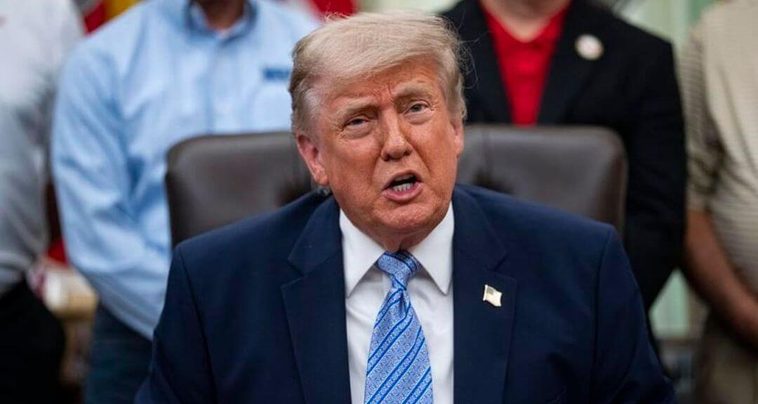
The catalyst behind the market surge was President Trump’s announcement late Sunday that a deal with Iran had been finalized. Posting on social media, he stated that an agreement was “now complete,” setting off a wave of reaction across global financial markets and diplomatic circles.
Adding further weight to the development, Pakistan Prime Minister Shehbaz Sharif indicated that a memorandum of understanding tied to the agreement would be formally signed Friday in Switzerland, signaling that international stakeholders are moving quickly to lock in the framework.
The announcement came after days of heightened tensions in the Middle East, including exchanges of fire between Israel and Iranian-backed Hezbollah forces in Lebanon, which had fueled uncertainty over whether diplomatic progress would collapse under renewed conflict.
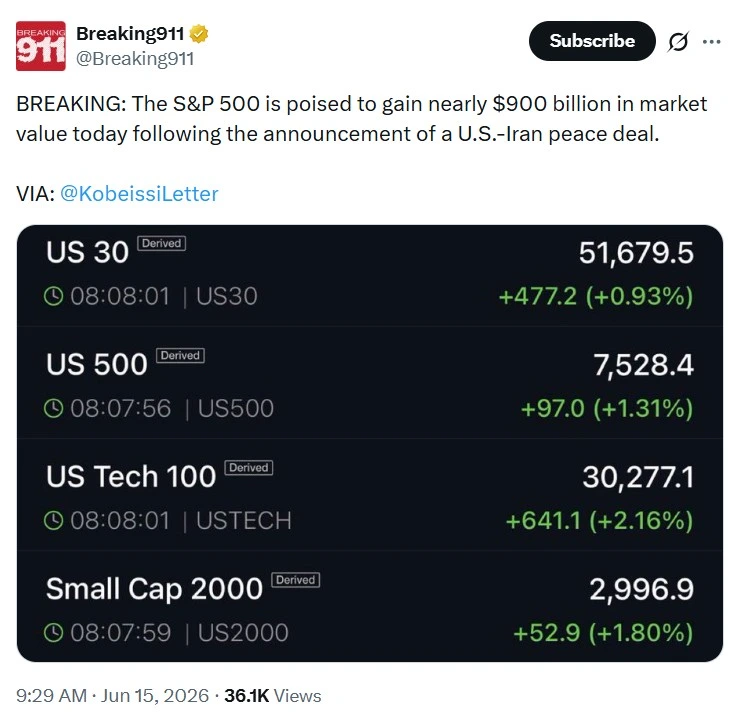
In a major economic development tied to the deal, Trump also said he authorized the reopening of the Strait of Hormuz, one of the world’s most critical oil transit routes and a frequent flashpoint during regional confrontations. The move immediately pressured energy markets.
Crude prices dropped sharply, with U.S. oil falling about 5% to near $80 per barrel. Vice President JD Vance told CNBC on Monday that he expects the passageway to remain open long-term under a “toll-free” arrangement, reinforcing expectations of reduced energy disruption risk.
Lower oil prices quickly fed into broader economic optimism. Investors interpreted the decline as a potential relief valve for inflation, giving the Federal Reserve more flexibility heading into its critical policy meeting this week. Market pricing, according to CME FedWatch data, showed more than a 98% probability that interest rates will remain unchanged.
Brian Mulberry noted that while some consumer energy relief may take time to filter through refined products, the drop in crude itself carries immediate significance.
He said the decline is “a strong signal, given that this is an FOMC week, that we don’t need to raise rates [and] that the price pressure should alleviate relatively quickly.”
The so-called reopening trade also gained traction across transportation and travel sectors. Airlines and cruise operators rallied as investors priced in a more stable global outlook and cheaper fuel costs.
United Airlines rose 3%, while Delta Air Lines gained 1.5%. In the cruise sector, Royal Caribbean Group climbed more than 4%, and Carnival Corporation advanced over 3%.
By the close of trading, the market narrative was clear: reduced geopolitical tension, falling oil prices, and expectations of steady interest rates had aligned to fuel a risk-on rally.
After weeks of volatility tied to Middle East uncertainty, Wall Street appeared willing to bet that the Trump administration’s Iran agreement could mark a turning point—cooling global tensions while helping keep the U.S. economy on a steady growth path.

